SYDNEY, 20 March 2026: Tourism Australia has launched a new sustainability initiative, Green is Our Gold, to rally the Australian tourism industry around a shared promise to protect and strengthen Australia’s natural environments, cultures and communities.
Tourism Australia launched the sustainability initiative at its annual conference, Destination Australia, earlier this week in Melbourne, which welcomed over 800 tourism industry professionals.
Photo credit: Tourism Australia.
The Green is Our Gold campaign responds to growing demand for tourism experiences that deliver positive social and environmental impact.
Tourism Australia’s Consumer Demand Project shows that sustainability is increasingly important to travellers, both in their everyday lives (77%) and in the way they choose to travel (70%).
There is also continued demand for sustainable practices among business events decision-makers, with three out of four incentive decision-makers (76%) ranking sustainability credentials as a significant driver of destination choice.
Tourism Australia Managing Director, Robin Mack, said: “Australia has a strong track record of sustainable growth in tourism, and many businesses have already embraced sustainability — delivering world-class experiences that are sensitive to our natural environments, our cultures and our communities.”
Green is Our Gold builds on the National Sustainability Framework for the Visitor Economy and the Sustainable Tourism Toolkit, launched by the Australian Government in 2023 alongside the State and Territory Tourism Ministers, and which is a key action under the national long-term visitor economy strategy, THRIVE 2030.
KATHMANDU, 20 March 2026: Visa is bankrolling a survey to demonstrate the level of digital payment adoption in the city’s popular Thamel district, which is visited by 80% of all tourists to the Nepalese capital.
Visa and its project partner, the Pacific Asia Travel Association (PATA) Nepal Chapter, launched the baseline survey phase of the ‘Cross-Border (XB) Acceptance in Thamel’ initiative earlier this week.
Photo credit: PATA Chapter Nepal.
PATA Nepal Chapter has engaged 30 tourism and hospitality students from its educational member institutions to conduct a survey assessing how small and medium enterprises in Thamel are meeting the challenges of adopting digital payment systems and participating in cross-border commerce.
The study has the backing and support of the Nepal Tourism Board (NTB), the Confederation of Nepalese Industries (CNI), and the Thamel Tourism Development Council (TTDC).
Survey objectives will focus on measuring the current status of digital payment usage, merchant readiness, challenges, and knowledge gaps among SMEs operating in Thamel.
PATA Nepal Chapter CEO Suresh Singh Budal said: “At PATA Nepal, we are committed to enabling our tourism SMEs to thrive in a digital-first global economy, with Thamel serving as a model destination. We sincerely thank Visa, NTB, TTDC, and CNI for their collaboration and support in this initiative.”
The project will later implement training programs, merchant engagement activities, and capacity-building initiatives to create a replicable model for SME digital transformation in other tourism destinations across Nepal.
Thamel is an iconic district in Kathmandu, famed for its maze of lanes and alleys packed with shops, restaurants and rooftop bars. The longest street in Thamel is known as Thamel Marg, a hive of jewellery shops, trekking stores, and souvenir shops. Chaksibari Street, also one of the longest streets in Thamel, is famous for trekking gear stores, travel agents, and book shops.
VALENCIA, Spain, 20 March 2026: Arival, a global leader in insights and events for the tours, activities, attractions, and experiences sector, has announced the full speaker lineup and expanded programme for Arival 360 Valencia, taking place at the Centre de Congressos from April 27–29, 2026.
This year’s theme, “The Tomorrow Operator: Europe & the Future of Tours & Experiences,” sets the stage for a forward‑looking programme designed to help operators navigate a rapidly evolving landscape.
Photo credit: Arrival.
In a period defined by rising demand, disruptive technology, overtourism pressures, and shifting traveller expectations, Arival 360 Valencia will provide operators with the insights, tools, and connections they need to build resilient, future‑ready businesses. The event will feature original Arival research, executive perspectives, hands‑on workshops, and peer‑to‑peer learning, all tailored to the realities of running and scaling an experiences business in 2026.
“The experiences sector is at a turning point,” said Arival, CEO and co-founder Douglas Quinby. “From the rise of AI to the challenges of overtourism and the shifting expectations of travellers, operators must rethink how they deliver, distribute, and grow. This year’s Arival 360 in Valencia is about equipping the industry with the insights and connections to thrive in this new era.”
Arival 360 Valencia brings together more than 60 speakers from across the global experiences ecosystem – including operators, OTAs, technology innovators, culinary experts, multi‑day specialists, and destination voices. The speaker lineup includes:
Doug Weiss, Airbnb
Guillermo Oxangoiti, TUI Musement
Josh Carr, Intrepid Travel
Kristin Dorsett, Viator
Matt Jones, Klook
Dan Christian, Travel Trends Podcast
Andrès Spitzer, Civitatis
Brennen Bliss, Propellic
Sam Jefferies, Bókun (Tripadvisor)
Christian Watts, Magpie Travel
Roisin O’Sullivan, Walks
Travis Pittman, TourRadar
Robin Harnish, OCTO
Sean Finelli, The Tour Guy
This year’s event introduces several new programme elements designed to reflect the sector’s most dynamic areas of growth, and there will be three dedicated Experience Streams – AI for Experience Creators, Multi‑Day Experiences, and Culinary Experiences.
Arival 360 Valencia will also be more accessible than ever, with sessions delivered in both English and Spanish and AI‑powered translation available in more than 15 languages.
Valencia provides an ideal backdrop for a conference focused on the future of experiences. The city blends rich cultural heritage with a thriving culinary scene, innovative urban development, and a strong commitment to sustainability. From its historic old town and iconic City of Arts and Sciences to its Mediterranean coastline and renowned gastronomy, Valencia reflects the spirit of the experiences that inspire travellers worldwide.
SINGAPORE, 20 March 2026: Digital travel platform Agoda announced the winners of its 2025 Gold Circle Awards this week, recognising over 3,000 top-performing hotel partners globally for operational excellence within Agoda’s ecosystem.
Now in its 17th edition, Agoda’s Gold Circle Awards celebrate properties that consistently deliver high guest standards, maintain strong digital engagement and stay adaptable.
Copilot generates AI image.
Taiwan’s standout performance marks a milestone: 2025 is the first time it has led the ranking and placed in the top five markets by winner count, underscoring the consistency and agility of hotel partners in the market.
This year’s national ranking highlights excellence across the hospitality sector, led by Taiwan in first place and Vietnam in second. Japan, Malaysia, South Korea, Thailand and Indonesia shared third place, followed by a tie between the Philippines and India in fourth, with Australia in fifth.
Regional travel demand remains dynamic, with intra-Asia travel continuing to shape travel patterns across the region according to Agoda’s recent ‘Tailored to Win’ report.
As traveller profiles diversify and expectations for seamless digital experiences continue to rise, the Gold Circle Awards commend hotel partners that have maintained strong operational fundamentals and refined how they engage and convert travellers through Agoda’s platform at scale.
“Every year, what stands out to me is how much effort happens behind the scenes to make a stay feel effortless for the guest,” said Agoda Senior Vice President, Supply, Andrew Smith. “Over the years, we have seen different markets rise through the rankings, which is a healthy sign for the industry. It shows hotels across the region are learning quickly, adapting to new guest needs and raising their standards in ways travellers can feel. Across Asia, our winners have stayed agile and digitally strong, and we will keep investing in tools and support that help them keep performing as traveller needs evolve.”
This year’s results also point to a continued appetite for distinctive stays, alongside trusted hospitality standards. Over 50% of this year’s Gold Circle Awards went to independent properties, representing an 11% increase from the previous year and underscoring growing appreciation for more unique, personalised guest experiences. Additionally, this year’s awards reflect renewed momentum within the hospitality industry, recognising 2,200 unique winners, including properties receiving a Gold Circle Award for the first time and those returning to the program since 2020.
SINGAPORE, 20 March 2026: JLL has achieved a dominant position in investment advisory services across emerging Southeast Asian markets throughout 2025, solidifying its role as the region’s leading advisor for institutional and private capital deployment.
According to MSCI Real Assets data, JLL captured an unprecedented 50.5% combined market share across Vietnam, Indonesia, the Philippines, Thailand, and Malaysia in 2025.
Individually, JLL achieved 50.5% market share in Thailand, 53.9% in the Philippines, 89.9% in Indonesia, 94% in Vietnam, and 34.7% in Malaysia, based on sell-side sales volume.
JLL’s capital markets team facilitated USD703.4 million in sell-side cross-border transactions across these five high-growth markets during 2025, representing a significant portion of institutional investment activity in these rapidly developing economies. The firm’s integrated platform connected global investors with high-quality opportunities in logistics, residential, office, and mixed-use developments as emerging Southeast Asia markets continued their post-pandemic growth trajectory.
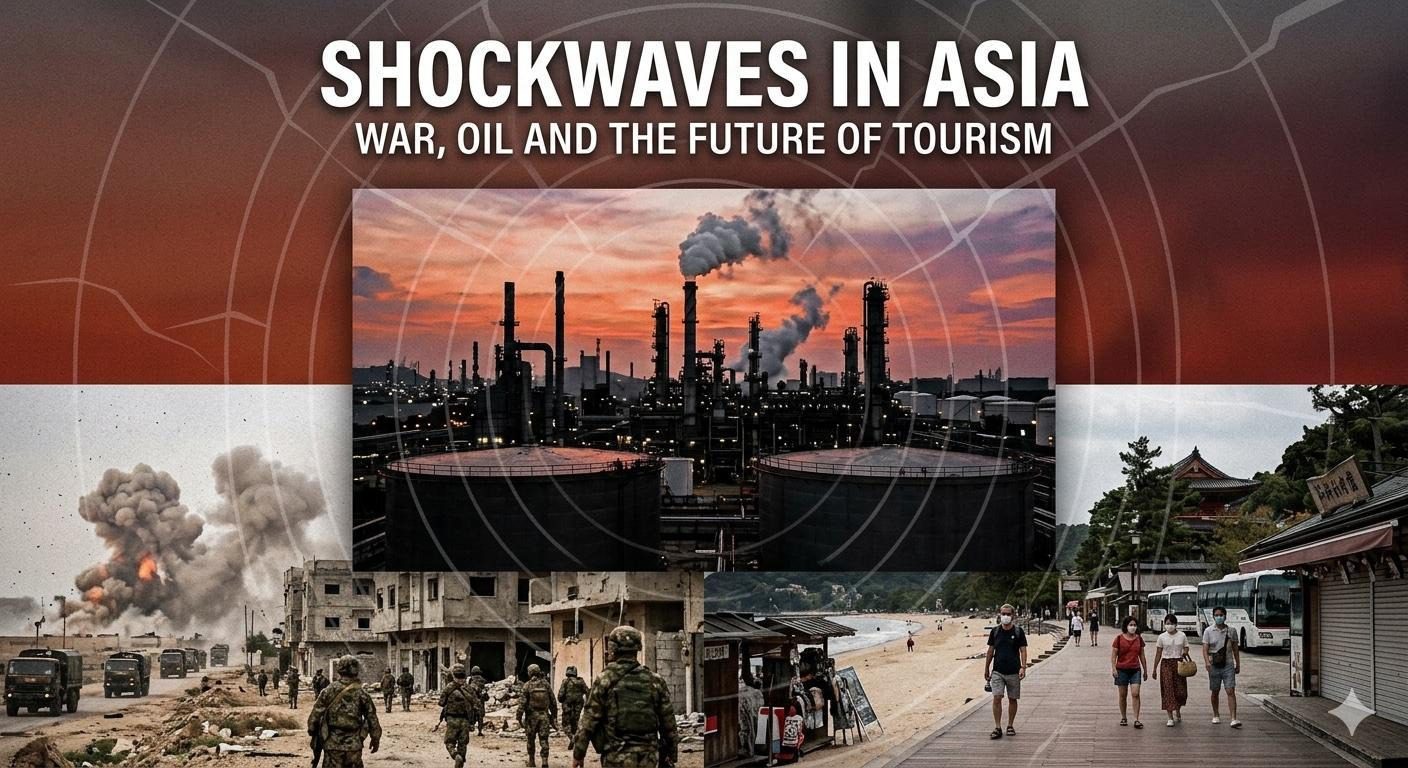
BANGKOK, 20 March 2026: The global power shifts do not remain confined to geopolitics. They travel quickly, and often invisibly, through economic systems.
For Asia, and particularly for Thailand, the consequences of the Gulf War are immediate. The most direct transmission channel is energy.
Image generated by Gemini AI.
Any sustained disruption in Middle Eastern supply routes pushes oil prices higher. This feeds directly into aviation fuel costs, which in turn drives airfares upward. The result is predictable. Long-haul travel demand weakens, particularly from Europe, where consumers are already sensitive to economic uncertainty.
For Thailand, where tourism remains a central pillar of the economy, this creates a series of cascading risks.
The first is long-haul softness. European travellers may delay decisions, shorten stays, or opt for closer destinations. Even marginal declines in arrivals can have a disproportionate impact on high-value segments.
The second is airline behaviour. Carriers respond quickly to rising costs and operational risk. Routes may be adjusted, frequencies reduced, and fares increased. Airspace constraints linked to Middle Eastern instability can further complicate scheduling, adding time and cost to long-haul journeys.
The third is psychological. War involving major powers alters traveller sentiment. Even when destinations such as Thailand remain entirely safe, perception often overrides reality. The result is hesitation.
For Thailand, the danger is not the war itself but the hesitation it creates in travellers’ minds. Yet the outlook is not uniformly negative.
Asia’s intra-regional travel market provides a buffer. Demand from China, India, and ASEAN is structurally stronger and less exposed to disruption in the Middle East. Short-haul travel can partially offset long-haul weakness, particularly if supported by targeted government stimulus and competitive pricing.
Thailand also benefits from a diversified base of source markets and a deeply embedded reputation for hospitality and value. These strengths have historically enabled rapid recovery following external shocks, from financial crises to pandemics.
However, timing is critical. The longer uncertainty persists, the more likely temporary softness becomes structural weakness.
Airlines, tour operators and hoteliers will need to remain agile. Pricing strategies, market diversification and regional focus will be key to maintaining momentum.
At a broader level, this moment highlights a deeper truth. Global conflicts no longer remain contained within their regions. Their effects ripple outward through energy markets, transport systems and consumer behaviour, reaching destinations thousands of miles away.
For Asia’s tourism economies, resilience will depend not only on demand but on adaptability. Because in this new global environment, stability is no longer guaranteed. It must be managed.
And for Thailand, success will depend on how quickly it can respond, reassure and reposition itself in a world where uncertainty has become the norm.
About the author Andrew J Wood is a Bangkok-based travel writer and former hotel executive specialising in Asian tourism.
HONG KONG, 20 March 2026: In response to the current situation in the Middle East, Cathay Pacific has suspended all passenger and cargo flights to Dubai and Riyadh up to and including 30 April 2026, the airline group’s Chief Customer and Commercial Officer, Lavinia Lau, reported on Wednesday.
“As customers prioritise alternative travel routes due to airspace closures in the Middle East, we have added extra flights to London and provided additional capacity to Zurich in March to cater for a surge in demand for Europe.
Photo credit: Cathay Group.
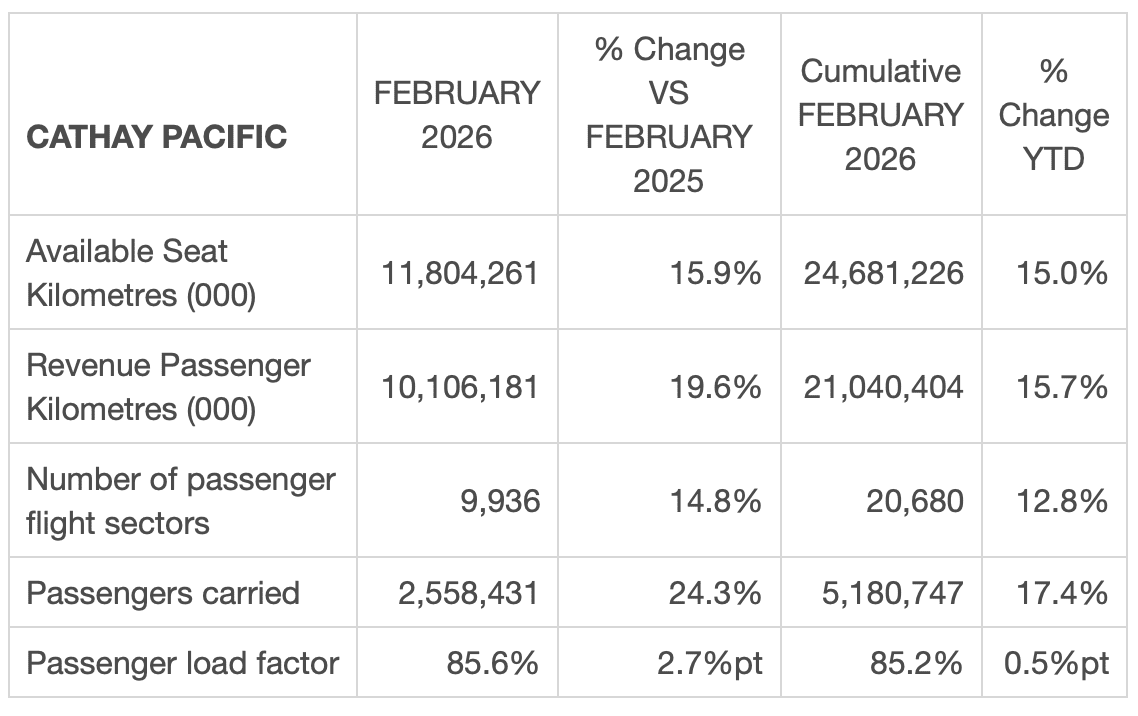
We are monitoring the situation closely and will remain agile in our response,” Lau explained as part of the group’s Traffic Performance Statement for February 2026.
Cathay Group delivered a positive performance during the first two months of 2026, with the solid momentum seen in January continuing into February, driven by the Lunar New Year travel peak.
“In addition to setting a new single-day passenger record by carrying around 128,000 passengers as a Group on 14 February, our passenger airlines Cathay Pacific and HK Express together carried more than 3.2 million passengers during the month, up 24% from the same period last year.”
Cathay Pacific
Cathay Pacific carried 24% more passengers in February 2026 compared with February 2025, while Available Seat Kilometres (ASKs) increased by 16%. In the first two months of 2026, the number of passengers carried increased by 17% compared with the same period in 2025.
Lau said: “During the Lunar New Year holidays, we saw particularly strong outbound travel demand from Hong Kong and the rest of the Greater Bay Area, with short-haul destinations being the most popular. Meanwhile, inbound traffic to Hong Kong also recorded healthy growth, supported by demand from long-haul markets and the Chinese Mainland.
Business travel rebounded quickly towards the end of the month, resulting in robust load factors in our premium cabins.
“Looking ahead, bookings remain robust for the rest of March, driven by leisure travel across Asia. We also look forward to launching our new five-times-weekly Seattle service on 30 March, further strengthening the connectivity of the Hong Kong international aviation hub.”
Cathay Cargo
Cathay Cargo carried 7% more cargo in February 2026 than in February 2025, while Available Freight Tonne Kilometres (AFTKs) increased by 4%. In the first two months of 2026, the total tonnage increased by 6% compared with the same period in 2025.
Cargo tonnage in February declined against the previous month due to the Lunar New Year holidays. We saw a pre-holiday rush across our home market and the wider Greater Bay Area, followed by softer demand later in the month.
“Turning to March, overall air cargo demand is expected to improve as we ramp up our scheduled freighter frequencies in preparation for the quarter end.”
HK Express
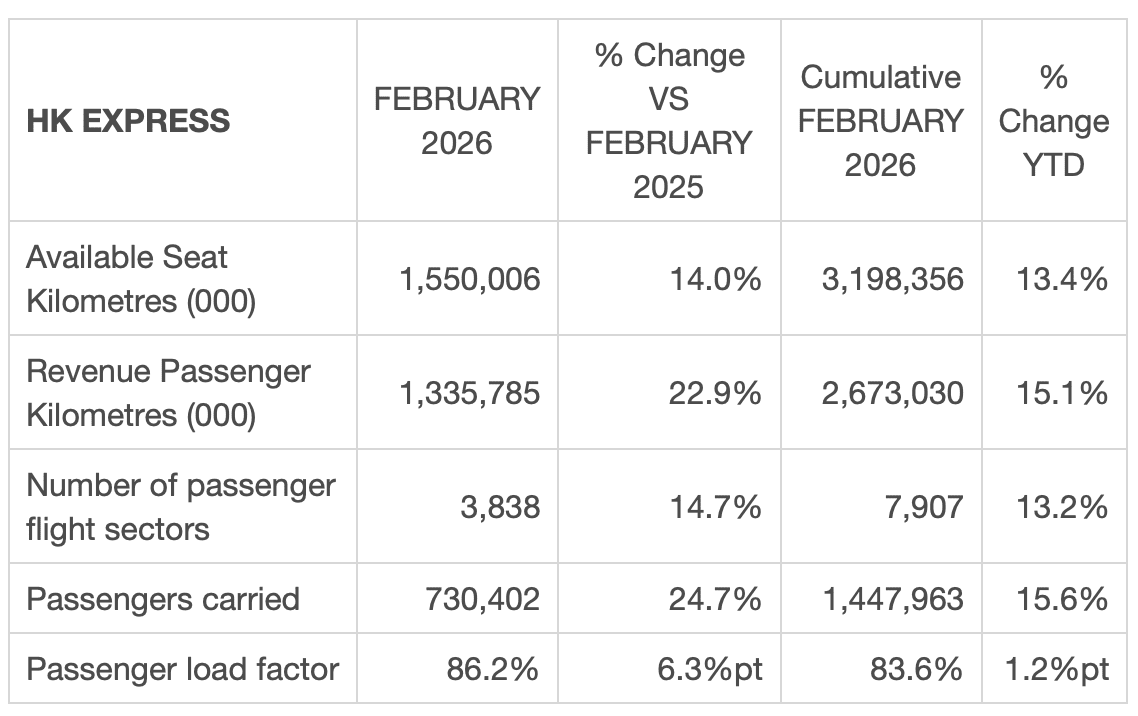
HK Express carried more than 730,000 passengers in February 2026, an increase of 25% year on year, while Available Seat Kilometres (ASKs) grew by 14%. In the first two months of 2026, the number of passengers carried increased by 16% compared with the same period in 2025.
Buoyed by Lunar New Year traffic, HK Express achieved a load factor of 86% in February, with its South Korea routes the most popular. The low-cost airline also saw a significant increase in demand to Malaysia and the Chinese Mainland, which outpaced capacity growth. Looking ahead, bookings remain healthy in March, with demand outpacing capacity increase compared with last year.
DELHI, 20 March 2026: ITA Airways has scheduled two additional frequencies between Rome Fiumicino and Delhi on 24 and 25 March.
The Italian airline says its decision follows reports from the Ministry of Foreign Affairs and International Cooperation, which identified a large number of Italian nationals temporarily stranded in India due to the conflict in the Middle East’s airspace and the closure of airport hubs.
Photo credit: ITA Airways.
Flights from Rome Fiumicino (FCO) to Delhi (DEL)
The first flight on 24 March will depart at 1740 (Italian time) and land in the Indian capital at 0555 (local time). The second flight on 25 March will depart at 1735 (Italian time) and land in the Indian capital at 0535 (local time).
Flights from Delhi (DEL) to Rome Fiumicino (FCO)
The first flight on 25 March will depart from DEL at 0825 (local time) and land at FCO at 1300 (Italian time). The second flight on 26 March will depart from DEL at 0735 (local time) and land at FCO at 1155 (Italian time).
Tickets for these flights are on sale on the airline’s website, the ITA Airways app and through the airline’s official sales channels.
Subject to developments in the geopolitical situation, ITA Airways will continue to operate direct services to Asia and is also assessing opportunities to strengthen its flight schedule to facilitate the return of Italian nationals currently in the region.
SINGAPORE: 19 March 2026: Ethiopian Airlines will resume direct passenger service between Ethiopia’s capital, Addis Ababa, and Atlanta in the US starting 21 May 2026, after pausing flights last February.
The resumption further restores a key connection between Addis Ababa Bole International Airport (ADD) and Hartsfield-Jackson Atlanta International Airport (ATL).
Photo credit: Ethiopian Airlines.
Ethiopian Airlines Group CEO Mesfin Tasew noted, “Atlanta is one of the most vibrant markets in the US, and Ethiopian Airlines is delighted to bring this route back into its network. The route serves growing demand from business travellers, members of the African diaspora, and tourists seeking convenient access to destinations across the African continent.”
Atlanta serves as a major economic and cultural centre in the US and hosts one of the largest African diaspora communities in the country. The renewed service will provide convenient travel options for passengers connecting to cities across the southeastern US and onward to destinations throughout Africa via Addis Ababa.
Ethiopian Airlines currently operates flights to multiple destinations across the US and continues to strengthen its transatlantic network as part of its long-term growth strategy.
The reintroduction of the Atlanta route further enhances the airline’s role as a vital bridge linking Africa with the rest of the world.
Tickets are available through Ethiopian Airlines’ website, mobile app, global ticket offices, Global Customer Interaction Centres, and authorised travel agents.
HONG KONG, 19 March 2026: Fusion Hotel Group, based in Ho Chi Minh City, has been acquired by Suchad Chiaranussati, Founder and Chairman of SC Capital Partners, as well as the owner of Hotel Management Japan (HMJ), and Indonesian hotel operator Topotels Hotels & Resorts (Topotels).
This acquisition marks a significant milestone for Fusion as it embarks on the next phase of growth, drawing upon HMJ and Topotels, and benefiting from SC Capital Partners’ expertise and established investment management platform.
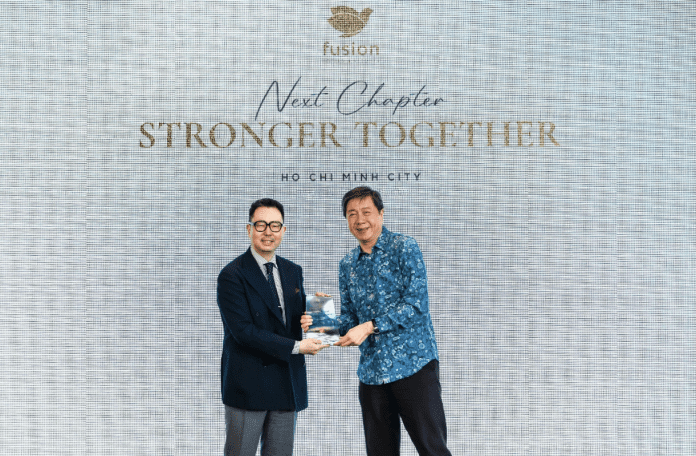
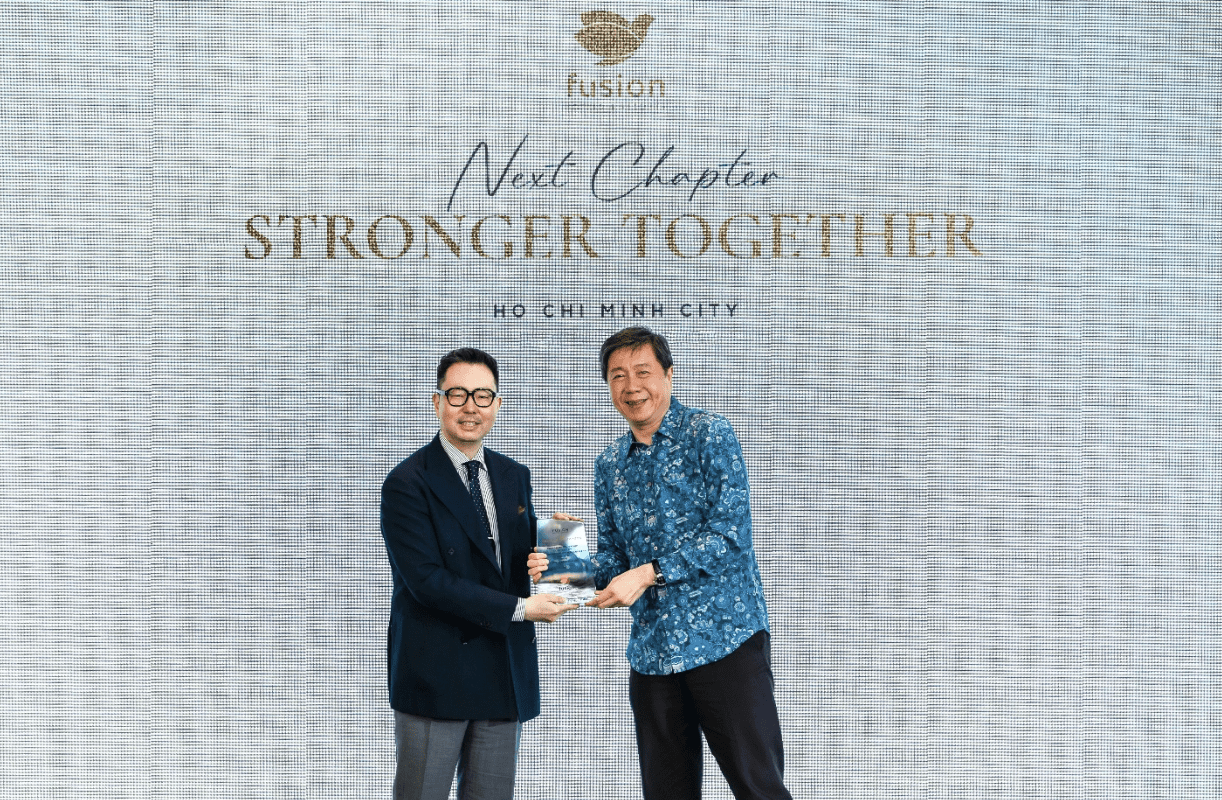
Photo credit: Christopher Hur, CEO of Fusion Hotel Group, with Suchad Chiaranussati, Founder and Chairman of SC Capital Partners.
Founded in 2008, Fusion Hotel Group is a wellness-focused hospitality platform with 18 operating properties and approximately 3,000 keys across Vietnam and Thailand, with a secured pipeline of over 2,000 keys.
Together, Fusion, HMJ and Topotels will represent approximately 16,000 keys across four growth markets, supported by a team of over 100 hospitality professionals.
“Investment in Fusion reflects our long-term strategy to expand our hospitality footprint across Asia,” said SC Capital Partners Chairman and Founder Suchad Chiaranussati.
“Joining Chiaranussati’s hospitality ecosystem opens up tremendous opportunities,” said Fusion Hotel Group CEO Christopher Hur. “This partnership allows us to accelerate our growth across Asia, leverage shared focus areas of technology, marketing and distribution, and invest further in brand development and talent—strengthening our mission to deliver exceptional hospitality experiences.”