SINGAPORE, 7 August 2024: Scoot, the low-cost subsidiary of Singapore Airlines (SIA), announced Tuesday the delivery of its third and fourth Embraer E190-E2 aircraft scheduled for September and October 2024.
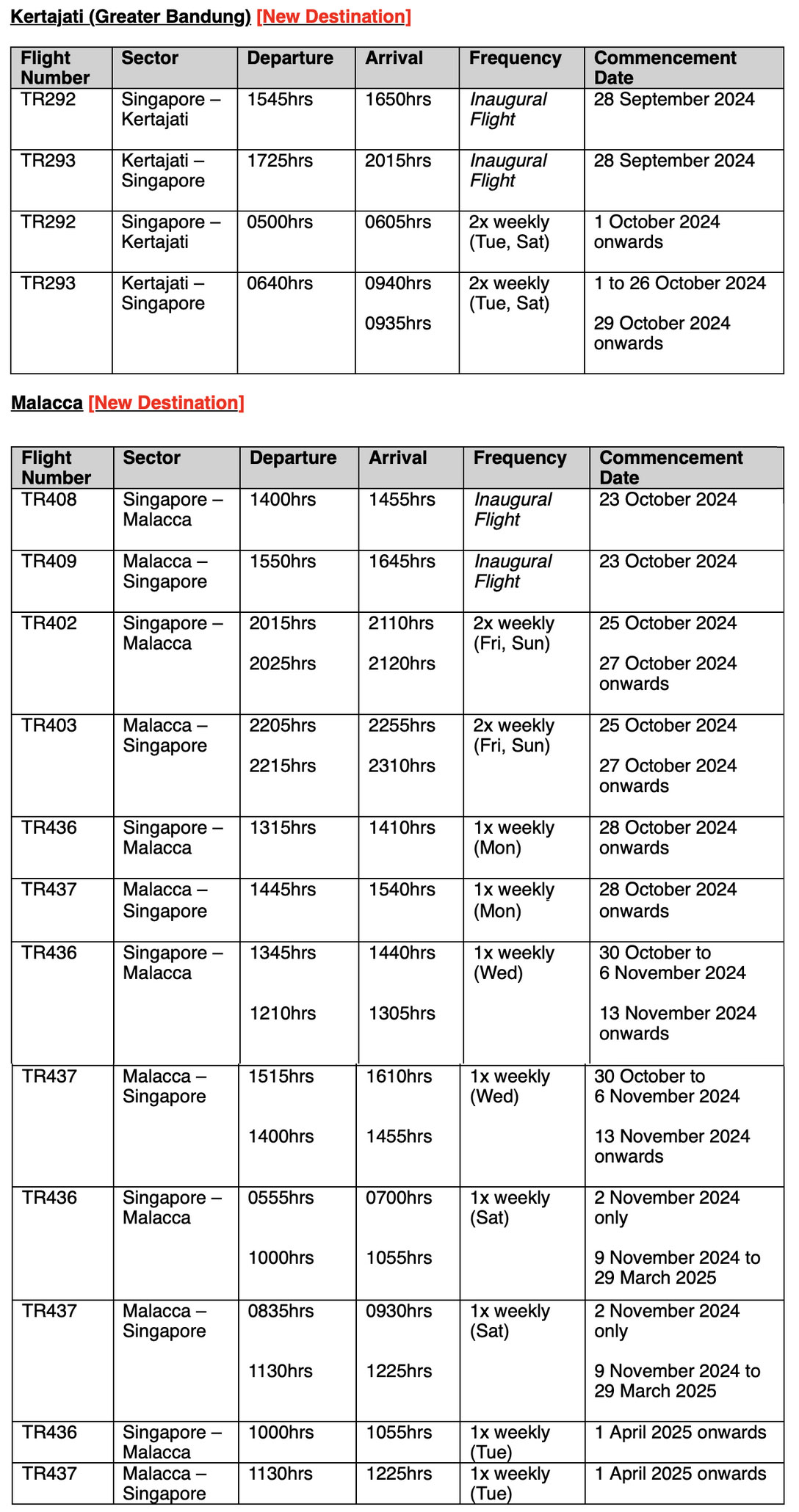
With the addition of the new aircraft, Scoot will launch flights to two new Southeast Asian destinations: Kertajati (Greater Bandung) in Indonesia and Malacca in Malaysia. Flights to Kertajati will commence on 28 September 2024, with a twice-weekly frequency, while Malacca will be served five times weekly from 23 October 2024.
Brimming with lush forests, natural waterfalls, and captivating wildlife, Kertajati is an alternative destinationn for nature enthusiasts. Travellers can also venture to the nearby metropolitan area of Greater Bandung to soak up the local culture and its architectural gems. Malacca offers an equally interesting experience with its rich heritage of Peranakan culture. Travellers can savour authentic Nonya dishes against the bustling backdrop of night markets and explore the historical buildings of this UNESCO World Heritage city.
Besides new destinations like Kertajati and Malacca, Scoot will also deploy the E190-E2s and A320s to increase passenger capacity. This includes twice weekly flights to Pekanbaru using an E190-E2s and three weekly flights using an Airbus A320 aircraft. The airline will also increase flights from three to four weekly to Balikpapan and Makassar, starting in October 2024. From November 2024, the E190-E2s will also operate nine weekly flights to Davao, up from seven weekly, and from December 2024, four weekly flights to Vientiane, up from the current three weekly.
The addition of Kertajati and Malacca to Scoot’s network follows the recent announcement that it will fly to more domestic destinations from Subang near Kuala Lumpur starting 1 September 2024. Subang, located 28 km from the Malaysian capital, offers travellers an alternative to fly to and from KLIA.
Including the new destinations served, Scoot will operate 78 weekly flights to Indonesia and 115 weekly flights to Malaysia by October 2024, 37 weekly flights to the Philippines by November 2024, and four weekly flights to Laos in December 2024. The airline’s network will also expand to 72 destinations, providing more direct connections for travellers to non-metro cities across Southeast Asia and reinforcing Singapore’s status as a regional air hub. With the new Southeast Asian destinations, Scoot also hopes to inspire more travellers to unleash that adventurous spirit in them and embark on new getaways in the region.
Flights to Kertajati and Malacca are open for bookings as of 6 August via Scoot’s website, mobile app, and progressively through other channels, with all-in economy class sale fares starting from SGD92 to Kertajati and SGD69 to Malacca, inclusive of taxes.
Schedules for new Southeast Asian destinations: Kertajati (Greater Bandung) in Indonesia and Malacca in Malaysia.
HO CHI MINH CITY Vietnam, 7 August 2024: Vietjet has celebrated a significant milestone by welcoming its 200 millionth passenger, marking a new achievement in its sky connection journey between Vietnam and the world.
The 200th passenger, Sandeep Mehta, an Indian businessman, received a gift of complimentary flights for a year on Vietjet’s international.
In conjunction with this celebration, Vietjet also announced the launch of a new route linking India’s western city, Ahmedabad, with Vietnam’s famous coastal city, Danang, which will commence in October 2024.
The announcement was made at the Vietnam-India Business Forum in New Delhi, India, which was witnessed by Vietnam’s Prime Minister Pham Minh Chinh and business representatives from both countries.
Vietjet has pioneered direct service between Vietnam and India since 2019. Today, it operates seven routes with 56 weekly flights between the two countries, connecting Hanoi and Ho Chi Minh City with the major cities of New Delhi, Mumbai, Ahmedabad, and Kochi, as well as popular Indian destinations such as Bodh Gaya, Varanasi, and others. Vietjet has transported nearly 1.3 million passengers between Vietnam and India so far.
BANGKOK, 6 August 2024: Reservations at the Dusit Thani Bangkok hotel are fast filling up ahead of its official opening to guests on 27 September 2024.
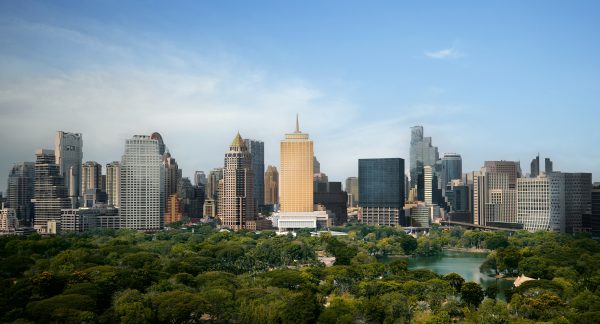
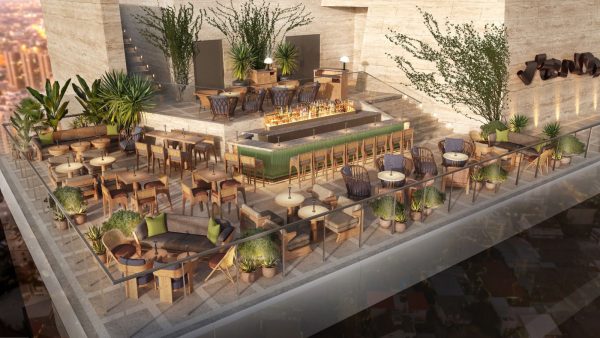
Dusit International’s reimagined flagship property has been completely rebuilt from the ground, paying homage to its 50-year legacy while setting a new standard for luxury hospitality. It’s an anchor feature of the Dusit Central Park mixed-use development.
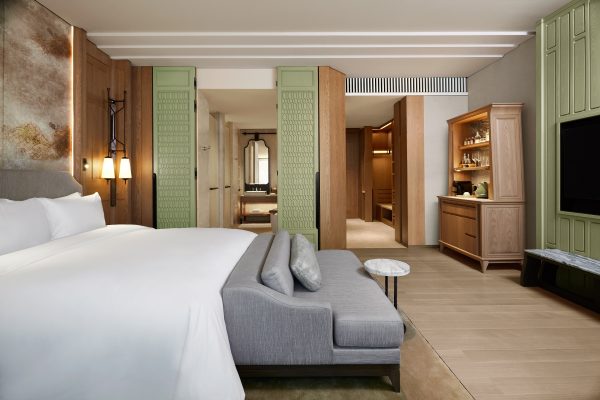
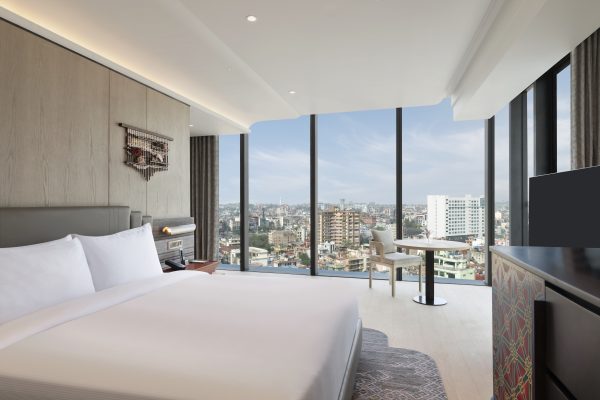
Designed with discerning travellers in mind, the hotel promises to make history once again and establish groundbreaking benchmarks in service and design. Rising on the same prestigious site as its predecessor, all 257 rooms at the new Dusit Thani Bangkok boast uninterrupted views of Lumpini Park. Elegant, cantilevered window seats extend from each guest room, inviting guests to immerse themselves in the stunning panorama.
Bookings for the new Dusit Thani Bangkok are available now via dusit.com.
The hotel’s considerate approach to redevelopment was recently unveiled at an exclusive media event in Bangkok led by Dusit Group CEO International Suphajee Suthumpun. She emphasised the company’s commitment to merging contemporary trends with the timeless spirit of the original Dusit Thani Bangkok, which was the city’s tallest building when it first opened in 1970.
“For over five decades, the original Dusit Thani Bangkok was a beloved landmark, a true ambassador of Thai hospitality for global travellers,” said Suphajee. “As we embarked on its reimagination, we were committed to honouring that legacy while exceeding the expectations of today’s sophisticated guests. This meant meticulously preserving elements of the original hotel and seamlessly blending them with a fresh, modern design. Throughout this process, we stayed true to the vision of Dusit’s founder, Thanpuying Chanut Piyaoui, and owner, Chanin Donavanik, to showcase Thai culture, art, and gracious service in a way that resonates with contemporary travellers and adapts to evolving preferences. Sustainability remains a core focus for Dusit, and this commitment is also reflected in the new hotel’s design and operations. Ultimately, we aim to deliver an unparalleled guest experience while preserving the warmth and service that have always been synonymous with the Dusit Thani name.”
Natapa Sriyuksiri, Managing Director of Dusit Estate and Group Creative Strategy for Dusit International, noted the main challenge in designing the new Dusit Thani Bangkok was capturing the essence of the original hotel’s warmth and character while ensuring a fresh, modern aesthetic.
“The original Dusit Thani Bangkok had a soul of its own, and our goal was to translate that spirit into a contemporary space equipped for the future. We started by reinterpreting the original hotel’s unique design elements through a modern lens. This involved studying the hotel’s distinctive interiors and architecture to identify patterns we could modernise or reference in new creations.”
Envisaged by Architects 49 International Limited and OMA Asia Hong Kong Limited, a division of the esteemed Office for Metropolitan Architecture (OMA), renowned for its groundbreaking contributions to architecture and urban planning, the new hotel’s architecture pays homage to the unique style of its predecessor. Its elegant interiors, exquisitely crafted by internationally acclaimed Asian interior design firm André Fu Studio, seamlessly blend the original hotel’s rich heritage with contemporary Thai aesthetics, incorporating warm colour tones and subtle traditional motifs for a modern interpretation of classic Thai artistry and craftsmanship.
Further honouring the hotel’s storied past, a signature ‘Heritage Floor’ designed by Thai interior design firm P49 Deesign & Associates Co. Ltd captures the spirit of the original property. This floor is adorned with exclusive artworks by local artists, each inspired by the hotel’s legacy.
The reimagined Dusit Thani Bangkok goes beyond design to celebrate its heritage. The original hotel’s iconic golden spire, a beloved landmark, has returned and is now contained within a new, three-times-larger spire. Guests can also admire paintings and murals from the original hotel’s Benjarong Thai Restaurant, including the restaurant’s meticulously preserved main pillars, which were carefully removed and reinstalled in the new hotel’s main lobby. The intricate carved teak ceiling from the same restaurant has also been meticulously reassembled and given a new life within the new hotel.
“By reimagining elements from the original Dusit Thani Bangkok and focusing on exquisite craftsmanship throughout the entire design process – from architecture to décor to furnishings – we’ve woven a connection between the hotel’s past and present, creating a timeless harmony guests will experience throughout the entire new hotel,” said Natapa.
The four key pillars of Dusit Graciousness — Service (personalised and gracious), Locality (uniquely linking guests to the local community), Well-being (delivering wellness experiences beyond the spa); and Sustainability (social, economic, and environmental) — that inspire the guest experience at Dusit Hotels and Resorts worldwide also influenced the new hotel’s design.
“Dusit Thani hotels, wherever they are in the world, are carefully designed to serve as a unique reflection of the communities they serve, creating places to see and be seen and bringing value far beyond the property’s walls,” said Ms Sriyuksiri. ‘The new Dusit Thani Bangkok is the epitome of this commitment. No inch of space has been wasted in our pursuit of hospitality excellence. With an unrivalled Thai-inspired design that becomes progressively more modern towards the building’s golden spire, we’ve gone to great lengths to ensure the aesthetics of each area serve as the stage for lasting memories to be made. There’s a genuine sense of theatre, too. Large, open windows in the ballroom and lobby seamlessly connect the hotel’s vibrant energy with the surrounding Lumpini Park, showcasing both the stunning cityscape and the exciting events happening within. This innovative design ensures the new Dusit Thani Bangkok stands out as a unique landmark, a true icon for a new era of Thai hospitality.”
Beyond aesthetics, the new Dusit Thani Bangkok also incorporates Feng Shui principles for a holistic guest experience. “Our goal,” explained Mr Somkiat Lo-Chindapong, Deputy Managing Director of Architects 49 Limited (A49), “was to seamlessly integrate world-class design with the legacy of the original hotel, and this included marrying ancient Feng-Shui wisdom about wind and water with modern architecture. This approach is evident in the building’s positioning within Dusit Central Park, ensuring each guest room offers unobstructed views of Lumpini Park through large bay windows with a luxurious gold finish. These breathtaking vistas act as ‘golden frames of memories,’ drawing positive energy into the hotel while creating lasting impressions for guests.
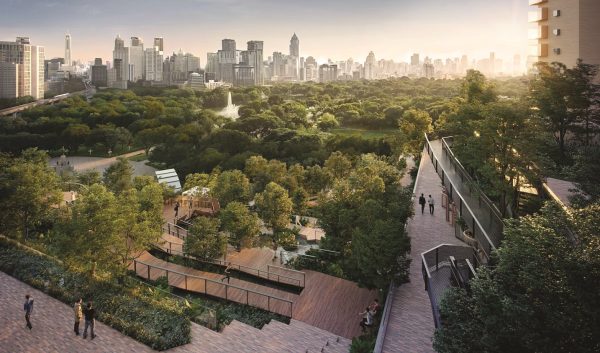
“Blending old-world charm with modern elegance, there simply is no other building like it in Bangkok. It is instantly recognisable as the Dusit Thani Bangkok, inside and out. Furthermore, the seamless connection to Lumpini Park and the upcoming roof park at the heart of Dusit Central Park ensures nature is truly at the heart of the guest experience.”
To complete this luxurious sanctuary, the new hotel features just 257 guest rooms – a thoughtful reduction from its predecessor’s 517, prioritising spaciousness. These exquisite rooms, starting at an impressive 50 square metres, were designed by the aforementioned André Fu Studio to seamlessly blend traditional elegance with modern luxury while uniquely framing the expansive park views beyond.
In addition to the luxurious rooms, the new Dusit Thani Bangkok boasts a unique urban wellness concept, delivering well-being experiences beyond the spa, as well as 10 restaurants and bars, including new venues created in collaboration with renowned chefs and mixologists. The hotel boasts over 5,000 square metres of dedicated meeting and event space for business travellers and event planners. The centrepiece is one of Bangkok’s largest grand ballrooms, featuring a dramatic eight-metre ceiling and a panoramic view of Lumpini Park. Additional meeting spaces cater to both intimate gatherings and large-scale events.
Additional elements of Dusit Central Park, including ultra-luxury residences (Dusit Residences and Dusit Parkside), a state-of-the-art office tower, a high-end retail centre, and an 11,200 sq m Roof Park, are all slated to open in 2025.
About Dusit Hotels and Resorts Dusit Hotels and Resorts is the hotel arm of Dusit International, one of Thailand’s leading hotel and property development companies. With a heartfelt belief and commitment to introducing Thai-inspired gracious hospitality to the world, Dusit Hotels and Resorts offers guests a uniquely special stay in high-style surroundings and a personalised approach to service. The group’s portfolio of hotels, resorts and luxury villas includes more than 300 properties operating under a total of eight brands (Devarana – Dusit Retreats, Dusit Thani, Dusit Suites, Dusit Collection, dusitD2, Dusit Princess, ASAI Hotels, and Elite Havens) across 18 countries worldwide.
SINGAPORE, 6 August 2024: Wyndham Hotels & Resorts, a hotel franchising company reported record growth in Asia Pacific for the first half of 2024 according to a statement released Monday.
It confirmed the introduction of four new brands and the signing and opening of 120 and 74 hotels, respectively. The expansion has driven an 8% year-on-year net room growth, equivalent to 15,100 rooms in the first half of this year.
“Wyndham’s record signings and strong performance in Asia Pacific reflects sustained growth powered by a travel resurgence in the region in 2024. This record performance underscores Wyndham and their business partners’ confidence in the growing travel demand,” the hotel group explained.
Key takeaways
The hotel group says the strong growth is attributed to Wyndham’s positive performance in Mainland China, where the company signed 104 hotels, contributing to a 22% increase in hotels signed in APAC as compared to the previous year.
In the past five years, over USD275 million in investments have provided Wyndham partners and owners with top-tier technology, including next-gen property and revenue management systems.
Global passenger demand rose 11%, with Asia Pacific leading at 27%. This reflects a positive travel industry outlook for Asia Pacific, aided by eased Chinese visa rules and domestic tourism recovery.
“Across Asia Pacific, we have seen a strong growth momentum in the tourism sector in 2024, and our growth reflects our confidence as well as that of our business partners in the rising travel demand. We remain focused on our Owner First philosophy, providing unparalleled support to help our owners succeed and delivering incredible experiences to guests as we continue to grow across the region,” said Wyndham Hotels & Resorts President, Asia Pacific Joon Aun OOI.
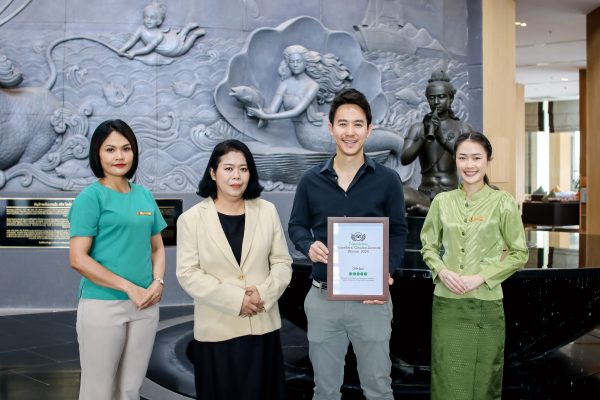
PATTAYA, 6 August 2024: Royal Cliff Hotels Group’s five-star sports & wellness facilities, Fitz Club – Racquet, Health & Wellness, and Cliff Spa, have earned Tripadvisor’s Travelers’ Choice Awards for 2024.
This award honours businesses that consistently earn great reviews, placing them among Tripadvisor’s top 10% of listings worldwide. This recognition emphasises Royal Cliff as a leading wellness destination, offering guests an escape from the hustle and bustle of everyday life, inviting them to embark on a journey of healthy and active lifestyle.
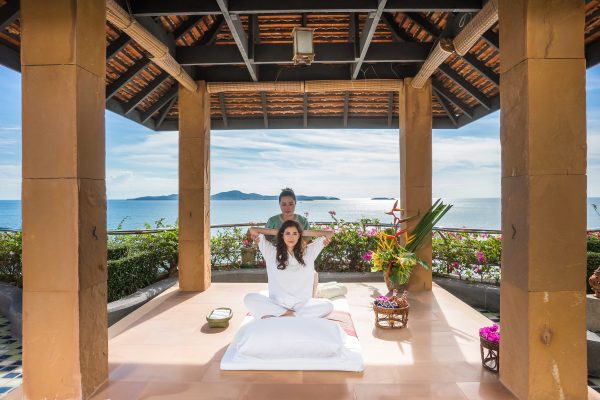
At Cliff Spa, guests can immerse themselves in tranquillity while being pampered by highly skilled therapists. They will transport you to a realm of bliss with world-class spa treatments tailored to revitalise your body, mind, and soul, all offered in panoramic sea-view treatment rooms. In addition to these treatments, guests can enjoy the sauna, steam room, and Jacuzzi, leaving them revitalised and refreshed.
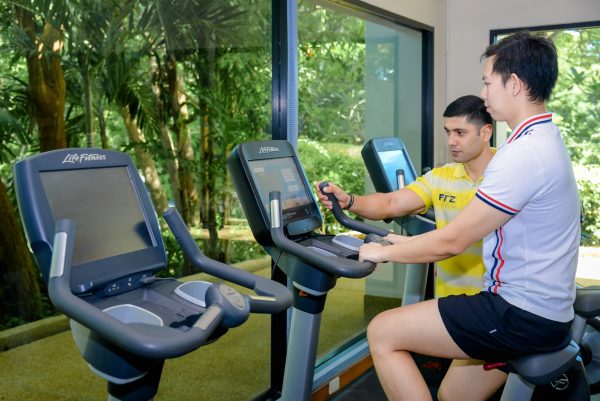
For those seeking an active getaway, look no further than Fitz Club, which has won the Tripadvisor award for two consecutive years. Fitz Club offers each guest a plethora of activities, including Tennis, Squash, Table Tennis, Swimming, Thai Boxing Classes, Personal Training and more. Whether you aspire to build strength or simply embrace a healthier lifestyle, the expert trainers are committed to helping you succeed.
“Congratulations to Fitz Club and Royal Cliff on its recognition in Tripadvisor’s Travelers’ Choice Awards for 2024,” said Tripadvisor Chief Growth Officer John Boris.
“Traveller’s Choice honours businesses that consistently demonstrate a commitment to hospitality excellence. This means you have made such a memorable impact on your visitors that many of them took the time to go online and leave a great review about their experience. People rely on Tripadvisor’s Travelers’ Choice seal to help them navigate the myriad of things to see, eat and do across the globe. We hope this recognition continues to drive business in 2024 and beyond.”
Check out all the reviews and discover more about Fitz Club and Cliff Spa
About Royal Cliff Hotels Group, Pattaya Perched atop a 64-acre private estate with breathtaking views of the Gulf of Thailand, the Royal Cliff Hotels Group boasts four award-winning hotels and an array of leisure facilities that delight and entertain travellers worldwide.To secure the premium experience you deserve, visit www.royalcliff.com, call reservations at (+66) 38 250 421 ext: 2732, or email [email protected].
SINGAPORE, 6 August 2024: Hilton announces the grand opening of the 172-room Hilton Kathmandu, marking the hospitality company’s first foray into Nepal.
The hotel is located in Naxal, Kathmandu Valley, just 4 km from Tribhuvan International Airport and a short commute from tourist attractions such as Thamel and Durbar Marg.
Owned and developed by the Shanker Group, the property represents a significant milestone in Hilton’s expansion in the Indian subcontinent.
Nepal enjoys a high travel demand and is extremely popular among consumers looking for adventure and cultural getaways.
As the tallest hotel in Kathmandu and the only one with a glass facade, it offers breathtaking views of the Langtang Valley’s mountain ranges.
Beyond its proximity to Tribhuvan International Airport, Hilton Kathmandu offers convenient access to Thamel district. This central location places guests within walking distance of various cafes, pubs, gaming hubs, and entertainment venues. Furthermore, the hotel’s proximity to the Narayanhiti Palace Museum and Durbar Marg allows easy access to Kathmandu’s rich cultural heritage.
Hilton Kathmandu is located at Thirbam Sadak, Near Bhagwati Bahal, Naxal, Kathmandu 44600, Nepal.
PHUKET, 6 August 2024: One of the world’s most inspirational green advocates will headline PHIST this year as Asia’s pioneering sustainability event enters its 8th year. The event is scheduled for 2 September at Angsana Laguna Phuket.
Unsung hero of sustainability Andrew Dixon, a former banker turned green activist and owner and operator of two private island resorts in Indonesian waters (Nikoi Island and Cempedak Island), will discuss his broad sustainability platform, which includes not only conservation but also culture, community, and commerce.
Green stalwarts: Andrew Dixon of Nikoi Island (left) and Jerawan (Blue) Srepetchdanond of Intrinsics (right) are among the leading speakers at PHIST 2024.
Stories will cover everything from micro-financing and cultural integration to a school that now has over 600 students, providing vital support and development systems that go much further than tree planting and the banning of single-use plastics.
Other highlight speakers include Jerawan (Blue) Srepetchdanond, Jerawan (Blue) Srepetchdanond, who is a founder and director of Intrinsics, a sustainable building design consulting company. Jerawan works with clients and development teams to ensure buildings and facilities deliver high environmental performance, support a healthy environment, and reach their sustainability objectives and goals, including certifications such as LEED, TREES, Green Star Australia, WELL and Fitwel.
In addition to leadership sessions and 18 workshops, an exhibition space will showcase the region’s best-in-class innovators in sustainability. These include Winnow, leading exponents of the opportunity food waste provides to drive efficiencies and margins by using AI; Diversey, a global firm excelling in hygiene and cleaning solutions; and outdoor accommodation experts Escape Nomade.
“We are excited to broaden the learning experience this year and establish ourselves as a leading regional platform for the industry to educate themselves about not only positive social and environmental change and how they can make a contribution but also learn how this can have a positive impact on the bottom line,” said C9 Hotelworks Managing Director Bill Barnett.
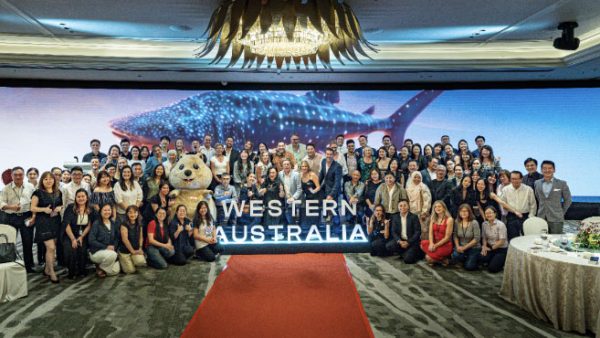
SINGAPORE, 6 August 2024: Tourism Western Australia (Tourism WA) held its largest-ever roadshow in Singapore last week as part of its 2024 Singapore and Malaysia Trade Mission.
Last held in 2022, the trade mission drew more than 400 trade partners across Singapore and Malaysia, of which more than 170 were from Singapore.
Additionally, 27 West Australian operators attended the Trade Mission in Singapore, with more than 1,900 B2B appointments held, showcasing the strong interest in Western Australia’s tours and travel experiences.
The trade show started in Kuala Lumpur, travelled to Penang and Ipoh, and then concluded in Singapore. It had notable partners including Scenic Helicopters, Busselton Jetty Inc, and Journey Beyond.
Australia ranks as the second-most popular travel destination for Singaporeans, with over 325,000 visitors recorded by the end of March 2024, spending approximately AUD1.12 million. Perth in Western Australia emerges as the third most sought-after destination within the country among Singaporean travellers. Many of these visitors are repeat travellers, underscoring Western Australia’s enduring appeal.
The Tourism WA 2024 Singapore Trade Mission educated trade partners on the new and exciting experiences and activities across dining, accommodation, adventure, nature, luxury, and culture that Western Australia has to offer visitors.
Tourism Western Australia Executive Director, Marketing Mel Forbes said Singapore represents a pivotal market for Western Australia.
“In collaboration with our trade partners, we are dedicated to delivering an authentic experience tailored specifically for Singaporean visitors. Emphasising luxury, adventure, and culinary excellence, our focus is on curating a captivating and immersive journey that appeals to the diverse interests of Singaporean travellers and showcases the finest in West Australian hospitality.”
The roadshow highlighted three new marine-based experiences for the aquaphiles. From on-land adventures to those where visitors can expand their knowledge of the rich biodiversity of the deep sea and get a taste of history, Western Australia tour operators showcased the new experiences visitors can enjoy.
Skybound with Scenic Helicopters in Albany
Embark on an aerial adventure across the picturesque landscapes of the Great Southern region with Scenic Helicopters. Taking flight from Albany this summer, Scenic Helicopters’ 20-minute flights take visitors on mesmerising journeys with stunning coast views, rolling countryside, and iconic landmarks such as Vancouver Peninsula and Misery Beach.
Interactive marine experience at the new Marine Discovery Centre at Busselton Jetty
Busselton Jetty in Western Australia’s Margaret River Region launched a new family-friendly Marine Discovery Centre in July. Established in the Railway House Ballaarat Room, the Discovery Centre hosts a 30-minute indoor, interactive experience that allows guests to interact with a virtual shark, drive a virtual submarine, and create their own fish habitat.
Experience a Pearl Farm at Roebuck Bay
Journey Beyond and Paspaley have jointly launched a new half-day pearling experience in Broome, the pearling capital of Western Australia’s North West. Departing from Gantheaume Point, the experience will explore the history of pearling in the Kimberley region and allow guests to view harvested pearls on board the boat at Paspaley’s on-water Pearl Farm in Roebuck Bay.
SINGAPORE, 6 August 2024: Jetstar Asia (3K) is celebrating Singapore’s National Day (Friday, 9 August) by launching a “Soar for Singapore” campaign that includes low-fare sales and the release of a song dedicated to Singaporean travellers.
Over the past two decades, Jetstar has carried over 50 million passengers, connecting Singapore to the world and celebrating 20 years of flying from its Singapore Changi hub.
Launching Tuesday morning, 6 August, the Soar for Singapore sale* will see the Singapore low-cost carrier release 20,000 seats across the entire Jetstar Asia network in honour of its upcoming 20th birthday, with fares as low as SGD70.
In addition to amazing travel deals, Jetstar Asia has partnered with Singaporean content creator Scott Van Der Ven to release a special song celebrating Singapore’s National Day and Jetstar Asia’s 20th birthday.
The tongue-in-cheek song celebrates Singapore’s unique spirit, pride, and culture, adding Jetstar fun and humour to the traditional National Day song and showcasing some uniquely Singaporean traits and quirks.
The song released last week on social media has already captured the hearts of many Singaporeans, earning close to 800,000 views as of 0900 SGT on 5 August.
Regional Manager Group Marketing of Jetstar, Belinda Allen, said this campaign was Jetstar Asia’s way of celebrating two decades of friendship with their customers while encouraging them to explore exciting new destinations.
“We are incredibly excited to celebrate Singapore’s 59th birthday with our ‘Soar for Singapore’ campaign,” Allen said. “Our partnership with Scott is a tribute to Singapore, and we hope this campaign brings joy to our customers and allows them to take off on more adventures with our great low fares.”
Jetstar Asia’s “Soar for Singapore” campaign underscores the airline’s commitment to making travel more accessible while celebrating Singapore, the place that’s been home to Jetstar Asia for 20 years and counting.
Soar for Singapore sale fare examples:
Singapore to Penang: SGD70 Singapore to Krabi: SGD79 Singapore to Jakarta: SGD82 Singapore to Broome: SGD119
*Sale fares are available on jetstar.com from 1000 (SGT) on Tuesday, 6 August, until 2359 (SGT) on Monday, 12 August.
SINGAPORE, 6 August 2024: Sri Lanka’s eVisa portal, run by VSC Global, will be offline for at least a week due to a Supreme Court injunction following a petition by a group of MPs.
As a result of the Supreme Court order, the platform switched off at 1700 on Friday, 2 August, leaving travellers with just two options: Apply for visas at the nearest embassy before travelling to Sri Lanka or queue for a visa-on-arrival at the first point of entry in the country, usually Colombo Bandaranaike International Airport.
Officially called an Electronic Travel Authorization, the eVisa process was awarded to VSC Global last April when it won the tender following Cabinet approval. A group of MPS is now challenging the legality.
The adoption of an exclusive eVisa service was effective on 17 April when the Department of Immigration announced:
“With effect from 17 April 2024, all tourist and business travellers to Sri Lanka must have an eVisa to enter Sri Lanka. Please visit https://www.srilankaevisa.lk for more information.”
The Supreme Court ruling suspended the website service and forced the government to revert to the pre-17 April system used for issuing tourist visas.
Travel trade sources in the Sri Lankan capital, Colombo, said the ETA system will remain suspended for at least a week while the court investigates the complaint and issues a ruling. If it rules in favour of the MPs’ petition VSC Global’s portal processing Sri Lankan eVisas could remain offline for much longer and may go back to the tender bidding process.
Sri Lanka grants tourists a 30-day visa costing USD50 with the option to extend in the country for another 30 days.
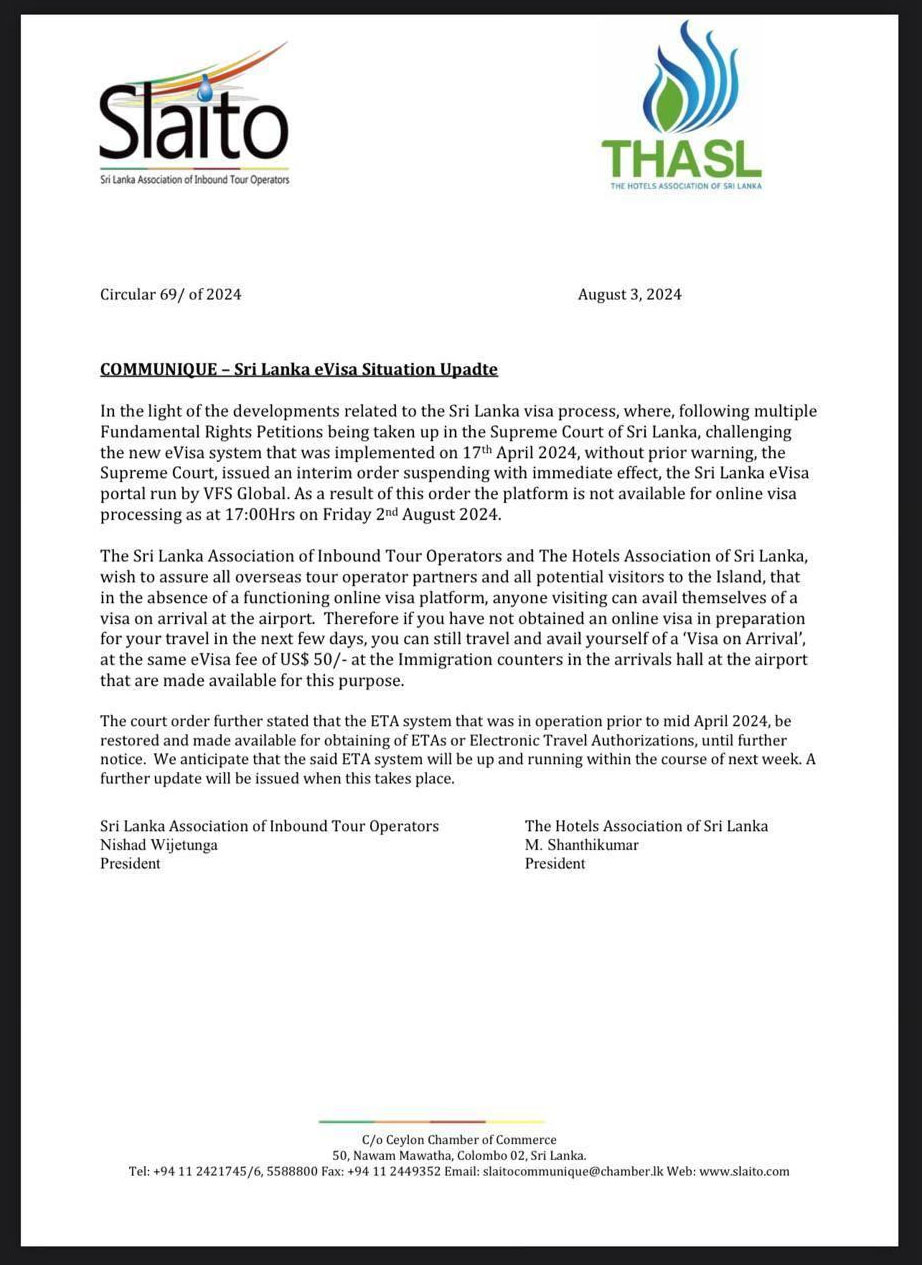
Sri Lanka Association of Inbound Tour Operators posted a statement on its Facebook page summarising the developments.
• “All eVisa applications that remain pending as of 2 August will receive a refund; application number and details need to be shared at [email protected]
• Currently, there is no platform for issuing an eVisa online to tourists coming to Sri Lanka.
• All tourists with no visa must apply for a visa-on-arrival until the former Electronic Travel Authorisation (ETA) system is re-established.
• We anticipate that the ETA system will be up and running within the next week.”