

BANGKOK, 11 May 2026: Thailand is strengthening its position as one of Asia’s leading destinations for remote workers, freelancers and long-stay international visitors through the Destination Thailand Visa (DTV), a flexible five-year multiple-entry visa programme aimed at the rapidly growing global digital nomad market.
The visa initiative forms part of Thailand’s wider strategy to stimulate long-term tourism, attract foreign talent and increase year-round visitor spending across the kingdom.

Officials and tourism analysts believe the programme could significantly strengthen Thailand’s competitiveness against rival long-stay destinations in Asia and Europe as countries worldwide compete aggressively for highly mobile professionals seeking flexible lifestyles and improved work-life balance.
The Destination Thailand Visa allows eligible foreign nationals to stay in Thailand for up to 180 days per visit, with the option to extend once per entry for an additional 180 days. The visa remains valid for five years, offering exceptional flexibility for remote workers, entrepreneurs and lifestyle travellers seeking extended stays in Southeast Asia.
Thailand has already become one of the world’s most popular destinations for digital nomads, thanks to its tropical climate, affordable cost of living, an internationally respected healthcare system, modern infrastructure, reliable internet connectivity, and a vibrant tourism and hospitality sector.
Popular destinations among long-stay visitors include Bangkok, Chiang Mai, Phuket, Pattaya, Samui Island and several emerging secondary cities offering strong lifestyle appeal and growing co-working communities.
Tourism analysts say the DTV programme reflects a broader shift in global travel trends, with an increasing number of professionals combining work, lifestyle and travel experiences rather than taking traditional short holidays. For Thailand, the economic implications are significant, with long-stay remote workers typically spending more per visit than short-term tourists, while supporting accommodation providers, restaurants, transport operators, domestic airlines, retail businesses, and local service industries over longer periods.
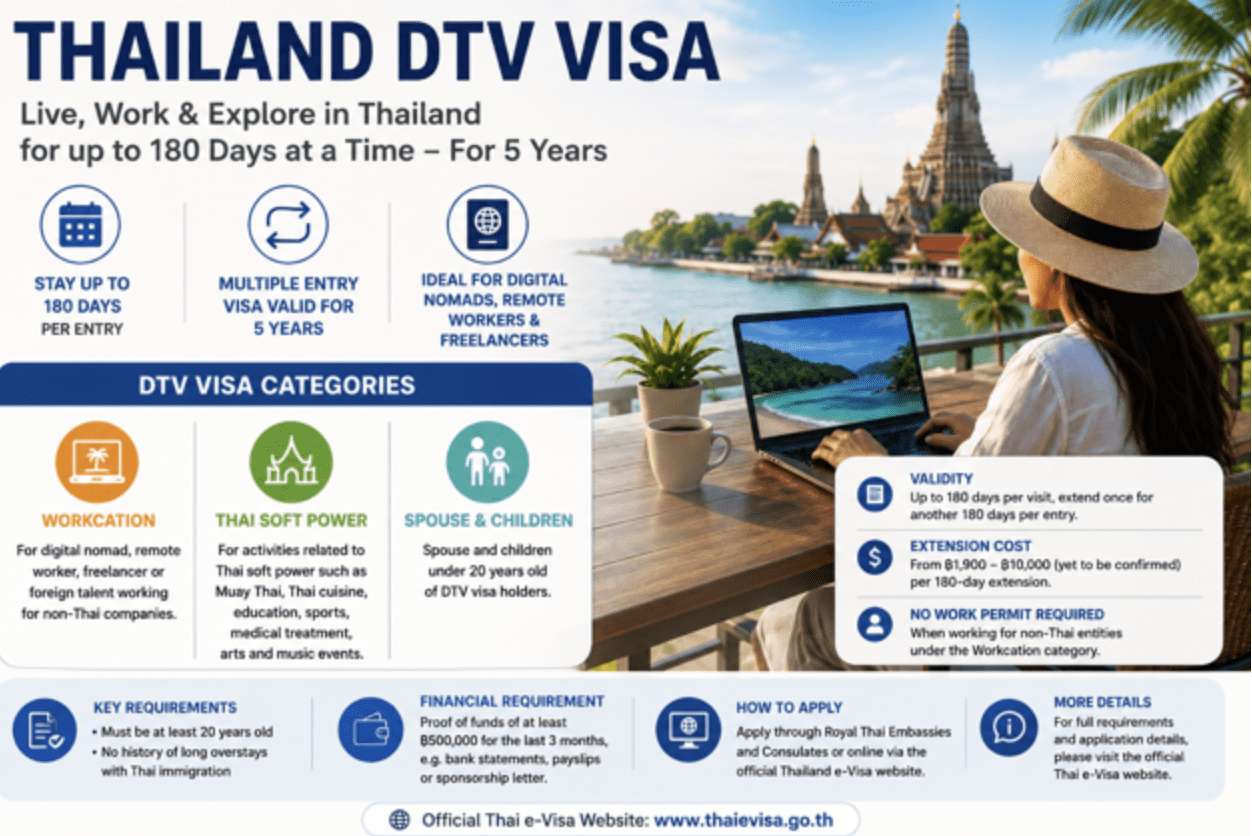
Applicants under this category are required to provide detailed supporting documentation, including proof of current location, financial evidence showing at least THB 500,000 maintained over the previous three months, proof of salary slips or monthly income for the previous six months, foreign employment contracts or employment certificates authenticated by the embassy of the country where the employer is based, and authenticated company registration documents. Applicants are also expected to provide a professional portfolio demonstrating their remote work or freelance status.
Importantly, no Thai work permit is required under the Workcation category, provided applicants work exclusively for overseas companies or clients. Those seeking employment with Thai companies must apply separately under Thailand’s existing work permit and employment visa regulations.
Thailand’s DTV programme also supports what officials describe as “Thai soft power activities”, broadening the visa’s appeal beyond traditional remote workers.
Eligible activities include Muay Thai training, Thai culinary programmes, education and seminars, sports training, medical treatment and participation in arts and music-related events. Applicants in these categories must provide letters of acceptance or appointment from recognised institutions, organisers, hospitals or medical centres.
The programme additionally extends to spouses and dependent children under 20 years old of DTV holders, making the visa increasingly attractive for international families seeking medium-term residence in Thailand.
Family applicants must provide relationship documentation, including marriage certificates, birth certificates or adoption certificates, together with proof of prolonged residence in Thailand and supporting financial evidence linked to the principal DTV holder. Additional requirements apply for minors travelling alone, including notarised parental consent documentation.
General eligibility requirements specify that self-supporting applicants must be at least 20 years old and should not have a history of serious immigration overstays in Thailand.
Applying for the DTV can be a detailed process, so please prepare carefully before submitting your documentation. As visa fees are generally non-refundable, many applicants are choosing to work with professional visa agencies familiar with the process and documentation requirements.
Applications may also be submitted directly through Royal Thai Embassies and Consulates or via the official Thai government electronic visa platform. Visa fees may vary by embassy or consulate, ranging from approximately THB8,533 to THB38,397.
The DTV also allows holders to request a change of visa type while remaining in Thailand, although such a change automatically terminates the DTV status.
Thailand’s strong hospitality sector, extensive domestic flight network, modern transport infrastructure and globally recognised healthcare services continue to make the kingdom highly competitive in the international long-stay tourism market.
For official information and application details, visit:
Thailand e-Visa Official Website
About the Author
Andrew J Wood is a Bangkok-based travel writer and well-respected tourism expert. A former hotelier, he has lived in Thailand since 1991. A past President of Skål Asia and long-time tourism industry leader, he writes widely on hospitality, travel and tourism trends across Asia.