

SINGAPORE, 17 April 2026: From AI agents booking our trips to cities limiting access, a new 2026 Executive Brief by Phocuswright and ITB Berlin reveals how trust, data, and inequality could redefine global travel over the next two decades.
Who will control travel in 2046: AI companies, governments, or the travellers themselves? What will determine value in an AI-driven industry? And will travel remain accessible to all, or become a privilege?
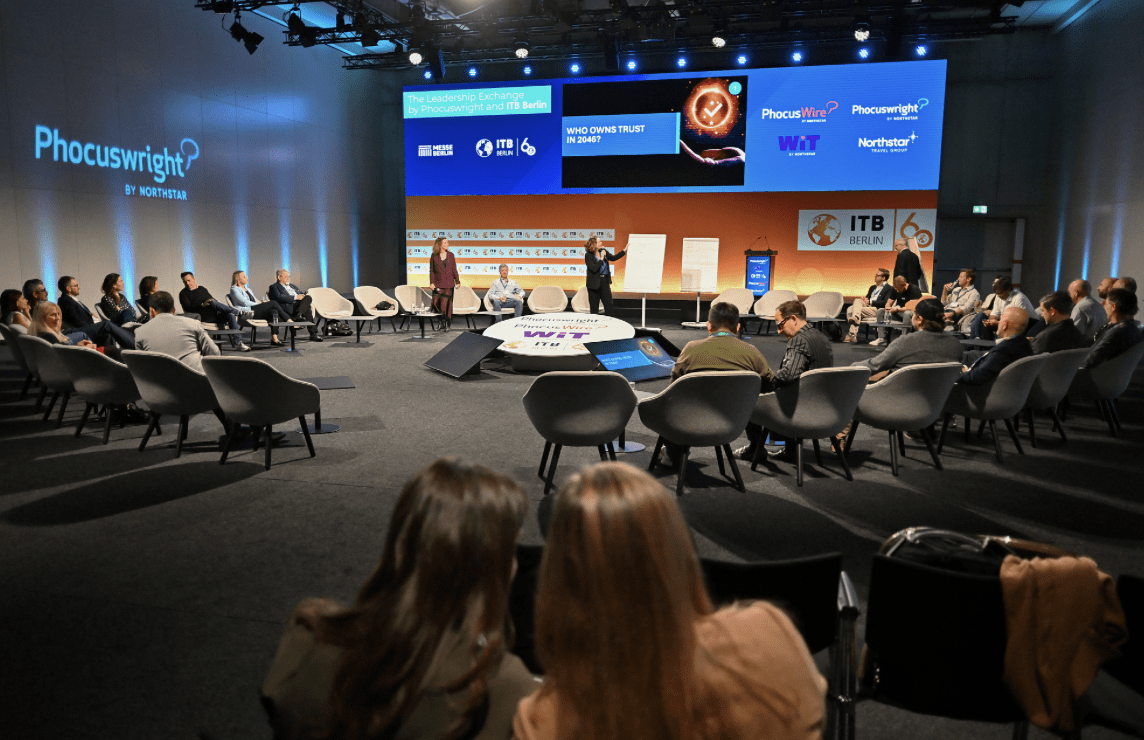
These questions were at the heart of the inaugural Leadership Exchange, hosted last month by Phocuswright, a leading global travel research and events company, and ITB Berlin.
The year is 2046: AI companies control global data flows, travellers rely on intelligent agents to plan and book journeys, and some destinations restrict access to combat overtourism. This is not science fiction, but one of several plausible futures envisioned by senior travel leaders during the closed-door Leadership Exchange.
The Leadership Exchange at ITB Berlin 2026, held under the Chatham House Rule, convened industry leaders in a strategic think tank format to tackle four key questions: Who owns trust?
Where does value sit in an AI-native industry? Is travel a right or a privilege? And will the sector consolidate or fragment? Its goal: to move beyond trend narratives and provide actionable insight for businesses, governments and stakeholders navigating a period of profound transformation.
A clear narrative emerged across all discussions: artificial intelligence will dramatically reduce friction in travel, but in doing so, it will fundamentally redistribute power.
“The travel industry is entering a structural shift unlike anything we’ve seen since the early days of digitalisation,” said Messe Berlin CEO Dr Mario Tobias. “With the Leadership Exchange, we created a space where decision-makers don’t just discuss the future but actively shape it. The choices we make now around trust, data and value creation will define the industry for decades to come.”
Download the complete Executive Brief 2026
Trust becomes the new currency
In a world mediated by AI, trust is no longer anchored to a single player. Instead, it becomes fragmented and more valuable than ever. Built through countless micro-interactions and human signals such as user-generated content, trust must be actively designed into every step of the customer journey.
At the same time, multiple AI-driven booking channels risk blurring accountability, increasing the likelihood of “catastrophic” trust failures in the near term.
“Trust is not an algorithm. There’s no single recipe, and in the future, not only companies, but also consumers will be assessed on whether they can be trusted,” said Sunweb Group CEO Mieke De Schepper.
AI shifts value, and challenges brands
As AI agents take over search and discovery, personalisation emerges as the industry’s greatest opportunity. Travel experiences will be tailored in real time, based on deep data insights and individual preferences.
However, this shift comes with a cost: traditional intermediaries may lose relevance, and even strong brands could see their influence erode as the “source of truth” becomes the key differentiator.
“By 2029, discovery as we know it today will almost disappear. The real value will sit with personal agents that act on our behalf,” said T2Impact principal Timothy O’Neil-Dunne.
Access to travel grows, and divides
While technology could make travel more seamless and inclusive, structural tensions remain. Easier mobility may foster more open and connected societies, but also intensify overtourism and strain infrastructure.
At the same time, economic inequality, geopolitics, and regulation will increasingly determine who can travel, turning mobility into a privilege for some rather than a universal right.
“To control immigration and overtourism, travel is becoming more of a privilege. Countries will either visa their way out of tourism or price people out,” said Protect Group global strategy lead Stephen Joyce.
Fragmentation vs consolidation: an open question
AI has the potential to empower smaller players through hyper-personalisation, enabling niche providers to reach highly targeted audiences. At the same time, control over data could lead to powerful monopolies.
Despite differing perspectives, participants agreed that the next three years will be decisive: choices made now on data ownership, trust frameworks and technological integration will shape the industry’s trajectory for decades to come. As one participant put it, the future of travel is not to be predicted, but actively shaped.
Additional information is available at www.itb.com and from the ITB News & Insights & Social Media.
(Source: ITB Berlin)