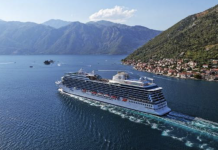


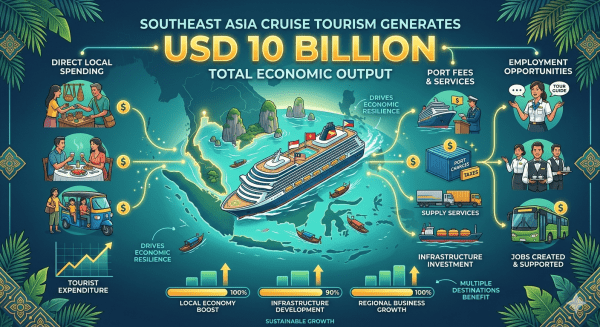
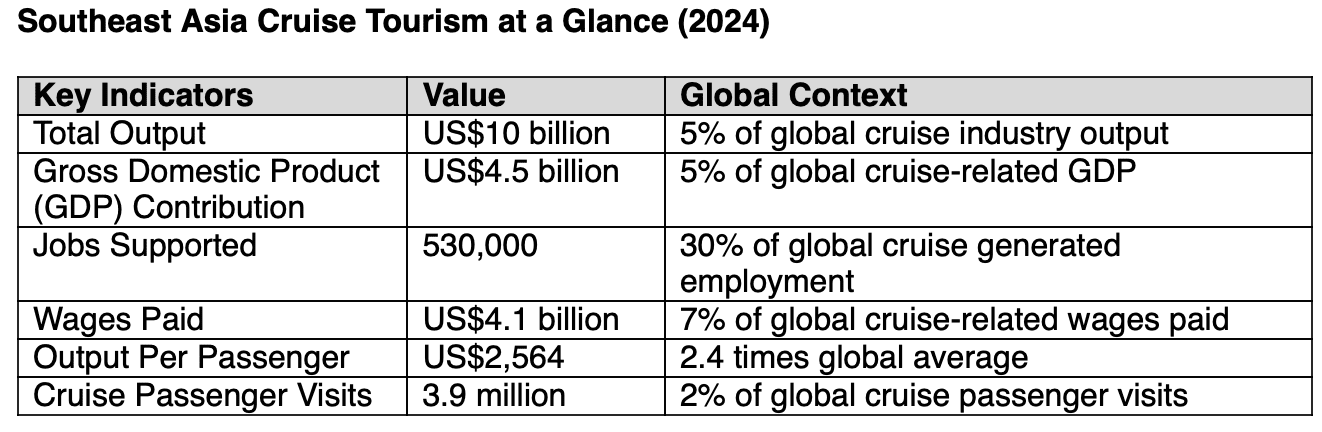
SINGAPORE, 21 April 2026: Southeast Asia’s cruise industry demonstrated strong economic value in 2024, generating USD10 billion[1] (SGD12.9 billion) in total output, representing 5% of global cruise industry output.
The region delivered USD2,564 (SGD3,308) per passenger visit — 2.4 times the global average per passenger — despite accounting for only 2% of global cruise passengers (186 million).
These findings are from the inaugural Economic Impact Assessment of Cruise Tourism for Southeast Asian countries*, produced by Tourism Economics[2] for the Cruise Lines International Association (CLIA), in partnership with the Singapore Tourism Board (STB).
The study released last week highlights the region’s cruise industry economic contributions in 2024, reinforcing the strategic importance of Southeast Asia in the global cruise landscape.
It also underscores how the cruise industry brings substantial economic returns to destinations across the region.
Singapore Tourism Board Assistant Chief Executive, Experience Development Group, Jean Ng, commented: “This study reinforces Southeast Asia’s strong cruise tourism value proposition, driven by a growing middle class, rising demand for diverse travel experiences, and rich destination variety.
As ASEAN’s lead coordinator for cruise developments, Singapore is committed to working with regional neighbours and global industry partners to unlock Southeast Asia’s full potential for cruising and building a compelling destination network that attracts cruise lines while delivering sustainable economic benefits across the region.”
Cruise Lines International Association (CLIA) President and CEO Bud Darr said: “We greatly value the collaboration with the Singapore Tourism Board on this project.
Their partnership enabled us to broaden the annual CLIA Economic Impact Studies and, for the first time, measure the economic contribution of cruise tourism across Southeast Asia within our global analysis.
“The results underscore the region’s growing role as a driver of jobs, economic activity, and a global cruise sector that brings unforgettable travel experiences to millions of guests worldwide.”
1 Based on the currency exchange of USD1 to SGD1.29 as of 6 April 2026
2 Tourism Economics, an Oxford Economics company, is a consulting firm that provides global economic impact studies, market forecasts, and data analysis for the travel and tourism industry.
Southeast Asia generates strong economic returns from cruise tourism.
Southeast Asia’s cruise tourism recorded a strong performance in 2024, contributing USD4.5 billion (SGD5.8 billion) to the regional GDP and 5% of global cruise-related GDP. This strong showing is reinforced by positive passenger sentiments, with 85% of cruise travellers rating their Southeast Asian experience positively and nearly half (47%) expressing intent to return for land-based travel. This attests to the sector’s potential to drive broader tourism growth.
The data also highlights cruise tourism’s role as a gateway to future growth. It introduces visitors to the region’s diverse attractions and helps generate sustained tourism demand beyond the initial cruise visit.
Market concentration data reveal that Singapore and Malaysia collectively accounted for 70% of Southeast Asian cruise passenger visits in 2024, with Singapore capturing a 48% share of the region’s 3.9 million passenger visits, while Malaysia secured 22%. There remains significant potential for other Southeast Asian destinations to develop cruise capabilities to capture a larger share of the growing market.
The industry supported approximately 530,000 jobs across the wider economy, including tourism and port-related sectors, representing 30% of the global cruise-related employment.
This shows the region’s importance as a primary workforce hub. Most of this employment is in the Philippines and Indonesia, collectively representing 85% of the workforce in Southeast Asia generated by cruise-related activities.
By providing comprehensive economic impact data, the study equips CLIA and Southeast Asia stakeholders with evidence-based insights to support investment decisions and catalyse cruise developments in the region.
Building on these strong economic contributions, there is a significant opportunity for Southeast Asian destinations to develop port infrastructure further and enhance their destination experiences to attract more cruise line deployments.
By making these enhancements to improve operational efficiency and increase appeal to both cruise operators and passengers, countries in the region stand to capture even greater economic value and long-term benefits from the growing cruise industry.
For more information: www.stb.gov.sg or www.visitsingapore.com
(Source: Singapore Tourism Board).