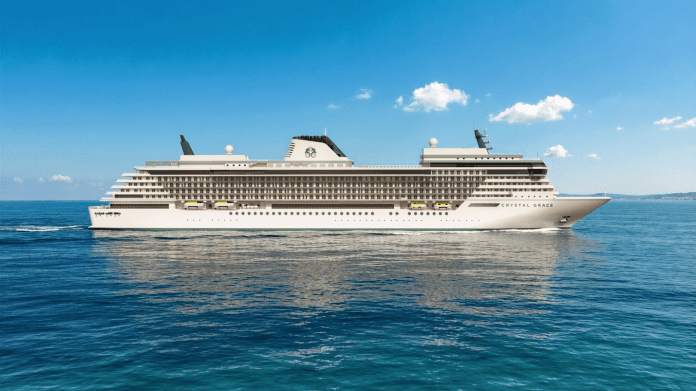
MELBOURNE, 4 June 2026: Crystal celebrated a defining milestone this week with the ceremonial steel cutting of Crystal Grace, the brand’s newest ocean ship, at the Fincantieri shipyard in Marghera, Italy.
The moment marks the official start of construction and signals the next chapter in Crystal’s continued evolution. Scheduled for delivery in May 2028, Crystal Grace represents a bold step forward for the brand, building on its legacy of exceptional service, spacious design and immersive, experience-led travel. The ship will introduce a refined vision of luxury at sea, thoughtfully designed to elevate every aspect of the guest journey.
Photo credit: Crystal. Crystal Grace artist impression.
“As we look to the future, we are focused on creating ships that feel both deeply rooted in Crystal’s heritage and unmistakably modern, where space, service and experience come together in a way that is both intuitive and extraordinary,” said AKTG CEO Cristina Levis. “Crystal Grace will do that for the brand, and we are so proud that this moment with our partners at Fincantieri brings that vision one step closer to reality.”
The steel cutting ceremony underscores Crystal’s continued partnership with Fincantieri, one of the world’s most respected shipbuilders and a long-time collaborator in bringing the brand’s vision to life through craftsmanship, precision and innovation.
Fincantieri Merchant Ships Division General Manager Luigi Matarazzo stated: “The steel cutting of Crystal Grace is a moment of great pride for our team and a significant milestone in our relationship with Crystal and the Lefebvre family. Over the years, we have built a partnership grounded in trust, shared values and an unwavering commitment to excellence. We are honoured to bring Crystal’s vision to life once again, shaping a vessel that reflects both the brand’s distinguished heritage and its exciting future.”
Once delivered, Crystal Grace will join the fleet as a next-generation ocean vessel, offering suites, including the brand’s first-ever Owner’s suite; elevated culinary concepts with renowned partners such as Chef Nobu Matsuhisa, three-time Michelin-starred Massimiliano Alajmo and his brother Raffaele and restaurateur Riccardo Girardi. The ship will embark on her inaugural voyage on 11 June 2028, from Civitavecchia (Rome) for an eight-night voyage concluding in Fusina (Venice).
SINGAPORE, 4 June 2026: Princess Cruises unveils its most expansive Europe season for 2028, with 291 departures across 150 itineraries aboard six ships sailing throughout Northern Europe, the Mediterranean and on Transatlantic voyages.
Now on sale, the season includes seven- to 53-day sailings, visiting 128 destinations in 37 countries, access to 101 UNESCO World Heritage Sites, and 32 late-night or overnight stays designed to give travellers more time ashore.
New for the season are Princess’ first calls to Galway and Killybegs, Ireland, as well as the debut of the new Pole-to-Pole Odyssey, and extended voyage linking Antarctica and the Arctic.
What’s New for Europe 2028
The 2028 season represents the largest European deployment in Princess history.
291 departures across 150 itineraries.
128 destinations in 37 countries.
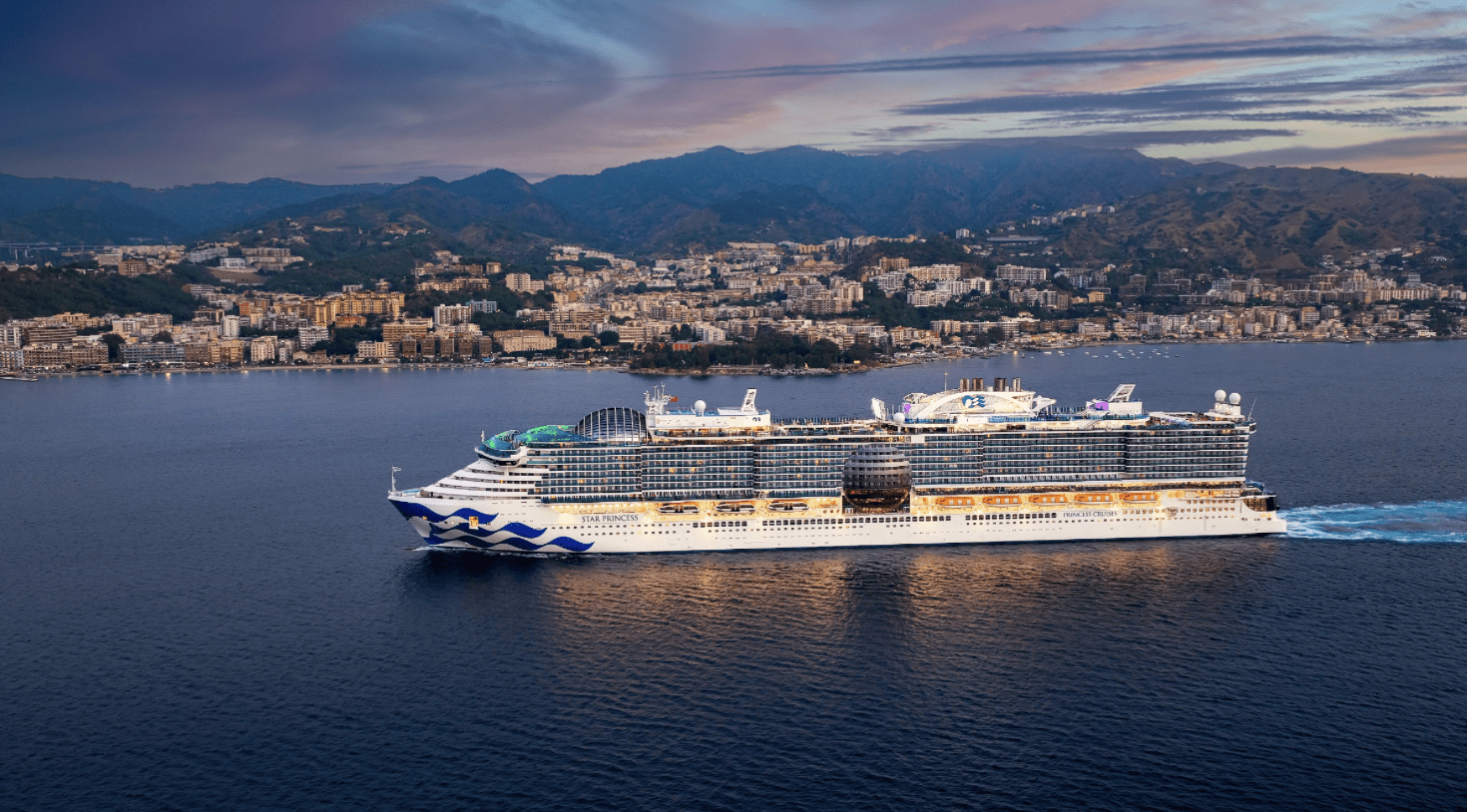
Six ships sailing from 13 departure ports – Caribbean Princess, Enchanted Princess, Majestic Princess, Regal Princess, Sky Princess and Sun Princess.
Maiden calls to Galway and Killybegs, bringing guests to Ireland’s rugged and culturally rich western coast for the first time.
The debut of the Pole-to-Pole Odyssey, a true epic European experience that links Antarctica and the Arctic in one voyage.
Access to 101 UNESCO World Heritage Sites and 32 late-night and overnight stays that allow for deeper, more authentic connections ashore.
Princess’ Europe itineraries go beyond traditional sightseeing, emphasising cultural immersion through Princess Local Connections and elevated “Ultimate” shore excursions. Guests can engage directly with local people, traditions and cuisine through experiences designed with regional experts and backed by Princess Cruises’ Guaranteed Return to Ship promise.
Northern Europe
Princess’ Northern Europe itineraries focus on smaller ports, dramatic landscapes and cultural connections, creating experiences that feel more personal and less commercialised.
They include visiting Norway’s breathtaking fjords, discovering Ireland’s rugged west coast through maiden calls to Galway and Killybegs.
Late-night and overnight stays are featured in destinations including Stockholm, Hamburg, Tromsø (Northern Norway), Amsterdam, Copenhagen, Belfast and Reykjavik.
Mediterranean
Princess’ Mediterranean voyages combine Europe’s most iconic destinations with local experiences that go beyond postcard moments.
They include exploring ancient ruins in Athens, Pompeii, and Ephesus before discovering the energy and charm of cities such as Barcelona, Lisbon, Dubrovnik, and Florence.
The season also features a strong lineup of late-night and overnight stays in dynamic ports including Istanbul, Mykonos, Ibiza, Valletta, Split, Lisbon and La Spezia (Florence/Pisa).
Transatlantic Voyages
Princess’ Transatlantic voyages are positioned as a relaxed, seamless alternative to flying, making long-haul travel part of the vacation itself. These sailings connect Europe with North and South America while allowing guests to settle into the journey at a slower, more enjoyable pace. Routes feature calls to destinations including the Canary Islands, Madeira, the Azores, Bermuda, Morocco, and the new Pole-to-Pole Odyssey.
HONG KONG, 4 June 2026: Langham Hospitality Group has appointed Josh Littman as Head of Development – EMEA, based in London.
Littman will lead the group’s expansion efforts across Europe, the Middle East and Africa, with a focus on securing new hotel and branded residence contracts for The Langham Hotels & Resorts, Cordis Hotels & Resorts, Eaton and Ying’nFlo.
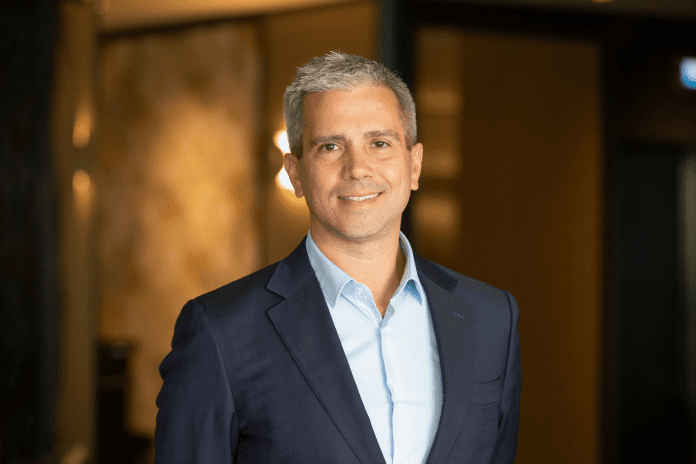
Josh Littman, Head of Development – EMEA, Langham Hospitality Group.
“The opportunities we’re seeing across the EMEA region continue to strengthen as owners and developers increasingly seek brands with clear positioning and long-term relevance,” Langham Hospitality Group CEO Bob van den Oord said. “With landmark openings such as The Langham, Venice and The Langham, Diriyah already helping to build momentum for the group across the region, Josh’s broad range of experience, which extends across the luxury, upscale, resorts and branded residences segments, makes him exceptionally well placed to help us capitalise on these opportunities. His track record of working with owners and investors across a wide range of projects and markets will be a major asset as we expand our portfolio.”
Littman brings over two decades of experience spanning hospitality development, investment advisory and mixed-use property planning. He most recently served as Vice President of Development, EMEA for Starwood Hotels, where he oversaw regional growth for Baccarat Hotels, 1 Hotels and Treehouse Hotels. Before that, Littman held senior development positions with InterContinental Hotels Group and Hard Rock Hotels & Casinos, where he played a key role in advancing the companies’ growth strategies across Europe and the Middle East.
SINGAPORE, 4 June 2026: Vietjet has launched one of its biggest promotions of the year, offering 12 million promotional tickets across its extensive domestic and international flight network in Vietnam.
The mega sale celebrates the airline’s continued international expansion, including two new routes connecting Hanoi with Almaty (Kazakhstan) and Prague (Czech Republic), both scheduled to commence on 10 October 2026.
Photo credit: Vietjet.
To celebrate the route expansion, Vietjet is offering a range of special promotions for bookings made from now until 0000 on 8 June 2026 (GMT +8) via Vietjet’s website, its mobile app, and official ticket offices and agents worldwide.
Eco-class fares starting at SGD86 one-way (inclusive of taxes and fees) for current Singapore-Vietnam routes. The discounted fares also apply to all Vietjet domestic and other international routes to and from Vietnam when entering the promo code SALE66.
Applicable for travel between 5 September 2026 and 31 March 2027 (travel periods vary by route), Blackout dates apply. Refer to vietjetair.com for details.
15% off Deluxe fares (excluding taxes and fees) on Hanoi–Prague and Hanoi–Almaty routes with the promo code HELLOVIETNAM. Applicable for travel between 10 October 2026 and 31 March 2027 (travel periods vary by route).
Also part of the 12 million-ticket sale, Vietjet is rolling out its Summer 2026 Sale for travel until 31 August 2026. Travel periods vary by route. Blackout dates apply.
30% off Deluxe fares (excluding taxes and fees) with the promo code SALE66DLX.
20% off SkyBoss and Business fares (excluding taxes and fees) with the promo code VJSALE20.
Passengers flying Deluxe can enjoy up to 20kg of complimentary checked baggage allowance, priority seat selection, and free flight schedule changes, offering greater flexibility and convenience for family holidays and summer travel.
For Singapore travellers, Vietjet’s growing network makes Vietnam both an easy getaway and a convenient gateway to wider adventures. With direct services from Singapore to Ho Chi Minh City, Hanoi, Da Nang and Phu Quoc, travellers can plan anything from a quick city break or beach escape to a multi-stop Vietnam holiday. The direct service linking Singapore and Nha Trang is scheduled to join the network from 11 December 2026.
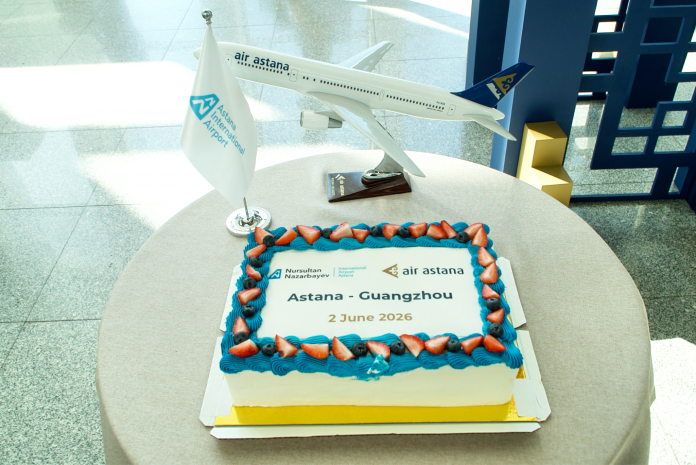
SINGAPORE, 4 June 2026: Air Astana continues to expand its network of services to major cities across China, with the launch of direct flights from Astana to Guangzhou on 2 June.
The new service complements the existing Almaty-to-Guangzhou route, which has operated five times a week since March 2025. Guangzhou, the capital of Guangdong province in southern China, is one of the country’s largest cities and is a major industrial, trading and transport hub.
Photo credit: Air Astana.
Flights from Astana to Guangzhou operate twice weekly on Tuesdays and Thursdays, departing from Astana at 1845 and arriving in Guangzhou at 0430 local time. Airbus A321LR aircraft serve the route with a flight time of six hours and 45 minutes.
Additional services to Guangzhou strengthen Air Astana’s long-term commitment to developing connectivity between Kazakhstan and China. This commitment began with its first flight between Almaty and Beijing in December 2002.
During the 2026 summer season, the Air Astana Group will increase frequencies on most of its existing routes to China, including services from Almaty to Urumqi, Guangzhou, Shanghai, Sanya and Yining, as well as from Astana to Beijing and Urumqi. As a result, the number of flights between Kazakhstan and China will reach 51 per week, the highest level in the airline’s history.
HONG KONG, 4 June 2026: If you’ve been steadily racking up miles through everyday shopping and dining, waiting for the perfect excuse to book a getaway, the wait is over.
To help customers maximise the value of their miles and travel strictly on their own terms, HK Express Airways (HK Express) has now made “Full Miles Redemption” available as a booking option, and to celebrate, it is launching a limited-time, uncapped 30% Asia Miles rebate.
Photo credit: HK Express.
The Asia Miles rebate started on 1 June, and customers can now use miles to cover flight add-ons, including extra baggage allowance, seat selection, and in-flight meals.
From now until 15 June 2026, passengers use the “Full Miles Redemption” option to book an “Essential” fare ticket (which includes one small item and 20kg checked baggage allowance) to earn a 30% uncapped Asia Miles rebate.
Limited-Time 30% Uncapped Asia Miles Rebate Details:
Redemption Period: Now until 15 June 2026 (23:59);
Travel Period: Any dates;
Applicable Fare: Essential (Includes one small item and 20kg checked baggage allowance).
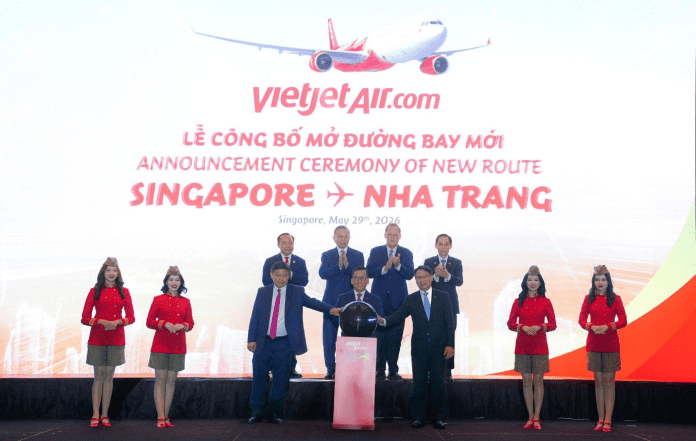
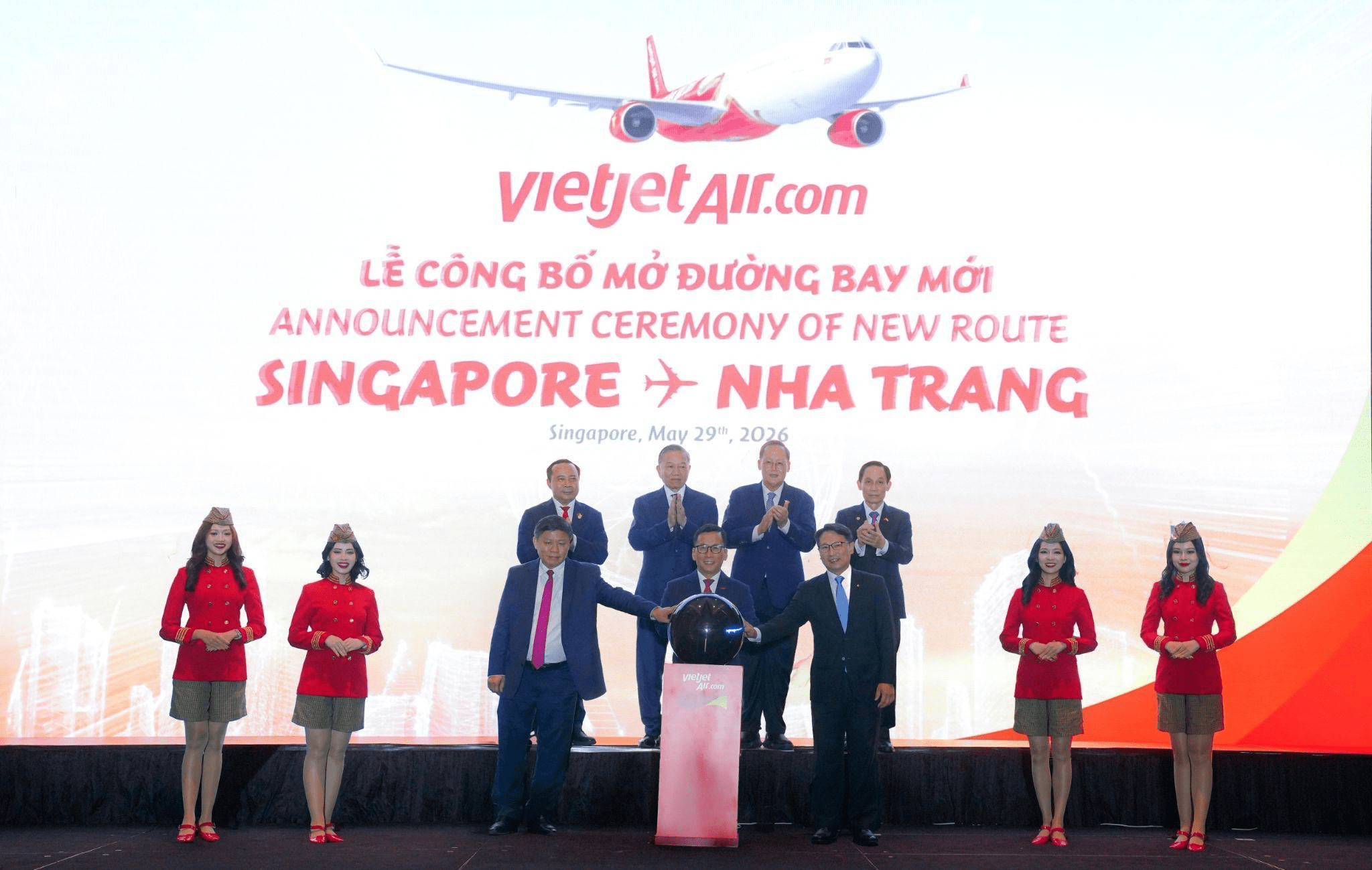
SINGAPORE, 4 June 2026: Vietjet has confirmed that a new direct route connecting Singapore and Nha Trang will be added to its regional network on 11 December 2026.
Airline officials announced the news last week at the Vietnam–Singapore Tech Connect Forum 2026 on 29 May.
Vietjet announces direct Singapore–Nha Trang service.
Scheduled to commence on 11 December 2026, the Singapore–Nha Trang route Vietjet will operate four return flights per week on Mondays, Wednesdays, Fridays and Sundays.
It will offer Singapore travellers a more convenient way to reach Nha Trang, reducing the need for domestic transfers in Vietnam and providing easier access to Vietnam’s south-central coast and its popular beach resorts.
Renowned for its pristine beaches, rich marine ecosystem, year-round pleasant climate, and world-class hospitality and entertainment offerings, Nha Trang continues to attract visitors from around the world. The new route will complement Vietjet’s existing direct services from Singapore to Ho Chi Minh City, Hanoi, Da Nang and Phu Quoc.
Earlier, in March 2025, Vietjet also announced its direct Singapore–Phu Quoc route in the presence of the Vietnamese leader during his visit to Singapore, contributing to tourism growth and regional connectivity.
Vietjet First Vice Chairman Dinh Viet Phuong commented: “As we continuously expand our flight network, Vietjet aims to serve as a bridge for growth between nations, helping to promote trade, investment, tourism and cultural exchange.
“Direct air links between Vietnam’s high-potential destinations and Asia’s leading economic centres, such as Singapore, are contributing to the development of new growth corridors for tourism, commerce, investment and international connectivity.”
Since launching its first route between Singapore and Vietnam in 2014, Vietjet has carried more than 3.8 million passengers on over 22,000 flights, contributing to stronger bilateral connectivity and meeting the growing travel demand of residents, tourists and the business community.
The airline currently operates four direct services linking Singapore with Hanoi, Ho Chi Minh City, Da Nang and Phu Quoc, offering more than 100 flights per week.
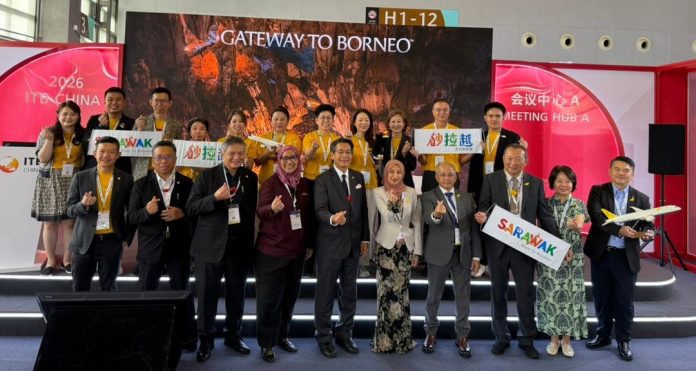
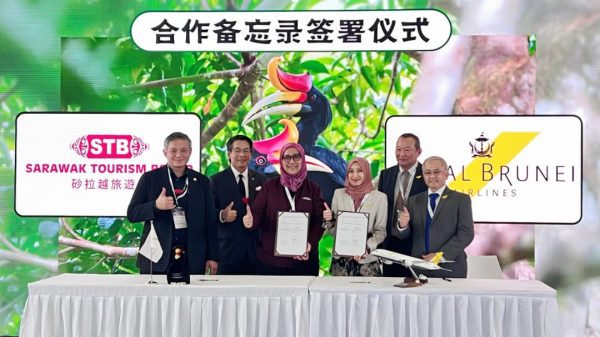
KUCHING, 3 June 2026: Sarawak Tourism Board (STB) and Royal Brunei Airlines (RB) have formalised a strategic partnership through the signing of a Memorandum of Understanding (MoU) during last week’s ITB China 2026.
The collaboration reflects both parties’ commitment towards strengthening accessibility in Sarawak while supporting broader efforts to position the destination as the Gateway to Borneo.
From the left: Mr Dylan Redas Noel (STB Marketing Director of North Asia and New Markets), YB Dato Dennis Ngau (Chairman of STB), Dr Sharzede Datu Haji Salleh Askor (Chief Executive Officer of STB), Yang Mulia Puan Colonel Norsuriati Haji Sharbini (Interim Chief Executive Officer of RB), Mr Alirahim Haji Abdul Rani, (Manager Integrated Marketing of RB) and Mr Song Kai (President of Beijing Longway International Travel, RB General Sales Agent in the People’s Republic of China) have formalised a strategic partnership through the signing of a Memorandum of Understanding (MoU) during ITB China 2026, reinforcing a shared commitment to strengthen regional connectivity and enhance Sarawak’s international tourism presence.
The partnership also highlights the growing importance of regional collaboration in supporting tourism growth, improving travel accessibility, and strengthening destination visibility across international markets.
The MoU was signed by Dr Sharzede Datu Haji Salleh Askor, Chief Executive Officer of STB, and Yang Mulia Puan Colonel Norsuriati Haji Sharbini, Interim Chief Executive Officer of RB. The signing was witnessed by Dylan Redas Noel, STB Marketing Director of North Asia and New Markets, and Alirahim Haji Abdul Rani, Manager Integrated Marketing of RB, representing STB and RB, respectively.
The ceremony was held in the presence of Dato Dennis Ngau, Chairman of STB, and Song Kai, President of Beijing Longway International Travel, RB General Sales Agent in the People’s Republic of China, as well as tourism industry stakeholders and trade partners in Shanghai.
Dr Sharzede said connectivity continues to play an important role in supporting tourism growth and strengthening how destinations position themselves within the increasingly competitive global travel landscape.
“Strategic collaborations such as this are important in strengthening accessibility, enhancing destination visibility, and creating greater opportunities to encourage travel into Sarawak and the wider Borneo region. As the Gateway to Borneo, connectivity remains an important component in supporting our ongoing tourism growth and international outreach efforts,” she said.
The partnership comes at a strategic time as STB continues to strengthen its tourism engagement efforts across China and North Asia through targeted destination marketing initiatives, trade collaborations, and consumer engagement programmes.
Through this collaboration with RB, both parties will strategically advance tourism promotion initiatives while enhancing seamless travel access into Sarawak. This partnership underscores a shared commitment to elevating Sarawak’s global presence, strengthening regional connectivity, and positioning the destination as a compelling gateway to Borneo’s rich and diverse experiences.
Yang Mulia Puan Colonel Norsuriati binti Haji Sharbini, Interim Chief Executive Officer of RB, noted: “We are pleased to strengthen our collaboration with Sarawak Tourism Board and our valued partners in China, as we continue to build on a long-standing relationship rooted in shared growth and connectivity. China remains a key market for Royal Brunei Airlines and the wider Borneo region, and together we see strong opportunities to position Brunei and Sarawak further as
compelling destinations for travellers seeking authentic cultural, nature, and wellness experiences.
Through our established network and ongoing partnerships, we remain committed to enhancing regional access and welcoming more visitors to discover the richness and diversity of Borneo.”
Separately, STB recently launched its first Campus Roadshow & Student Engagement Programme in collaboration with Qunar at Zhejiang International Studies University in China. The initiative was
aimed at introducing Sarawak to university students and young travellers through interactive tourism showcases and engagement activities highlighting the destination’s culture, adventure, nature, food, and festivals. Together, the MoU with RB and STB’s recent engagement initiatives in China reflect a broader strategy to strengthen Sarawak’s international market presence through connectivity, destination visibility, trade engagement, and consumer outreach. These efforts continue to support Sarawak’s positioning as the Gateway to Borneo while enhancing the destination’s accessibility and appeal across key international markets.
PHUKET, 3 June 2026: C9 Hotelworks, a leading experienced branded residences development advisor in Asia, has been appointed branded residences content partner for SEAHIS 2026 in Bangkok and JHIS 2026 in Tokyo, both part of the HOFTEL Summit Series organised by HOFTEL.
Asia’s branded residences sector has expanded to USD40 billion across more than 50,000 units, and the developers and owners driving that growth are converging on two events this year where C9 Hotelworks will deliver dedicated sector content.
Both events attract the owners, developers, and investors who are actively making capital decisions in this sector.
SEAHIS takes place from 15 to 16 June 2026 in Bangkok. Four dedicated branded-residences sessions will cover market intelligence, deal structures, and development dynamics shaping the sector across the region. For owners and developers with Asia-wide exposure, this is the most concentrated briefing on branded residences available this year.
JHIS takes place on 24 to 25 September 2026 in Tokyo, addressing a market at an earlier, particularly significant inflexion point.
Japan’s branded residences sector is drawing sustained attention from international capital as the country’s hospitality fundamentals, inbound tourism growth, and regulatory environment converge to create conditions for accelerated sector entry. For developers and investors considering Japan, JHIS represents a direct entry point into that conversation.
For more information on SEAHIS 2026, CLICK and JHIS 2026 CLICK.
SYDNEY, 3 June 2026: The Australian Travel Industry Association’s (ATIA) Campaign for Commonsense has lifted a notch following a major weekend of mainstream media coverage, with the peak body now mobilising its national membership to join the push for urgent travel advice reform on travel through the Middle East.
The campaign is a direct response to critical feedback from frontline ATIA members. Travel agents and tour operators report that while clients are transiting through major hubs such as Dubai, Abu Dhabi, and Doha without incident, Australia’s rigid Level 4 (“Do Not Travel”) blanket advisory is exposing these travellers to an unintended travel insurance void.
Following extensive national exposure across News Corp, all commercial television networks, and widespread radio, ATIA members will now also be able to amplify the call for common sense via a Member Toolkit with social media assets, key talking points for clients, and template letters to key decision-makers.
Since the conflict started, ATIA has been working in partnership with the Federal Government and the Department of Foreign Affairs and Trade (DFAT). However, the campaign has reached a critical inflexion point. Australia is now a distinct international outlier. Key global allies, including the UK, Germany, France, and Ireland, have already updated their risk parameters, downgrading transit through these airports to Level 3.
While ATIA is a staunch supporter of DFAT and the Smartraveller network, it warns that maintaining an advisory disconnected from the reality on the ground is actively eroding public trust, with returning Australians telling family and friends to ignore official advice. ATIA is demanding a staged, proportionate response that moves airport transit to Level 3 (“Reconsider your need to travel”), recognising that a 90-minute airside transit carries a fundamentally different risk profile to an extended holiday in-country.
ATIA CEO: Dean Long noted: “This campaign started exactly where it should: with our members. Our travel advisor and tour operator members raised the alarm because their clients are transiting these airports safely every day. Yet, many of them are flying into a travel insurance void because the official advice refuses to decouple a brief airport transit from an in-country holiday.”
“We have worked constructively and quietly with the government for two months now, but we have reached an inflexion point where Australia is a total outlier. More than 150,000 Australians have transited these hubs safely over the last six weeks alone. We are absolutely not telling people to holiday in Dubai or Doha; we are asking for a staged, commonsense approach for transit passengers.”
“The greatest risk right now is that Australians stop trusting Smartraveller altogether because the advice doesn’t match the reality on the ground. That is a dreadful outcome for travellers, for the industry, and for the government. Following this weekend’s incredible wave of national media support, we are providing our members with the tools and assets to stand together and push for a commonsense adjustment immediately.”