

KUALA LUMPUR, 30 April 2026: Preliminary March 2026 traffic figures released on Tuesday by the Association of Asia Pacific Airlines (AAPA) showed robust growth in international passenger traffic, reflecting healthy travel demand.
Asian carriers also benefited from an upsurge in demand on Asia-Europe routes, as travellers shifted to alternative routings following airspace closures and operational disruptions at Middle East hubs.
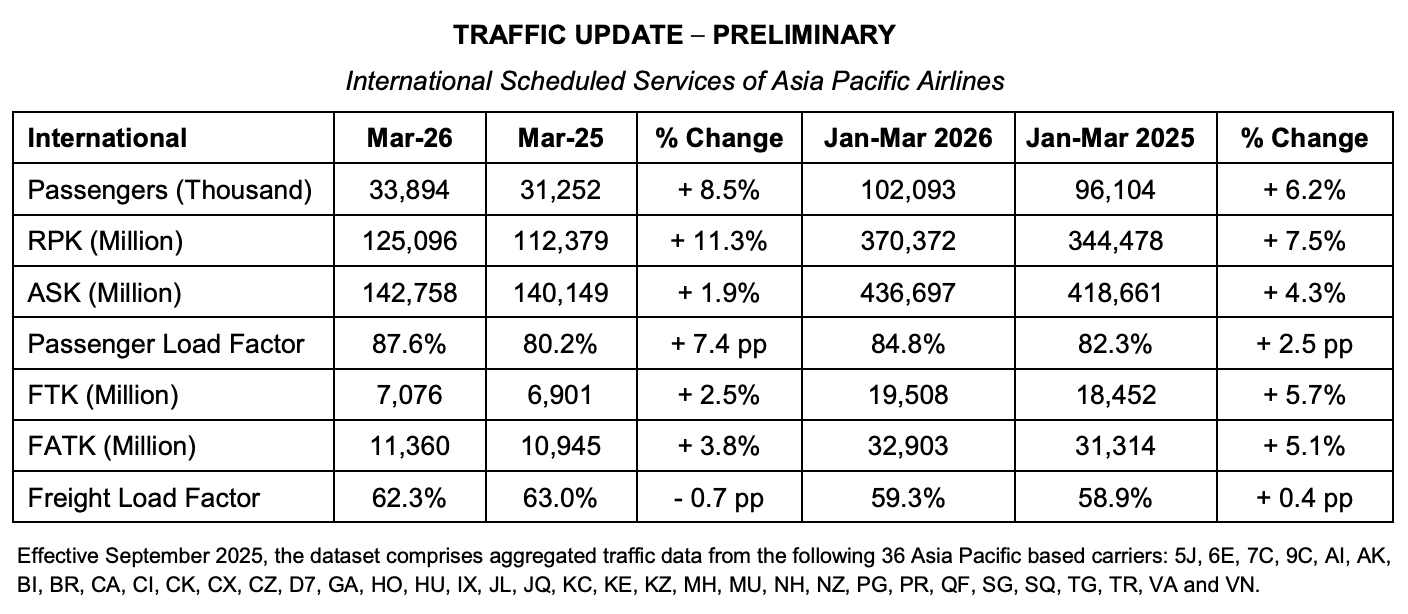
For the month, a combined total of 33.9 million passengers flew on the region’s carriers, representing an 8.5% year-on-year increase. Demand, as measured in revenue passenger kilometres (RPK), rose by a solid 11.3%, reflecting strength on longer-haul routes. This increase in demand significantly outpaced the 1.9% year-on-year expansion in available seat capacity. As a result, the average international passenger load factor rose markedly, by 7.4 percentage points to a record high of 87.6% in March.
Supply chains were also disrupted by the war, leading to flight cancellations and the rerouting of Asia-Europe cargo flows away from key Middle East hubs. Against this backdrop, international air cargo demand, as measured in freight tonne kilometres (FTK), rose by 2.5% year-on-year in March, supported by an increased demand for timely shipments. Offered freight capacity rose by 3.8%, resulting in a 0.7 percentage point decline in the average international freight load factor to 62.3%.
Commenting on the results, AAPA Director General Wong Hong said: “The aviation industry faced multiple challenges in March, as military conflict in the Middle East led to flight cancellations and a sharp increase in jet fuel prices. Asia-Pacific airlines responded swiftly by making network adjustments, including adding flights on key Asia-Europe routes and trimming unprofitable routes amid higher fuel and operating costs. This supported both passenger and cargo demand during the month, bringing first-quarter growth to 6.2%, with 102 million international passengers carried, and a 5.7% increase in air cargo demand.”
Wong Hong added: “However, the impact of the Middle East conflict has begun to weigh on what had been an encouraging start to the year. Already grappling with high operating costs due to persistent supply chain issues, airlines are now facing additional strain, with jet fuel prices up by 80% year-on-year to an average of USD156 per barrel in March, compared to US$87 per barrel a year earlier. Fuel remains the single largest cost item for Asia Pacific carriers, accounting for around 30% of total operating expenses.”
Looking ahead, he concluded: “The duration of the Middle East conflict is going to add uncertainty to the global economic outlook and air travel demand. Against this backdrop, Asia-Pacific airlines continue to exercise vigilance over cost controls while maintaining international connectivity. The region’s airlines remain committed to the highest safety standards, and to working closely with governments and industry stakeholders to ensure safe, efficient and sustainable operations.”
(Source: AAPA)