


SINGAPORE 2 February 2026: The International Air Transport Association (IATA) released the 2025 full-year and December 2025 passenger market performance, showing record-high demand.
Total full-year demand in 2025 (measured in revenue passenger kilometres or RPKs) rose 5.3% compared to 2024. Total capacity, measured in available seat kilometres (ASK), was up 5.2% in 2025. The overall passenger load factor (PLF) reached 83.6%, up 0.1 ppt and a record for full-year traffic.
International full-year demand in 2025 increased 7.1% compared to 2024, and capacity rose 6.8%. The full-year international load factor was 83.5%, up 0.2 ppt from 2024. This was also a record high for international PLF.
Domestic full-year demand for 2025 rose 2.4% compared to the prior year, while capacity expanded by 2.5%. The full-year load factor averaged 83.7%, down 0.1 ppt from 2024.
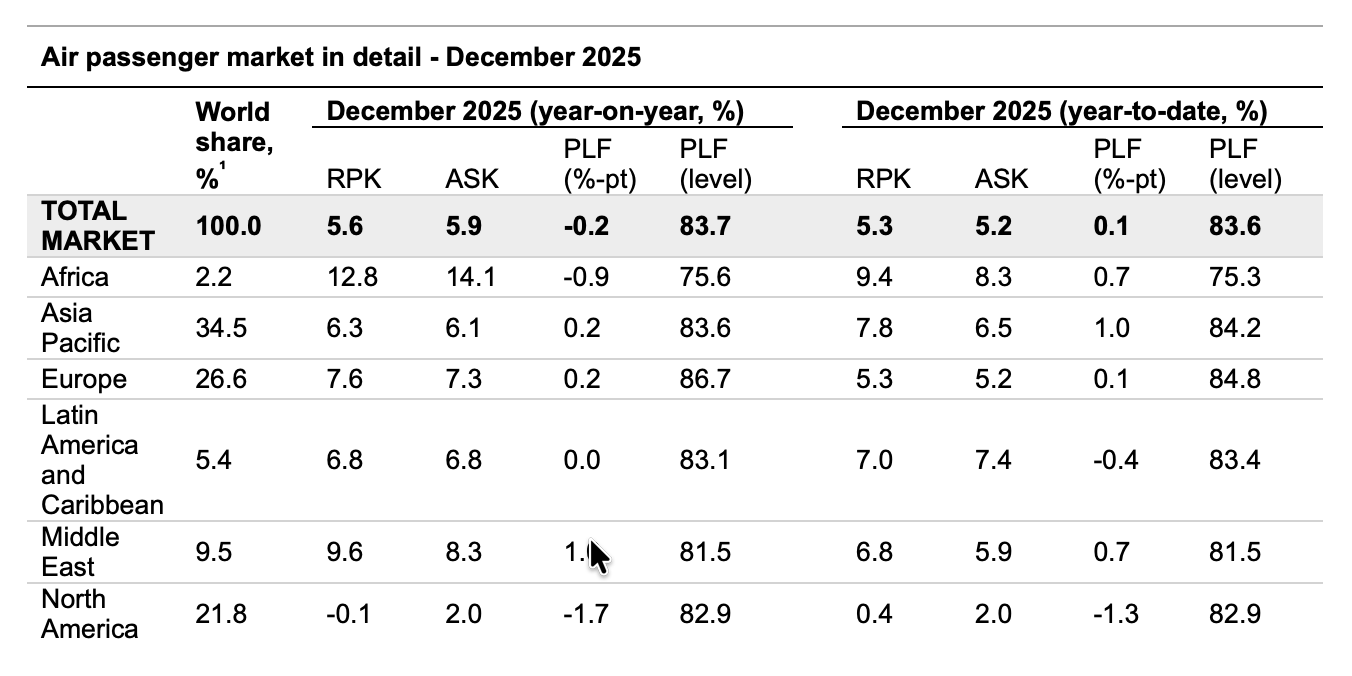
December 2025 was a strong finish to the year, with overall demand rising 5.6% year-on-year, capacity up 5.9%, and a load factor of 83.7%.
“2025 saw demand for air travel grow by 5.3%, with international demand growing by 7.1% and domestic by 2.4%. This returns industry growth to align with historical growth patterns after the robust post-COVID rebound. The substantial and sustained increase in demand puts two key challenges into sharp focus: decarbonisation and supply chain management.
The first, decarbonisation, will protect future long-term growth. Governments whose economies grow because of aviation and whose citizens thirst for connectivity need to provide a supportive fiscal policy framework to rapidly accelerate progress, particularly in the energy sector, to expand Sustainable Aviation Fuel (SAF) production.
The second, supply chain challenges, was the biggest headache for airlines in 2025. People clearly wanted to travel more, but airlines were continually frustrated by unreliable delivery schedules for new aircraft and engines, maintenance capacity constraints, and resulting cost increases estimated at more than USD11 billion. Airlines scrambled to accommodate the demand by keeping aircraft in service longer and filling more seats on every flight. With load factors just shy of 84%, it’s clear that these measures were an effective band-aid, but we need a real solution. It’s vital that 2025 proves to be the nadir of the supply chain crisis, and 2026 marks a rebound. Every new aircraft means a quieter, cleaner fleet, with more capacity and flight options than at any previous point in history, which is what airlines and their customers want to see,” said IATA’s Director General Willie Walsh.
Regional Breakdown – International Passenger Markets
Full-year international traffic rose by 7.1% compared to 2024, while capacity rose 6.8%. For December, global demand grew by 7.7%, capacity increased 7.9%, and the load factor declined by 0.1 ppt (compared to December 2024) to 83.9%.
Asia-Pacific airlines posted a 10.9% rise in full-year international 2025 traffic compared to 2024. Capacity rose 10.2%, and the load factor rose 0.5 ppt to 84.4%. The region finished 2025 with the fastest growth rate and highest load factor of any region. December 2025 traffic rose 7.5% compared to December 2024.
European carriers’ full-year traffic climbed 6.0% versus 2024. Capacity increased 5.9%, and load factor rose 0.1 ppt to 84.1%. For December, demand climbed 8.4% compared to the same month in 2024.
Middle Eastern carriers saw a 6.7% increase in traffic in 2025 compared to 2024. Capacity increased 5.8%, and load factor climbed 0.7 ppt to 81.6%. December demand rose 9.5% compared to the same month in 2024.
North American airlines reported a 2.1% year-over-year increase in traffic in 2025 compared to 2024. Capacity increased 2.4%, and load factor fell -0.2 ppt to 83.9%. Both traffic and capacity growth were the slowest in 2025 among all regions. December 2025 traffic rose 3.5% compared to the year-ago period.
Latin American airlines posted an 8.6% year-over-year increase in traffic in 2025 compared with full-year 2024. Annual capacity climbed 10.2% and load factor declined -1.2 ppt to 83.6% (the sharpest load factor fall of any region). December demand rose 8.2% compared to December 2024.
African airlines’ annual traffic rose 7.8% in 2025 versus the prior year. Full year 2025 capacity was up 6.5%, and load factor climbed 0.9 ppt to 74.9%. This was the lowest load factor among regions, but it was a record high for Africa and the most significant increase in load factor of any region. December 2025 traffic for African airlines rose 10.3% over December 2024.
IATA report 2025 and December.
(Source: IATA)