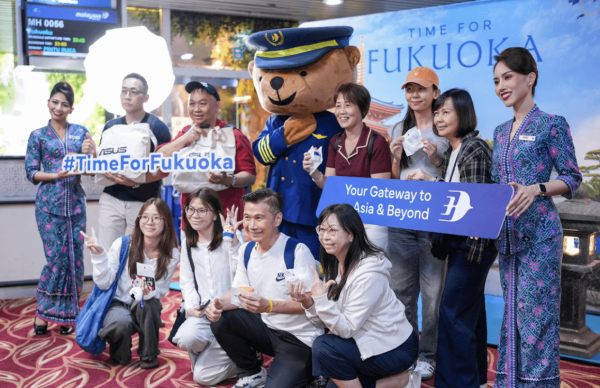
KUALA LUMPUR, 7 September 2026: Malaysia Airlines returns to Fukuoka, after a 20-year absence, serving the route five times weekly since the inaugural flight on 2 September.
The resumption of direct flights from Kuala Lumpur to Fukuoka strengthens the airline’s Japan network, offering the only direct connection between Kuala Lumpur and Fukuoka and opening two-way tourism between Malaysia and Japan’s Kyushu region.
MH stopped flying the route in August 2006.
Flight schedule
MH56 departs Kuala Lumpur (KUL) at 2345 and arrives in Fukuoka (FUK) at 0705 plus a day. Departs from KUL: Monday, Wednesday, Friday, Saturday and Sunday. MH57 departs Fukuoka (FUK) at 1000 and arrives in Kuala Lumpur (KUL) at 1545. Departs from FUK: Monday, Tuesday, Thursday, Saturday and Sunday.
The airline deploys a 174-seat Boeing 737-8 on the route. Flight time is six hours and 45 minutes.
According to advance timetables for the winter season, from December 2026 to 31 March 2027, flights will increase to daily.
The service complements Malaysia Airlines’ existing services to Tokyo (via Narita) and Osaka, bringing the airline’s total weekly frequency to Japan to 26 flights. Together, these services strengthen connectivity between Malaysia and Japan, while marking an important milestone for the Malaysia Airlines-Japan Airlines Joint Business partnership.
Through the codeshare arrangement, customers travelling via Fukuoka can connect to Japan Airlines flights to Amami, Sapporo, Izumo, Kochi, Miyazaki, Kagoshima, Yakushima, Matsuyama and Tokushima.
Japan Airlines also places its code on Malaysia Airlines-operated services between Kuala Lumpur and Fukuoka, offering a seamless booking experience and a broader range of travel options between Malaysia and Japan.
For travellers from Japan, the route offers convenient onward connections via Kuala Lumpur to destinations across domestic Malaysia, ASEAN, South Asia and Australasia, while supporting inbound tourism in conjunction with Visit Malaysia 2026.
To celebrate the return to Fukuoka, travellers can save up to 30% under the MATTA Fair promotion for bookings made by 14 September 2026. Enrich members can enjoy an additional 5% off, while payments made with a VISA card through the Malaysia Airlines official website or mobile app qualify for a further 5% discount. For more information and to book your flights, visit www.malaysiaairlines.com.
MUMBAI, 7 September 2026: The fourth in-person edition of ITB India concluded on 3 September after bringing the international travel industry together for three days of business, networking and knowledge exchange at the Jio World Convention Centre, Mumbai.
From 1 to 3 September, professionals across the Leisure, MICE, Corporate Travel and Travel Technology sectors came together to connect with regional and international partners, gain new market perspectives and explore avenues for future growth.
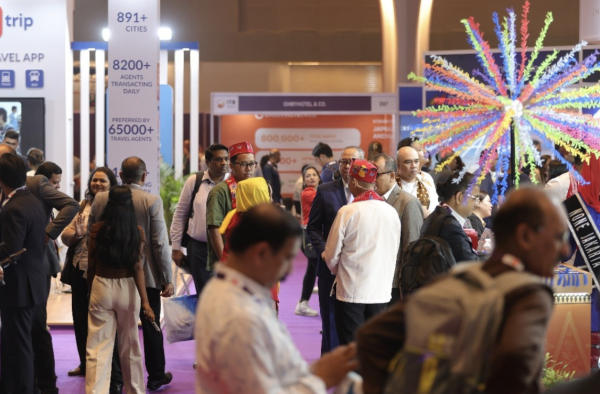
Photo credit: ITB India 2026. Trade show visitors walking the show floor.
More than 3,000 industry professionals attended this year’s edition, including over 400 qualified buyers, with more than 100 exhibiting brands represented at ITB India 2026.
“India and South Asia continue to offer significant opportunities for the global travel industry, and the international participation at ITB India this year reflects the strong interest we continue to see in these markets,” said Messe Berlin Asia Pacific Executive Director, Darren Seah. “By connecting global suppliers with qualified buyers and combining commercial exchange with industry insights, networking and senior-level dialogue, ITB India offers a valuable B2B marketplace where new relationships and ideas can develop into long-term business.”
Exhibiting brands from Southeast Asia, South Asia, Europe, Africa, Northeast Asia and South America participated in this year’s edition. Among this year’s exhibitors were Columbia Pictures Aquaverse, DoubleTree by Hilton Jakarta Kemayoran, Halong International Cruise, Hotel Indonesia Kempinski Jakarta, IHCL, MakeMyTrip, Northern Lights Villages, oneworld alliance, Philippine Airlines, Sarawak Tourism Board, Seibu Prince Hotels & Resorts, Tokyu Hotels Japan and Visit Maldives Corporation.
ITB India 2026 was backed by a network of travel trade and industry associations, strengthening its engagement with travel agents, tour operators, MICE professionals and tourism communities across India. Participating associations include the Adventure Tour Operators Association of India (ATOAI), Association of Domestic Tour Operators of India (ADTOI), Enterprising Travel Agents Association (ETAA), Global Travel Agent Association (GTAA), Network of Indian MICE Agents (NIMA), Outbound Tour Operators Association of India (OTOAI), Skal International India, Tourism India Alliance (TIA), Travel Agencies Association Pune (TAAP), Travel Agents Association of India (TAAI), Travel Agents Association of Nashik (TAAN), Travel Agents Federation of India (TAFI) and Travel Trade Association of Uttar Pradesh (TTAUP).
Dates for the diary
ITB Asia will be held in Singapore from 21 to 23 October 2026, covering the APAC market. The inaugural ITB Americas will be held in Guadalajara, Mexico, from 10 to 12 November 2026, covering the American market. ITB Berlin, the world’s leading B2B trade show for the travel industry, will take place in Berlin from 16 March to 18 March 2027. ITB China, the premier marketplace for China’s travel industry, is scheduled for 25 to 27 May 2027 in Shanghai.
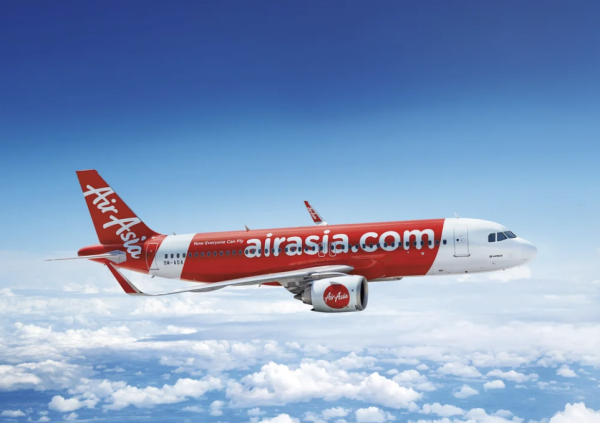
SEPANG, Malaysia, 7 September 2026: The ongoing eruption of Mount Anak Krakatau in the Sunda Strait, Indonesia, has produced extensive volcanic ash clouds that are disrupting airline services in the region, AirAsia reports in a travel advisory.
In response to the volcanic ash that “poses a significant threat to the safe operation of aircraft in the vicinity of volcanic clouds the airline confirms some AirAsia flights to and from Jakarta have been cancelled or rescheduled.
“The volcanic ash situation has also required operational adjustments to selected AirAsia services whose flight paths may be affected.
“AirAsia has notified all affected guests on their flight status and recovery options to ensure they can resume their journeys safely on the next available flight.”
The airline points out that the weather event remains fluid, and AirAsia guests travelling to and from the affected destinations are strongly encouraged to check their latest flight status at airasia.com/flightstatus.
AirAsia is continuing to monitor Mount Anak Krakatau’s volcanic activity and will update its travel advisory with the resumption of normal operations.
SINGAPORE, 7 September 2026: Trafalgar has announced a major expansion of its brand, bringing the 2027 portfolios of Trafalgar, Insight Vacations and Costsaver together under one trusted name to offer greater breadth across travel styles and price points.
Building on nearly 80 years of expertise in guided travel, the new Trafalgar portfolio, available on the Travel Agent Portal (TAP) in Q4 2026, will encompass five travel categories — Tours, Small Groups, River Cruises, Rail Journeys and Group Sales – and three value tiers: Saver, Classic and Premium.
Photo credit: Trafalgar.
“Travel agents have always been central to our growth, and they’ll be central to where we go next,” said TTC Tour Brands Managing Director, Asia, Mae Cheah.
“Expanding what Trafalgar offers means more opportunities for agents to meet the needs of the clients they already have, reach new ones and keep them travelling with us as their needs evolve. As we prepare for our biggest-ever investment in the Trafalgar brand in 2027, we want to bring our advisor partners along with us, giving them the time, tools and support to be ready for the demand we’re working to create and the opportunities that come with it.”
Together, the Trafalgar portfolio will represent more than 600 itineraries across 75 countries, backed by more than 150,000 five-star reviews. With a growing river cruise portfolio, a broader range of small group tours, rail journeys and classic tour categories, Trafalgar is gearing up for 2027 with more itineraries and experiences for agents and their clients.
To help agents prepare, a Your New Era with Trafalgar hub is now live on TAP, giving agents a central place to learn more about the expanded portfolio and access training.
Agents will see additional features integrated into TAP that will make it easier to navigate the five travel categories and three value tiers, plus new experiences that will go live and be bookable on TAP in Q4 2026. Travel agents can learn more at agents.ttc.com.
SINGAPORE, 7 September 2026: Carnival Cruise Line has launched Carnival Rewards, the first-of-its-kind loyalty programme in the cruise industry.
The new programme introduces Carnival Rewards Points, which guests can earn and redeem for Carnival cruises and eligible onboard experiences, plus Status Qualifying Stars, which unlock status and additional benefits.
The Milestone Recognition Programme further celebrates guests as they reach key sailing achievements based on the number of days sailed.
Carnival Rewards Mastercard cardholders also have the opportunity to accelerate their status and earn even more Points through everyday spending beyond their Carnival vacation.
Guests earn three points for every USD spent on eligible Carnival purchases, including gratuities.
Points can be redeemed toward future Carnival cruises and eligible onboard experiences, including shore excursions, speciality dining and spa treatments.
Points are earned at the end of the sailing (posted approximately 14 days after the sailing end date). Points can be redeemed as soon as they become available, creating more immediate opportunities to enjoy rewards.
Status within Carnival Rewards is determined through Status Qualifying Stars, which recognise guest activity throughout their Carnival vacation.
Guests can earn three stars for every USD spent on eligible Carnival purchases, including gratuities. There are also four status levels: Red (upon enrollment), Gold (upon earning 10,000 stars), Platinum (upon earning 50,000 stars), and Diamond (upon earning 100,000 stars).
Status is earned during a two-year Status Qualifying Window and enjoyed during the remainder of that period and the following two-year status enjoyment window. The inaugural qualifying period runs from 1 September 2026 through 31 December 2028, giving guests an extended opportunity to earn Status Qualifying Stars for the first qualifying window.
KUALA LUMPUR, 7 September 2026: The 59th National MATTA Fair hosted at the Malaysia International Trade and Exhibition Centre (MITEC), Kuala Lumpur, welcomed a record turnout of travel consumers over the show’s three days, 4 to 6 September.
The show unfolded at a defining moment for Malaysia’s national tourism agenda. Malaysia welcomed 42.2 million international visitors in 2020, an 11.2% increase compared with the previous year. This positive momentum has continued into 2026, with 21.2 million international arrivals recorded in the first half of the year alone.
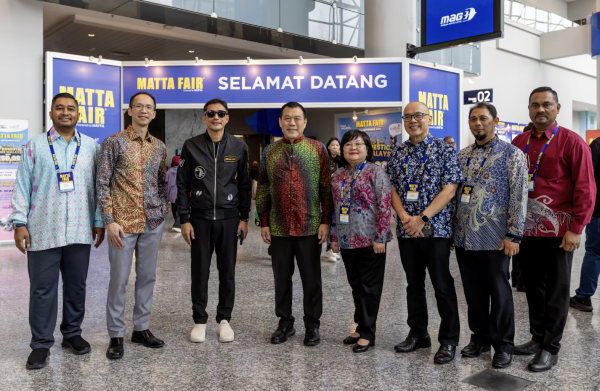
Photo credit: MATTA Fair. From Left: Mohd Hizzat, MATTA Deputy President; Nigel Wong, MATTA President; Dato Adi Putra (Mohamed Hadi Putera Halim), actor; Yang Berhormat Tuan Loh Sze Yee, Perak State Committee Chairman, Tourism, Industry, Investment and Corridor Development; Wendy Shin, MATTA Perak Chapter Chair; Rocky Kho, MATTA Honorary Treasurer; Shazli Affuat Ghazal, MATTA VP Education & Training; Subramaniam Punusamy, MATTA Honorary Secretary General.
Under Visit Malaysia 2026, the country is targeting 47 million international tourist arrivals and MYR147.1 billion in tourism receipts by year-end, and this edition of the National MATTA Fair aims to contribute directly to that push.
The 59th edition of the MATTA Fair extended over 10 exhibition halls at MITEC, bringing together the country’s largest gathering of licensed travel agencies, tourism boards, hotels and airlines, alongside 12 state tourism organisations (STOs) from across Malaysia, and 16 national tourism organisations (NTOs) worldwide, with Taiwan taking centre stage as this edition’s International Favourite Destination.
Adding to the momentum, Malaysia Aviation Group (MAG) returned as Official Airline Partner and Premier Sponsor, anchoring the fair and showcasing its growing portfolio of travel and lifestyle offerings.
Meanwhile, RHB Bank, the fair’s Official Bank Partner, delivered an expanded suite of travel rewards and financing options for visitors looking to fund their next holiday.
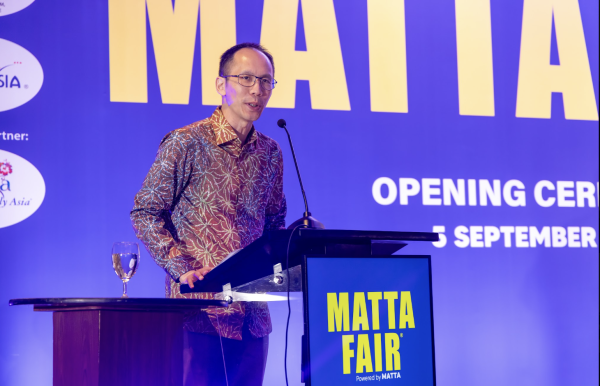
“The positive tourism performance we are seeing this year is encouraging and presents opportunities for the entire tourism industry. We are actively seeking to build on this progress by making travel more accessible and trustworthy. As a Strategic Partner to Visit Malaysia 2026, MATTA will continue working closely with the government and our industry partners to support the national tourism agenda and promote Malaysia as a preferred destination for travellers,” said MATTA President Nigel Wong.
Photo credit: MATTA Fair: MATTA President Nigel Wong.
PHUKET, 7 September 2026: Hotels are expanding wellness beyond spas and dedicated retreats as younger travellers seek health, fitness, food and social experiences that can be integrated into a luxury stay, according to executives from leading wellness and hospitality brands.
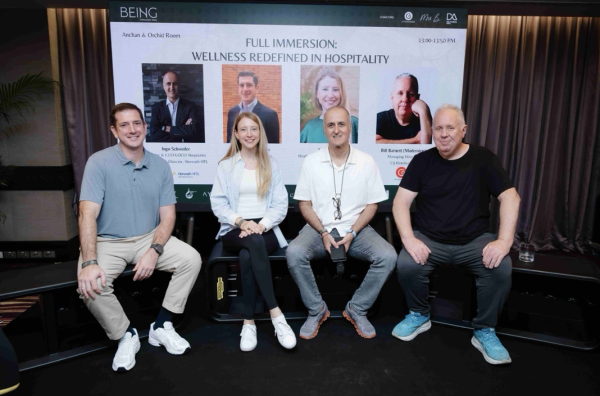
“It’s not about following the trends where there’s always a beginning and an end,” said Ingo Schweder, founder and chief executive officer of GOCO Hospitality and managing director of Horwath HTL Health & Wellness, at BEING Thailand 2026 in Phuket. “The term trend means it is coming and it is going.
BEING’s organisers: (from left) David Johnson, CEO, Delivering Asia; Sumi Soorian, Founder, Mrs B Group; Viona Zhang, Viona Healing Flow; and Bill Barnett, Managing Director, C9 Hotelworks; (right) Wellness dog.
That means you should never do something in a real estate development which is a short-term trend.”
Schweder said emerging concepts including ice baths and sound healing can nevertheless help expand the sector by introducing consumers to wellness experiences and creating future demand for more established operators.
The comments reflect a shift from immersive wellness, where guests stay at dedicated resorts to pursue specific health goals, toward hybrid models that make wellness part of a broader hotel experience.
At Six Senses, guests can choose how deeply they engage, from structured programmes to healthier food, sustainable practices, fitness and social activities integrated into a conventional stay, said Jael Fischer, the group’s head of development for Asia Pacific.
A younger customer base is accelerating the change. Schweder said millennials account for 41% of global wellness spending, with younger consumers increasingly willing to spend on experiences that support health and wellbeing.
That demand is reshaping hotel development. Wellness facilities that once occupied hundreds of square metres are increasingly reaching several thousand square metres in high-end hotels and resorts, Schweder said, as operators devote more space to fitness, recovery and social wellness.
Food is becoming a core part of the wellness proposition. Operators are moving away from restrictive menus toward healthier versions of familiar dishes, while fermented foods and adaptogens are gaining prominence. Six Senses combines everyday dining with menus tailored to programmes including detoxification, fitness and weight management.
Wellness is also becoming more social. Community tables, shared saunas and group activities are challenging the idea that wellness must be a solitary pursuit. At Kamalaya, Chief Financial Officer Matthew Brennan said the resort’s community table is popular with guests travelling alone.
Fitness is emerging as another important entry point, with running, swimming and outdoor activities allowing hotels to connect health and movement with the destination.
The shift is also moving into cities. Six Senses has developed urban wellness concepts combining fitness, spa, food and social spaces, while Schweder said luxury city hotels are allocating significantly more space to wellness. The goal is to make wellbeing part of daily life rather than an annual retreat.
For Thailand, the opportunity comes with a warning: the country must evolve without losing its identity.
Thailand helped establish Asia’s international spa industry and combines hospitality expertise, medical infrastructure and traditional health practices. The panel argued that Traditional Thai Medicine should play a larger role in the country’s next generation of wellness offerings.
“Thailand has to protect its uniqueness and its heritage and its traditional medicine,” Brennan said.
Fischer added that Thailand’s ability to combine Eastern and Western approaches, alongside its strong hospitality culture, gives the country an advantage as global wellness becomes more sophisticated.
The executives also warned against “well-washing” — adding wellness branding or fashionable equipment without integrating wellbeing throughout the guest journey.
The emerging competitive battleground is therefore not the latest wellness gadget, but how effectively hotels integrate health, fitness, nutrition, sustainability and human connection into the overall stay.
Full Immersion: Wellness Redefined in Hospitality (from left) Matthew Brennan, Chief Financial Officer, Kamalaya Wellness Sanctuary & Holistic Spa; Jael Fischer, Head of Development – Asia Pacific, Six Senses Hotels Resort Spas; Ingo Schweder, Founder & CEO, GOCO; Bill Barnett (Moderator), MD, C9 Hotelworks.
Event overview and organisers C9 Hotelworks, QUO, and Mrs B Group organised Being Thailand 2026, with support from Delivering Asia, Phuket Hotels Association, SAii Laguna Phuket, Meliá Hotels International, Layan Life by Anantara, Gardens of Eden, Laguna Phuket, the Bangkok Hospital Network in Phuket, and Lemongrass House.
KUCHING, Sarawak, 4 September 2026: Sarawak has won the bid to host the 38th International Conference on Microelectronics (ICM) 2026, bringing the prestigious international conference back to Malaysia after more than thirty years.
Taking place from 7 to 10 December 2026 in Kuching, at the Borneo Cultures Museum as a principal conference venue, ICM 2026 is expected to welcome more than 300 delegates, connecting researchers, engineers, academics and industry professionals from the international microelectronics community to exchange expertise and explore developments shaping the future of the sector.
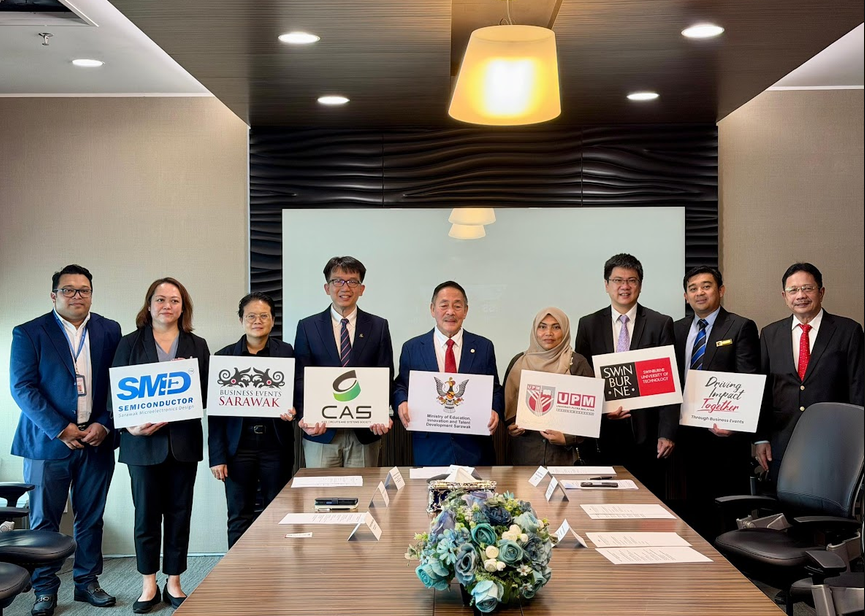
The Hon. Dato Sri Roland Sagah Wee Inn (centre) together with ICM 2026 organising committee and event collaborators.
Hosting ICM 2026 directly supports Sarawak’s development priorities under the Post COVID-19 Development Strategy (PCDS) 2030, particularly in innovation, digital transformation, human capital and advanced manufacturing. As Sarawak develops its semiconductor ecosystem, the conference will connect global expertise with local talent, research and industry, while advancing artificial intelligence (AI) as an accelerator for microelectronics development.
The conference will feature a broad technical programme comprising regular papers, special sessions, cross-society special sessions, an embedded workshop, live demonstrations, tutorials and a technical industry visit, creating multiple platforms for researchers and industry practitioners to exchange knowledge and explore emerging developments in circuits, systems and microelectronics.
Additional activities being developed alongside the main conference include a Sino-Malaysia workshop, CASS Standards workshop, and CAS Industry Forum, further extending ICM 2026 beyond the conventional academic conference format and creating opportunities for industry engagement, standards discussions and international collaboration.
“ICM 2026 is an important step towards the Sarawak Government’s ambition of building a high-income economy driven by innovation and technology,” said The Honourable Dato Sri Roland Sagah Wee Inn, Minister of Education, Innovation and Talent Development Sarawak. “For Sarawak to compete in the industries of the future, we must create opportunities for our people to learn from the best, participate in global networks and turn knowledge into real opportunities. ICM brings that global community directly to us, creating opportunities for our talent and industry to learn, collaborate and turn knowledge into new possibilities for Sarawak.”
“Winning ICM 2026 demonstrates the strategic value of attracting specialised international conferences that align with local development priorities,” said Jason Tan Chin Foo, Chief Executive Officer of Business Events Sarawak (BESarawak). “The conference is expected to generate RM2.5 million in total estimated economic impact, but its greater value is what it can leave in the long term. ICM can be a powerful catalyst to strengthen Sarawak’s growing electronics sector through new knowledge, connections and opportunities that continue well beyond the conference. BESarawak is proud to support legacy-driven events such as ICM 2026.”
“The next big step for AI is not only about smarter software, but also building better and more efficient technology to power it,” said Ts. Ir. Dr Fakhrul Zaman Rokhani, IEEE CASS Vice President for Education and Communications and General Chair for ICM2026. “ICM 2026 will explore how we can make AI faster, more energy-efficient and more sustainable through advances in microelectronics and hardware. Bringing these global conversations to Malaysia via Sarawak gives professionals and young talent in the region greater access to the ideas and technologies shaping our future.”
Organised by the Institute of Electrical and Electronics Engineers Circuits and Systems Society (IEEE CASS), with the IEEE CASS Malaysia Chapter as a co-financial sponsor and active contributor to the organising committee, ICM 2026 is supported by the Ministry of Education, Innovation and Talent Development (MEITD), Business Events Sarawak (BESarawak), Malaysia Convention & Exhibition Bureau (MyCEB), Universiti Putra Malaysia (UPM), Sarawak Microelectronics Design (SMD) Semiconductor Sdn Bhd, and Swinburne University of Technology Sarawak. The Academy of Sciences Malaysia is also participating as ICM 2026’s Science & Technology Partner.
ICM 2026 is supported by the wider IEEE Circuits and Systems community, with technical co-sponsorship from the IEEE Circuits and Systems Society and 13 IEEE CASS chapters worldwide. The conference has also received IEEE Xplore publication approval. At the same time, selected papers will be invited for extended submission to IEEE Transactions on VLSI Systems, Neuroelectronics, and the Journal of Integrated Circuits and Systems, subject to each journal’s review process.
Researchers, scientists, academics, entrepreneurs, engineers, policymakers, and industry professionals working across circuits, systems, and related technologies are invited to be part of ICM 2026 in Sarawak and contribute to the conversations, collaborations, and innovations shaping the future of microelectronics. For registration, call for papers and sponsorship opportunities, visit www.ieee-icm.org.
BANGKOK, 4 September 2026: The Pacific Asia Travel Association (PATA) and the Global Business Travel Association (GBTA) have entered into a partnership to strengthen the corporate business travel component of PATA Travel Mart 2027, due to be hosted in Macao, China, from 20-22 September 2027.
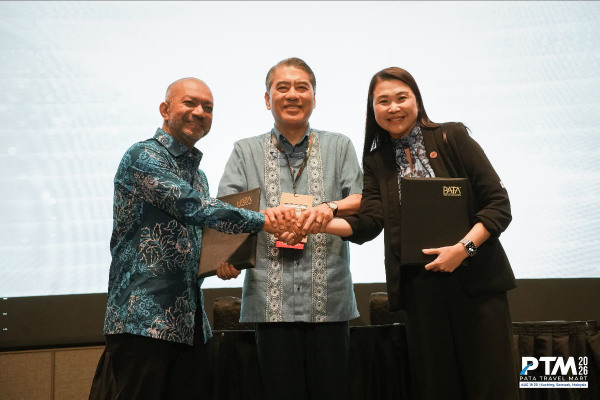
The Memorandum of Understanding (MOU) was signed by PATA CEO Noor Ahmad Hamid and GBTA Senior Director – APAC Elle Ng-Darmawan during the recent PTM Knowledge Forum at PATA Travel Mart 2026 in Kuching, Sarawak, Malaysia.
L/R: PATA CEO Noor Ahmad Hamid, PATA Chairman Henry Oh and GBTA Senior Director for APAC Elle Ng-Darmawan at the MOU signing ceremony during the PTM Knowledge Forum at PATA Travel Mart 2026 in Kuching, Sarawak, Malaysia.
Under the agreement, GBTA will serve as the Corporate Travel Partner for PATA Travel Mart 2027, bringing its global network of corporate buyers, procurement professionals, and travel managers together with PATA’s established Asia-Pacific tourism marketplace.
The partnership will focus on enhancing the business travel and business events components of PATA Travel Mart 2027 through programme development, corporate buyer mobilisation, knowledge exchange, and targeted business-to-business engagement.
As part of the collaboration, GBTA will work with PATA to support the development and delivery of corporate business travel content as part of the PTM Knowledge Forum. GBTA will also leverage its extensive professional network and communication channels to encourage qualified corporate buyers to participate in the event.
PATA will work with GBTA to facilitate the participation of qualified corporate buyers at PATA Travel Mart 2027, in accordance with PATA’s standard hosted buyer qualification and approval procedures.
The partnership will also include joint marketing and promotional activities across the respective communication channels of PATA and GBTA, helping to connect the Asia-Pacific travel industry with a wider international community of corporate travel buyers and decision-makers.
“Corporate travel plays an important role in connecting destinations, businesses and communities across the Asia-Pacific region,” said PATA CEO Noor Ahmad Hamid. “Our partnership with GBTA will bring together complementary networks and expertise, creating new opportunities for meaningful business connections and knowledge exchange. We look forward to working together to strengthen further the corporate travel component of PATA Travel Mart 2027 in Macao.”
GBTA Senior Director, APAC Elle Ng-Darmawan added: “As the world’s largest and fastest-growing region for business travel spending, APAC continues to play a critical role in driving global economic growth, trade and connectivity. GBTA’s recent 2026 Business Travel Index report underscores the scale and dynamism of the APAC market, which in turn makes collaboration across the travel ecosystem more essential than ever.
Our partnership with PATA creates a timely platform to connect travel managers, suppliers, destination leaders and other industry professionals in Macao. By combining our networks and expertise, we can unlock new opportunities, drive greater value for our members and ensure the region’s travel industry will continue to thrive.”
The partnership is designed to support a more business-driven PATA Travel Mart 2027 by giving corporate buyers more opportunities to discover Asia-Pacific destinations, products and services, while enabling suppliers to engage directly with qualified decision-makers from the global business travel community.
PATA Travel Mart 2027 will take place in Macao, China, from 20 to 22 September 2027, bringing together tourism suppliers, buyers, and industry stakeholders from across the Asia-Pacific region and beyond for business exchange, networking, and knowledge sharing.
SINGAPORE, 4 September 2026: Grand Prix Season Singapore (GPSS) will take over the city from 2 to 11 October 2026, bringing the excitement of the race season beyond the circuit with a full slate of race-themed lifestyle experiences in multiple precincts across Singapore.
Complementing the FORMULA 1 (F1) Singapore Airlines Singapore Grand Prix 2026, the 17th edition of GPSS offers both visitors and locals a wide range of limited-time experiences to savour throughout this race season.
Two new headliners join GPSS this year: the adidas Motorsport Popups at Funan and Raffles City Shopping Centre, and Orchard Paddock 2026 at Ngee Ann City Civic Plaza, alongside returning headliner CQ@Clarke Quay’s Ray-Ban presents: Beyond the Track. Alongside the three headliners and their large-scale programming, this year’s programme partners span both new and returning names — with debutants PlayStation’s Gran Turismo World Series Round 3 and Porsche with Raceborn Fest joining familiar favourites such as Zouk, TRIFECTA and LEGO.
Singapore Tourism Board Director, Sports, Lilian Chee said: “Grand Prix™ Season Singapore amplifies the race experience by building anticipation and bringing fans together in the lead-up to one of the most exciting weekends on Singapore’s events calendar. Every year, our programme partners bring fresh ideas and experiences to GPSS, adding to the energy across the city and reinforcing Singapore’s position as a dynamic and vibrant destination. We invite seasoned motorsport fans and first-timers alike to feel the buzz across the city, soak in the atmosphere, and create memories that make our race weekend truly distinctive.”
Orchard Paddock 2026 brings the energy of race weekend to Orchard Road, Singapore’s most iconic thoroughfare. Making its debut at GPSS from 8 to 10 October, the event will transform Ngee Ann City Civic Plaza after dark with late-night dining, live performances from local acts, and open-air movie screenings — giving visitors more ways to experience the excitement of race season into the night.
The live music line-up on 8 October at Orchard Paddock will be headlined by ALYPH, a Singapore-born rapper, songwriter and producer who is one of the region’s most prominent contemporary hip-hop names and is the artist behind viral hit ‘SWIPE’; and YAØ, a Singaporean singer-songwriter and producer celebrated for his genre-blending contemporary pop sound.
Over at the Singapore River, CQ @ Clarke Quay returns this year with Ray-Ban presents: Beyond the Track, as Ray-Ban brings the Scuderia Ferrari Collection to life at the bustling riverside precinct. Visitors can explore limited-edition pieces from the collection, take on thrilling race-themed challenges, including Race Simulators, Pit Stop Challenge, and Reflex Test, and stand a chance to win exclusive merchandise. In addition, fans can also look forward to a special appearance by a Scuderia Ferrari HP Formula 1 driver and continue the night at the popup with live performances from international acts as part of Music Matters Live.
At Marina Bay, PlayStation’s Gran Turismo World Series (GTWS) Round 3 makes history as Singapore becomes its first-ever GTWS championship stop in Southeast Asia, bringing the world’s premier virtual racing championship to the Sands Theatre at Marina Bay Sands on 3 October. With the world’s best GT drivers battling for crucial points in the Manufacturers Cup and Nations Cup, the stakes couldn’t be higher as the penultimate round before the finals in Tokyo, promising an unmissable showdown for sim racing and esports fans alike.
Also making its debut at GPSS this year, Porsche’s Raceborn Fest at Guoco Midtown invites thrill-seekers to experience the marque’s rich motorsport heritage, with iconic classic racing cars on display and the first-time unveiling of the new 911 Challenge race car in Southeast Asia. Visitors can take part in exciting motorsport-themed activities, step into the world of motorsport with professional racing simulators, and discover more about the upcoming Porsche Experience Centre Singapore — set to open next year in Changi.