

BANGKOK, 6 January, 2026: With Thailand’s 2026 business travel and events calendar firmly underway, preparations are already well advanced for the IMF-World Bank Group Annual Meetings, scheduled for 12 to 18 October 2026 at the Queen Sirikit National Convention Centre in Bangkok.
A global gathering that perfectly demonstrates how deeply embedded the meetings industry and the MICE sector are within Thailand’s tourism and economic strategy.
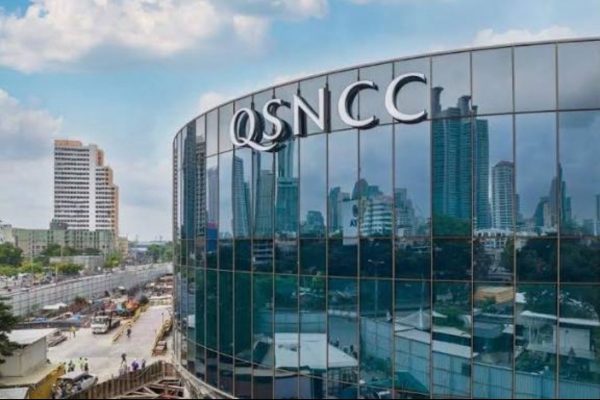
The choice of venue is symbolic. The original Queen Sirikit National Convention Centre was designed and built in just 18 months to host the IMF-World Bank Group Annual Meetings in 1991, marking Thailand’s arrival on the global meetings stage.
I was personally involved in itinerary planning during that landmark year, including arranging the first-ever helicopter transfer from Don Muang Airport to the Shangri-La Hotel. It was also my first year living in Thailand, and the event’s impact on Thailand’s international standing was unmistakable.
Without the helicopter transfer, typical journeys between the airport and the hotel were about four hours. Also, the Armed Forces were generally unhappy about helicopters flying over the capital, which is why they did not complete the approval process until the 12th hour — literally at midnight the day before — historic times. We conducted a test run to ensure everything was in order. I invited well-respected journalist Don Ross of TTRW to accompany me.
More than three decades later, the meetings will return to Bangkok at the new Queen Sirikit National Convention Centre. This second-generation facility is significantly larger, more technologically advanced and purpose-built for today’s complex international events. The evolution from the original venue to the new QSNCC reflects Thailand’s broader journey in MICE, from emerging host to a mature, globally competitive destination.
In my view, the MICE sector is one of Thailand’s most strategically essential pillars of tourism.
MICE visitors consistently:
• Spend more per visit
• Use higher-quality accommodation
• Travel year-round, not only during peak leisure seasons
• Support airlines, transport providers, catering companies and creative and professional services
A single major conference can directly and indirectly support thousands of jobs while reinforcing Thailand’s reputation as a confident and capable international host.
Thailand’s strength also lies in its ability to host:
• Small executive and board-level meetings
• Medium-sized regional and international conferences
• Very large global conventions and exhibitions
Very few destinations in Asia can manage this range effectively within one country.
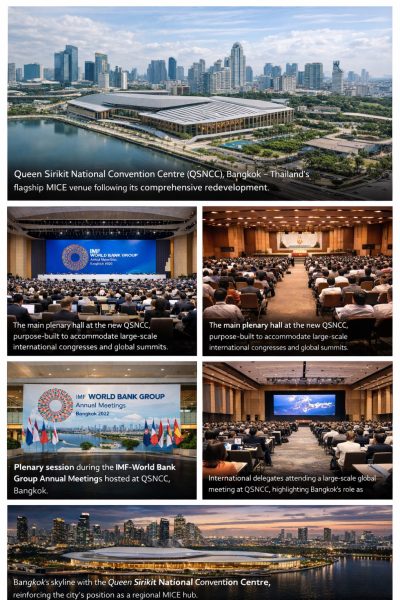
Mega Meetings and National Convention Centres
Photo: Thailand has the scale, infrastructure and organisational depth to host some of Asia’s largest and most complex business events
The return of the IMF-World Bank Group Annual Meetings in 2026 underscores international confidence in Thailand’s venue capabilities, security standards, and operational professionalism.
Key national venues include:
• Queen Sirikit National Convention Centre, Bangkok
• IMPACT Muang Thong Thani, Bangkok
• Bangkok International Trade and Exhibition Centre, Bangkok
• Chiang Mai International Exhibition and Convention Centre, Chiang Mai
These venues form the backbone of Thailand’s ability to compete for high-profile international congresses, exhibitions and multilateral meetings.
Typical large events hosted by Thailand
Thailand regularly hosts:
• International medical and scientific congresses attracting 8,000 to 15,000 delegates
• Major trade exhibitions in sectors such as food, travel, energy, auto and manufacturing, drawing 20,000 to 40,000 visitors over several days
• Regional association congresses with 3,000 to 8,000 delegates
• Government and multilateral meetings ranging from 1,000 to 5,000 participants
At peak capacity, Thailand can host events for 30,000 or more delegates, particularly at large exhibition complexes in Bangkok.
The role of secondary cities
Thailand’s real competitive advantage in MICE extends beyond its largest venues. Secondary cities allow the country to diversify, manage capacity and offer more tailored event experiences.
Bangkok is the primary hub
Bangkok remains the centre of gravity for Thailand’s meetings industry. Its strengths include international air access, a large hotel inventory, experienced professional organisers and strong institutional support. It is best suited to large conventions, exhibitions, and regional association meetings that require scale and connectivity.
Beyond Bangkok
Central and Eastern Thailand, together with the Gulf coast, offer calmer and more focused alternatives within easy reach of the capital. Destinations such as Pattaya—home to PEACH, a purpose-built convention hall capable of hosting more than 12,000 delegates—and Hua Hin provide resort-style environments that combine privacy, space and discretion. These locations are particularly well-suited to leadership meetings, board retreats and high-value incentive programmes.
Chiang Mai and the North
Chiang Mai brings cultural depth, a relaxed pace and a strong sense of place. It performs exceptionally well for academic, creative and sustainability-focused events, as well as small- to medium-sized conferences. The Chiang Mai International Exhibition and Convention Centre (CMECC) can accommodate up to 10,000 delegates, reinforcing the city’s position as the North’s leading meetings and events destination.
Phuket and Southern Thailand
Phuket plays a complementary role to Bangkok. Its strengths include resort-based meeting environments, appeal for incentive travel, international air access, and the ability to combine business with leisure and wellness.
Bangkok’s Leading MICE Hotels
For organisers seeking a single/multiple-venue solution, leading options include:
1. Bangkok Marriott Marquis Queen’s Park
2. Grand Hyatt Erawan Bangkok, Park Hyatt and Hyatt Regency Sukhumvit
3. Centara Grand at CentralWorld
4. Shangri-La Bangkok
5. The Athenee Hotel, a Luxury Collection Hotel, Bangkok
6. Royal Orchid Sheraton Riverside Hotel Bangkok
7. InterContinental Bangkok
8. Pullman Bangkok King Power
9. Siam Kempinski Hotel Bangkok
10. Millennium Hilton Bangkok
11. Dusit Thani Hotel Bangkok
Outlook
Thailand’s future is not about chasing volume. It is about protecting quality, nurturing repeat business and using its strengths intelligently.
Thailand remains competitive because it offers confidence, warmth and flexibility. It can host one of Asia’s largest conventions one week and a focused executive retreat the next, while still delivering genuine hospitality.
As 2026 unfolds, that balance of scale and soul remains Thailand’s most significant tourism asset.
About the author
Andrew J Wood is a British-born travel writer, former hotelier and tourism consultant who has lived in Thailand since 1991. With more than four decades of experience in international hospitality and tourism, he brings long-standing, on-the-ground insight into destination development, the meetings industry and tourism strategy.
He is a former Director of Skål International and a past President of Skål International Asia, Thailand and Bangkok. Andrew writes extensively on tourism trends, sustainability, aviation, MICE development and destination strategy across the Asia-Pacific region, contributing to travel and hospitality publications worldwide.
His work reflects a sustained commitment to responsible tourism, cross-cultural understanding and the evolving role of travel in a changing global economy.