

BANGKOK, 15 December 2025: I began this rail journey on the Thailand–Burma Death Railway line* in the morning at Bangkok’s Thonburi Railway Station, on the west bank of the Chao Phraya River.
Ceiling fans turned lazily above wooden benches. Vendors poured coffee into plastic cups. The train waited patiently, worn but dependable, its carriages carrying the quiet authority of long service rather than modern polish. This was not a journey for haste. It was a journey for attention.
As a child, I remember encountering WH Auden’s Night Mail, the celebrated 1936 poem written for the GPO Film Unit film of the overnight postal train running north from London to Scotland. What struck me then, and still does now, is how Auden makes language behave like machinery. The poem begins deliberately, then gathers pace, the metre (rhythm) tightening as the train accelerates, the words themselves starting to run, clatter, and surge like wheels on rail.
That memory returned as I climbed aboard the train in Bangkok. Here, too, was a train with a voice. But unlike Auden’s mail train, this one did not build towards speed or efficiency. Its rhythm felt restrained, almost cautious, as though the rails themselves remembered what they had once been asked to bear.
Important travel notice for rail passengers
Despite being Bangkok’s new flagship rail hub, Krung Thep Aphiwat Central Terminal, still widely known as Bang Sue, does not serve trains to Kanchanaburi or the Death Railway.
All public passenger services to Kanchanaburi, the River Kwai Bridge, Hellfire Pass access points, and the line’s terminus at Nam Tok depart exclusively
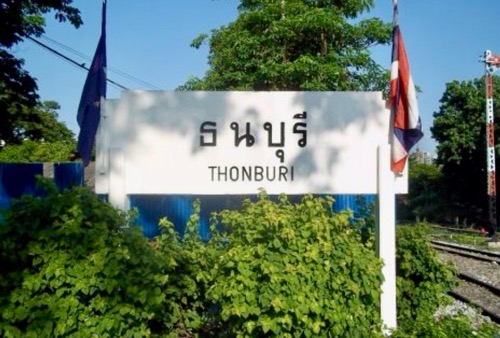
from Thonburi Railway Station, on the west bank of the river. These are local State Railway of Thailand services that remain rooted in the historic western alignment and have not been transferred to the new central terminal.
Travellers arriving in Bangkok at Krung Thep Aphiwat must therefore cross the city to Thonburi Station by taxi, bus, or river boat. There are no direct services, no through tickets, and no seamless interchanges. In many ways, this is appropriate. The journey to the Death Railway does not begin in a cathedral of glass and steel, but in a modest riverside station where the past is never far from view.
The journey westbound
The 0745 SRT ordinary service eased out of Thonburi with a gentle shudder. Tickets are simplicity itself. A flat fare of THB100, bought at the station on the day. No reservations. No seat numbers. Third class only; open windows and fans overhead.
This is railway travel reduced to its bare essentials. As the train threads its way out of Bangkok’s western suburbs, the city slowly releases its grip. Concrete yields to canals and low-lying farmland. Rice paddies appear. Water buffalo stand motionless in the heat. Inside the carriage, life is unremarkable and quietly human. Students heading home. Elderly couples with shopping bags. A monk gazing out of the window. A handful of travellers drawn by history rather than novelty.
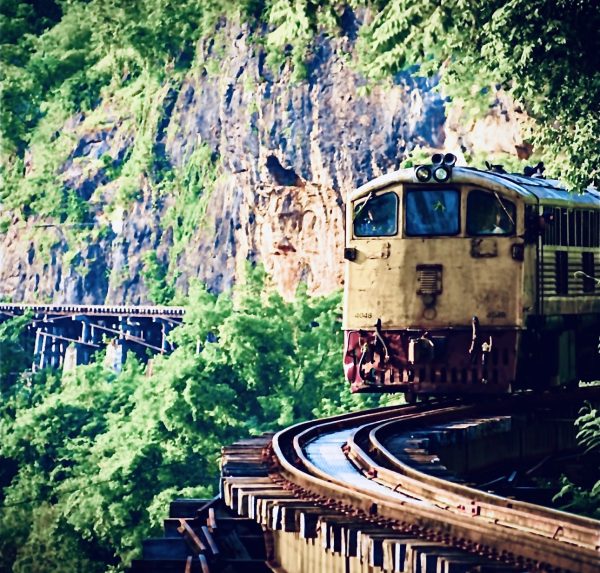
The train pauses at Nong Pla Duk Junction, the official starting point of the Thailand–Burma Railway. From here, the track curves north-west towards Kanchanaburi, following a route that once carried unimaginable weight.
By late morning, we roll into Kanchanaburi Station, a modest provincial stop forever linked to one of the most painful chapters in railway history.
Kanchanaburi and the River Kwai
Kanchanaburi exists in two timelines at once. There is the present, with cafés, guesthouses, and riverside walks. And there is the past, which asserts itself with quiet persistence.
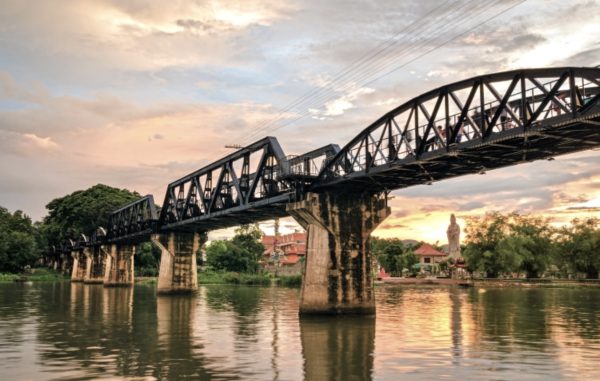
A short walk leads to the bridge on the River Kwai, its steel spans instantly recognisable. Popular culture has softened its image, but the reality is more sobering. This bridge formed part of a supply route built by the Imperial Japanese Army during the Second World War to support campaigns in Burma.
Nearby, the JEATH War Museum provides essential context. Its displays are unvarnished and sometimes confronting. Photographs of emaciated prisoners. Tools worn smooth by forced labour. Reconstructions of bamboo huts where men were housed, starved, and driven to exhaustion. JEATH stands for Japanese, English, Australian, American, Thai, and Dutch, reflecting the nationalities most closely bound to the railway’s history.
Night mail, and what came after
Auden’s Night Mail famously celebrates motion and purpose. In a brief, well-known passage, he writes:
“This is the Night Mail crossing the Border,
Bringing the cheque and the postal order…”
The lines surge forward, their cadence quickening as the train presses north through darkness, stitching a nation together overnight.
Here, on Thailand’s western line, the rhythm felt altogether different.
The train did not hurry. It did not surge. Its cadence remained measured, almost grave. The rails carried memory rather than momentum. And so, as the wheels settled into their steady beat, another rhythm formed in my mind, shaped by this place and its past.
Steel on steel through jungle night,
Stone cut hard by torch and bite.
Wheel on wheel, no time to slow,
Tracks remember what we owe…
Where Night Mail celebrates progress, this railway demands remembrance.
The Death Railway
The Thailand–Burma Railway stretched approximately 415 kilometres between Ban Pong in Thailand and Thanbyuzayat in Burma. Construction took place between 1942 and 1943 under conditions that defy easy description. Jungle terrain, monsoon rains, tropical disease, starvation, and systematic cruelty combined to produce one of the deadliest engineering projects of the 20th century.
More than 60,000 Allied prisoners of war were forced to work on the line. At least 12,000 to 13,000 died from disease, exhaustion, malnutrition, and brutality. The suffering of Asian civilian labourers, often referred to as romusha (Japanese for labourers), was even greater. Conservative estimates suggest 80,000 to over 100,000 deaths, many unrecorded and unnamed.
This was not simply hard labour. It was deliberate dehumanisation.
Hellfire Pass
No section of the railway embodies that brutality more starkly than Hellfire Pass, also known as Konyu Cutting. Here, prisoners were ordered to cut through solid rock using hand tools, often working through the night by torchlight to meet impossible deadlines.
Survivors described skeletal figures silhouetted against flame, hammering stone in a narrow cutting, the air thick with dust and despair. The name Hellfire Pass was not a poetic exaggeration. It was a literal description.
Today, the Hellfire Pass Interpretive Centre preserves the cutting and its history with restraint and dignity. Walking the path is a silent experience. The rock faces loom close. The railway bed remains visible. It is impossible not to imagine the sound of tools striking stone, the enforced rhythm of labour driven by fear rather than purpose.
A railway that still runs
From Kanchanaburi, the line continues past the River Kwai Bridge to Nam Tok, passing wooden trestle bridges and cliffs that fall sharply to the river below. Trains still run daily. School children still ride them. Life continues along the line.
Yet this is not a heritage railway in the nostalgic sense. It is a functional line that carries memory, whether acknowledged or not.
As I rode back towards Bangkok later that afternoon, the train’s pace felt deliberate, almost respectful. There was no accelerating urgency, no rising tempo as in Auden’s poem. Instead, the rhythm remained steady and unyielding, as though each turn of the wheel marked not progress, but responsibility. This is not a journey taken lightly. Nor should it be. But it matters.
Practical Rail Information
Departure station: Thonburi Railway Station, Bangkok.
Morning service: SRT Ordinary Train No. 257 departs at approximately 0745.
Afternoon service: SRT Ordinary Train No 259, departs approximately 1355.
Journey time: Around 2.5 to three hours to Kanchanaburi.
Fare: THB100 (USD3), purchased at the station on the day.
Line continues to: River Kwai Bridge and Nam Tok.
About the author
Andrew J Wood is a British travel writer and former hotelier who has lived in Thailand for more than three decades. A past Director of Skål International and former President of Skål International Asia and Thailand, he writes extensively on travel, tourism, and heritage across the Asia-Pacific region. His work focuses on journeys where place, history, and human experience intersect.
*Editorial note and heritage disclaimer
This article examines a railway line shaped by war, forced labour, and immense human suffering. Built during the Second World War, the Death Railway claimed the lives of thousands of Allied prisoners of war and Asian civilian labourers through brutality, disease, and starvation. The journey is presented in the spirit of remembrance and historical accuracy, not as a romanticised travel experience. Readers are encouraged to approach the railway and its associated sites with respect, recognising them as both a working line and a living memorial.