KUALA LUMPUR, 29 June 2026: MHholidays, the holiday arm of Malaysia Airlines, is bringing back its Kids Fly & Stay Free campaign, offering families incentives to plan their next getaway together.
The campaign makes domestic travel more accessible by allowing children aged 2 to 11 to enjoy complimentary flights and hotel stays on selected MHholidays packages when travelling with two paying adults and one child.
Photo credit: MHholidays.
Families can enjoy savings of up to 45% on selected domestic holiday packages, making it easier to turn holiday plans into reality without compromising on comfort or experience. Whether it’s a city escape in Kuala Lumpur, a food adventure in Penang or a retreat in Langkawi, MHholidays offers curated holiday experiences designed to suit every travel style. Combining Malaysia Airlines flights with carefully selected hotel stays, the one-stop booking platform makes planning a getaway effortless and convenient.
Guests booking eligible Malaysia Airlines flights through MHholidays can also earn Enrich Points, adding value to every getaway. In addition, eligible customers can enjoy MYR50 off attractions booked via the Journify app or website using their MHholidays flight booking reference, unlocking even more ways to explore, discover and create memorable experiences at their destination.
The Kids Fly & Stay Free campaign is available for bookings until 31 December 2026, for travel until 22 June 2027. The offer is valid on selected MHholidays domestic packages for bookings comprising two adults and one child.
BANGKOK, 29 June 2026: Minor Hotels is strengthening its global wellness strategy by appointing Aditya Saluja as Commercial Director – Spa & Wellness for MSpa International.
Saluja brings over 20 years of leadership experience exclusively within the luxury wellness hospitality sector. He joins from The Farm at San Benito, where he led commercial strategy and oversaw the property’s integration into the Marriott Autograph Collection, driving international expansion and accelerating digital growth.
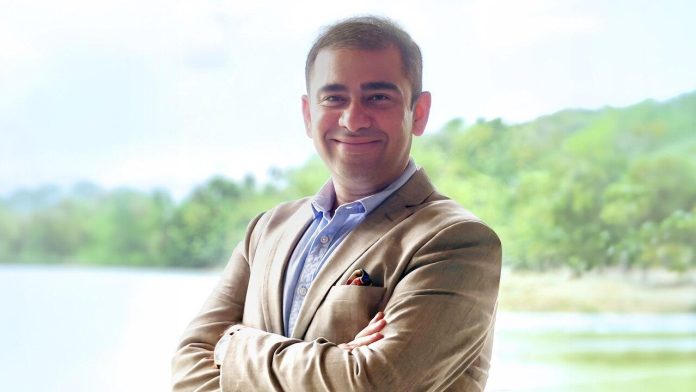
Photo credit: Aditya Saluja, Commercial Director – mSpa and Wellness.
Before this, he played a key role at Six Senses Vana, India, where he architected business expansion across European and Middle Eastern markets. He began his journey at Ananda in the Himalayas, where he built his foundational expertise in Wellness and contributed to significant growth across multiple business segments.
Commenting on his appointment, Saluja said: “There is a clear opportunity to elevate mSpa and wellness through focused commercial strategy, innovation and meaningful guest engagement. I look forward to working closely with the team to drive sustainable growth and deliver experiences that truly resonate.”
In his new role, he will lead the commercial strategy for mSpa and Wellness, focusing on growth, innovation and strengthening the brand’s position as a leader in integrated wellness experiences.
About Minor Hotels Minor Hotels is a global leader in the hospitality industry with more than 640 hotels, resorts and branded residences in operation and committed development across 66 countries. The group crafts innovative and insightful experiences through its hotel brands, including Anantara, Elewana Collection, The Wolseley Hotels, Tivoli, Minor Reserve Collection, NH Collection, nhow, Avani, Colbert Collection, NH, Oaks, and iStay, as well as a diverse portfolio of restaurants and bars, travel experiences, and spa and wellness brands.
HONG KONG, 29 June 2026: Shelley Tai, founder of Mius in Hong Kong, has won the Altos Bartenders’ Bartender Award 2026. Voted exclusively by bartenders from venues ranked on the 2026 list, the accolade is the only peer-judged award in the Asia’s 50 Best Bars programme.
The award forms part of a series of special accolades announced ahead of the live awards ceremony for Asia’s 50 Best Bars 2026, sponsored by Perrier, which will take place at Wynn Palace, Macau, on 28 July.
Photo credit: Asia’s 50 Best Bars. 2026 winner Shelley Tai, founder of Mius Hong Kong.
This prestigious award recognises an individual who has made a significant positive impact on the bar industry, celebrating outstanding hospitality, industry leadership, and contributions to the cocktail community.
For Shelley Tai, the accolade represents the latest milestone in a career that began almost by chance at 20, when she “just needed a job and bartending looked really fun and cool”. Honing her craft at acclaimed venues like FINDS and Quinary, she was named Diageo World Class Competition 2019 HK & Macau Bartender of the Year — a defining achievement that laid the foundation for her subsequent success as Operations Director of Singapore’s Nutmeg & Clove, voted No.24 on Asia’s 50 Best Bars 2025 and No.50 on The World’s 50 Best Bars 2025.
After five years in Singapore, she returned home to Hong Kong to launch her own independent project, Mius, a neighbourhood cocktail bar rooted in her philosophy of “simple things, done well”. The menu showcases reimagined classics, refined house signatures, and one of Hong Kong’s most thoughtfully curated grower champagne selections, underscoring Tai’s commitment to craftsmanship over spectacle. Standouts include a Highball served ice-free to preserve clarity and texture, a bright Garibaldi refined with house techniques, and the Dirty Margarita – a subtle, savoury interpretation featuring tequila, fennel pollen, olive, gentian and lime. Each drink is stripped back to its essential elements, demonstrating her belief that restraint can be as powerful as innovation.
Since opening, Mius has quickly earned recognition within Hong Kong’s bar community for its restrained elegance and hospitality-first ethos. Every detail from service flow to staff training reflects Tai’s belief that genuine care and technical precision must go hand in hand.
Beyond her own bar, Tai is recognised for her advocacy and mentorship within the regional bartending community. Her cross-market experience in Hong Kong and Singapore, combined with her calm, disciplined leadership style, has positioned her as a role model for a new generation of hospitality professionals.
Mius Founder Shelley Tai commented: “I’m truly honoured to receive this recognition, especially among a community of experienced bartenders whose craft I deeply respect. I’m also grateful for the Mius team I get to work with every day. Their support, talent and dedication make this kind of moment possible. I hope I can be a role model in return, and inspire others in our community the way so many of you have inspired me.”
Asia’s 50 Best Bars Director of Content & Creative Emma Sleight noted: “Shelley represents a new wave of hospitality leadership in Asia – grounded in humility, precision and an unwavering commitment to craft. Through Mius and her broader career across Hong Kong and Singapore, she has demonstrated how neighbourhood bars can shape culture just as powerfully as large-scale institutions. It is fitting that her peers have recognised her contribution with this year’s Altos Bartenders’ Bartender Award.”
Asia’s 50 Best Bars 2026, sponsored by Perrier, will culminate in a live awards ceremony revealing the region’s 50 best bars and The Best Bar in Asia 2026. This year’s event programme includes the Bartenders’ Feast, showcasing Macau’s diverse F&B scene and Meet the Bartenders, an exclusive media roundtable session. The countdown to Asia’s 50 Best Bars 2026 will also be broadcast live globally on the 50 Best YouTube channel.
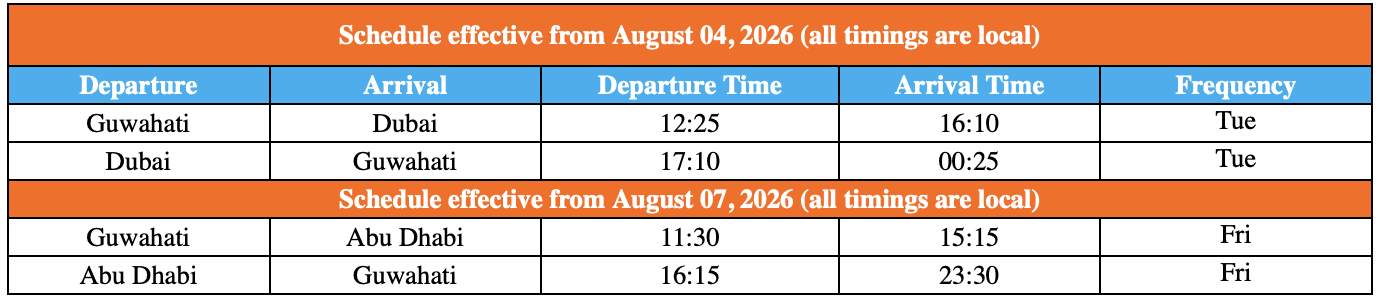
GUWAHATI, India, 29 June 2026: Air India Express has announced the launch of direct flights between Guwahati and Dubai and between Guwahati and Abu Dhabi, becoming the first airline to connect Northeast India with West Asia directly.
The services will commence on 4 August and 7 August, respectively, marking a significant milestone in expanding international travel options and strengthening global connectivity for the region.
Photo credit: Air India Express.
Guwahati, widely regarded as the gateway to Northeast India, is one of the largest stations in the Air India Express network, with around 120 weekly flights. The launch of direct services to Dubai and Abu Dhabi marks the airline’s first international operations from the city, providing convenient access to two of the UAE’s leading economic and travel hubs.
The new routes are expected to support tourism, trade, and cultural exchange, while bringing Northeast India closer to key global markets and opportunities.
Bookings for the new flights are now open on airindiaexpress.com, the Air India Express mobile app, and other major booking channels.
With the addition of Abu Dhabi and Dubai, Air India Express continues to strengthen its presence across Northeast India, where it now operates over 290 weekly flights from four stations: Dibrugarh, Dimapur, Guwahati, and Imphal. Beyond enhancing connectivity and supporting the region’s economic and tourism potential, the airline also celebrates the Northeast’s rich cultural heritage through its ‘Tales of India’ initiative.
Among the distinctive art forms featured on its aircraft tail designs are Assam’s iconic Gamosa and Jaapi motifs, as well as Tsüngkotepsu from Nagaland, Akyobi, Moirang Phee, and Saphee Lanphee from Manipur, Idu Mishmi from Arunachal Pradesh, Khneng from Meghalaya, and Puanchei from Mizoram.
CHIANG MAI, Thailand, 29 June 2026: Tripseed, a Thailand-based destination management company and People and Planet First Verified Social Enterprise, announced over the weekend that it has been awarded the Fair Tax Mark.
Tripseed is the first business operating in a single country outside the UK to secure the accreditation, and the first company in the world to be certified under the Fair Tax Foundation’s newly launched National Business Standard.
Photo credit: Tripseed.
The Fair Tax Mark is an independent accreditation that recognises businesses that pay the right amount of corporation tax, in the right place, at the right time, and are transparent about how they do so.
Until now, the Fair Tax Mark has been available through three standards: a UK small business standard, a UK-based business standard, and a Global Multinational Business Standard.
The National Business Standard, launched this week, is the Foundation’s fourth, and opens the Mark for the first time to businesses anywhere in the world that operate in a single country. Tripseed’s accreditation marks that standard’s launch.
Tripseed pursued the Mark because tax conduct is the most overlooked and most verifiable dimension of economic sustainability in tourism, and one that the sector’s leading sustainability frameworks have so far left largely unaddressed.
Tripseed, Co-founder and Chief Growth Officer, Ewan Cluckie, said: “We’re incredibly proud for Tripseed to be the first business accredited under the Fair Tax Foundation’s new national business standard for single-country businesses worldwide.
“For us, responsible tourism has to be built on honesty, evidence and accountability, not just compelling stories or glossy marketing claims. That means being transparent about how a business is structured and governed, and how it contributes to the places where its operations have an impact.
“Tourism has become very comfortable talking about sustainability, but far less comfortable talking about tax. Yet tax avoidance and opaque corporate structures are among the sector’s most significant forms of economic extraction. If responsible tourism is serious about local benefit, then tax transparency cannot be excluded from the conversation.
“We hope this accreditation helps open a wider industry discussion about how travel can move from good intentions to better evidence, stronger governance, and more accountable business practices.”
Tripseed’s route to the Mark began before a relevant standard existed. The company first published an independent tax disclosure aligned to GRI 207, the global reporting standard for tax transparency, at a point when no applicable accreditation was available to a single-country operator.
When the Fair Tax Foundation made Tripseed aware of its upcoming National Business Standard, Tripseed worked with the Foundation to assess that existing disclosure against the new criteria and to meet them in full.
Fair Tax Foundation Head of Accreditation Jamie Boswell said: “There’s no business I’d rather be launching this new Fair Tax Mark standard with than Tripseed, which has been exceptional at pursuing fair tax. It really gets why a fair tax is so important for the tourism industry, and for business in general. I’m delighted to have Ewan and his team in the fair tax community and hope many other businesses operating in single countries around the world will follow their lead.”
Tripseed is using the announcement to invite the wider travel industry, and the bodies that certify it, to treat tax conduct as a measurable part of economic sustainability rather than an optional disclosure. The company has published a three-part analysis during Fair Tax Week, examining how value can exit destination economies and auditing what the major tourism and business sustainability frameworks currently ask of the companies they accredit regarding tax.
About Tripseed Tripseed is a leading social-purpose destination management company based in Chiang Mai, Thailand, designing premium, tailor-made trips across Thailand for tour operators and travel advisors in the UK, the US, and Europe. A People and Planet First Verified Social Enterprise and member of the Social Enterprise Thailand Association, Tripseed is 70% locally owned and 70% women owned,
About the Fair Tax Mark The Fair Tax Foundation, based in Manchester (UK), operates the Fair Tax Mark accreditation scheme, which certifies businesses that pay the right amount of corporation tax, in the right place, at the right time, and are transparent in their tax affairs. The National Business Standard, launched during Fair Tax Week 2026, extends the Mark to businesses operating within a single country anywhere in the world, alongside the Foundation’s existing UK small business, UK-based business, and Global Multinational standards.
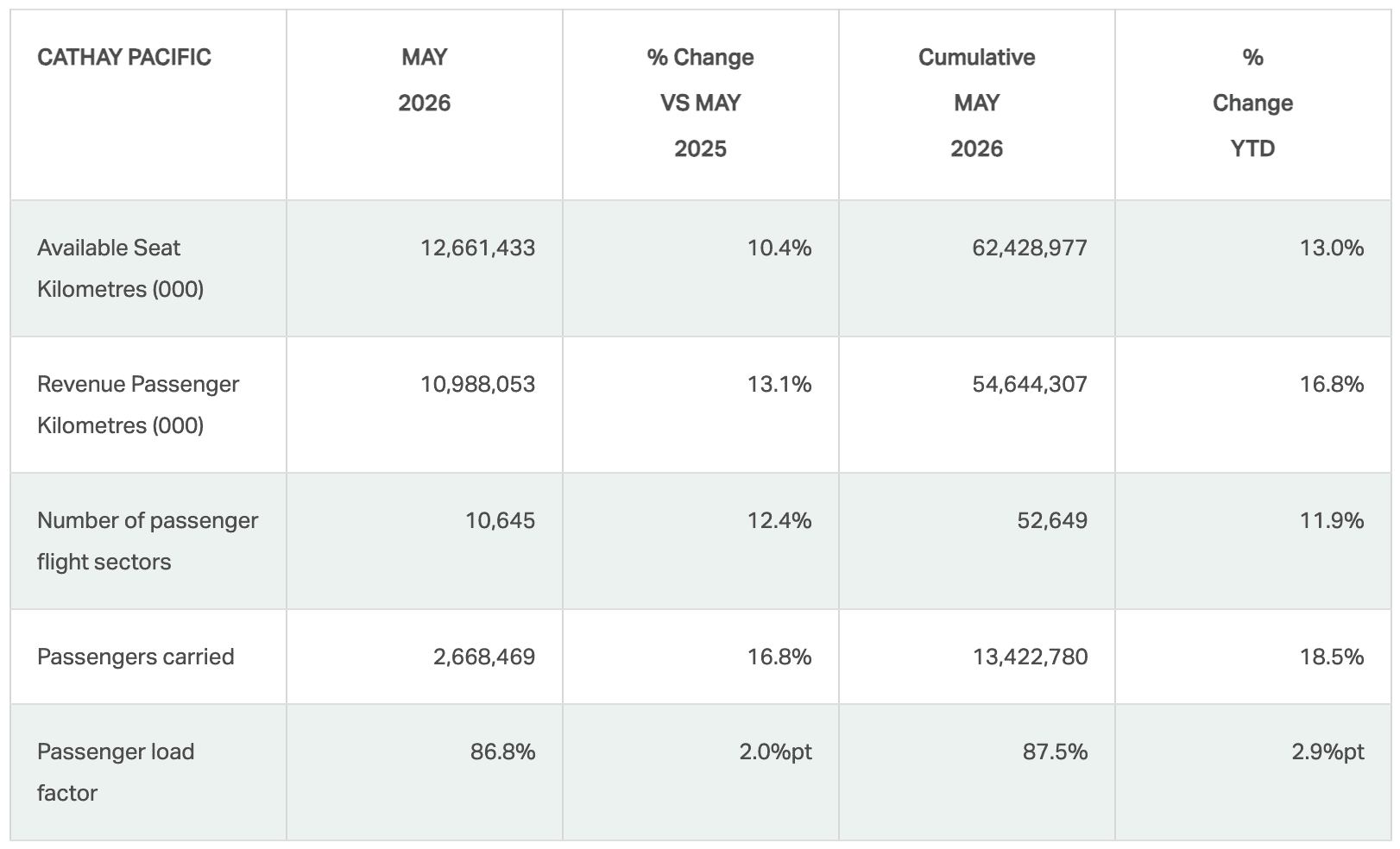
HONG KONG, 29 June 2026: The Cathay Group released traffic figures for May 2026 last week, reporting that both passenger traffic and cargo uplift saw double-digit growth year-on-year.
Cathay Chief Customer and Commercial Officer Lavinia Lau noted: “We continued to see year-on-year growth in our travel and cargo businesses in May, albeit against a backdrop of high jet fuel prices.
Cathay Pacific and HK Express together carried a combined total of over 3.3 million passengers, 14% higher than in May 2025, while Cathay Cargo carried over 150,000 tonnes of cargo during the month, representing an 11% increase year on year.
Photo credit: Cathay Group.
“Meanwhile, we are continuing to expand our global network. Earlier this month, Cathay Pacific announced plans to launch direct flights to Almaty in the first quarter of 2027, marking our first destination in Central Asia and strengthening Hong Kong’s connectivity with an important Belt and Road region. HK Express will also launch direct daily flights to Wuxi in July.”
Cathay Pacific
Cathay Pacific carried 17% more passengers in May 2026 compared with May 2025, while Available Seat Kilometres (ASKs) increased by 10%. In the first five months of 2026, passenger traffic increased by 19% compared with the same period in 2025.
Lau said: “May got off to a strong start, supported by solid traffic as passengers from across Asia returned from their Golden Week and other holiday travels at the beginning of the month. This was followed by robust travel demand from our home market as travellers took advantage of the Buddha’s Birthday long weekend in Hong Kong towards the end of May. These traffic flows, together with increased connecting traffic via Hong Kong as travellers seek alternative hubs due to the situation in the Middle East, contributed to a high network load factor of 87%. Meanwhile, our premium cabins continued to see high demand from business and premium leisure travel.
“Looking ahead, the outlook for the summer travel peak remains positive, particularly on our long-haul routes, while bookings for short-haul destinations are accelerating.”
Cathay Cargo
Cathay Cargo carried 11% more cargo in May 2026 than in May 2025, while Available Freight Tonne Kilometres (AFTKs) increased by 6%. In the first five months of 2026, the total tonnage increased by 8% compared with the same period in 2025. Cargo business performed well in May, with year-on-year growth underpinned by robust demand on key trade lanes, particularly between the Chinese Mainland and Southeast Asia.
HK Express
HK Express carried more than 670,000 passengers in May 2026, an increase of 5% year on year, while Available Seat Kilometres (ASKs) grew by 4%. In the first five months of 2026, passengers carried increased by 12% compared with the same period in 2025.
Lavinia commented: “Demand for HK Express’s Southeast Asia routes extended beyond the Easter holidays into May, with Thailand and the Philippines remaining particularly popular. The airline’s Beijing (Daxing) service was also a bright spot, with load factor exceeding 90%. Looking ahead to the summer, HK Express is seeing a healthy pickup in bookings on various routes.”
Financial
As a result of the completion of an issuance of A shares as announced by Air China Limited (“Air China”) on 9 June 2026, the Cathay Group expects to recognise a deemed disposal gain of approximately HK$1.4 billion in the first half of 2026. This arises from the resulting dilution of the Group’s equity interest in Air China from 15.09% to 12.85%.
BANGKOK, 29 June 2026: After more than 35 years living and working in Thailand’s tourism industry, I have learnt that tourism rarely moves in a straight line. If one were to plot Thailand’s hotel occupancy over the course of a typical year, the graph would resemble a series of rolling waves, rising to predictable peaks before falling into seasonal troughs.
Today, Thailand finds itself in one of those troughs.
Thailand remains one of the most compelling travel destinations in the world
Yet what feels different this year is that the traditional green season has become an extended green season. The slowdown has lingered longer, dipped deeper and tested the patience of many tourism operators who would normally be preparing for the first signs of recovery.
Unlike previous slow periods that seasonal travel patterns could largely explain, this year’s market has been shaped by a convergence of international events arriving at precisely the wrong time. Continuing disruptions to air routes serving Europe and the Middle East have complicated long-haul travel, increased airline operating costs, and reduced scheduling flexibility.
At the same time, an exceptional heatwave across much of Europe has altered traditional summer travel patterns, while economic uncertainty in several key source markets has encouraged some travellers to postpone or shorten overseas holidays. The consequences have been felt across Thailand.
During the recent Middle East airspace closures, more than 30 flights serving Phuket were cancelled or disrupted, leaving over 5,000 visitors temporarily stranded on the island. Koh Samui and Koh Phangan also experienced significant disruption, while airlines including Emirates, Qatar Airways, Etihad Airways and Air Arabia were forced to reroute or suspend services.
Airports of Thailand, local authorities, hotels, and tourism operators responded quickly, assisting affected visitors as travel schedules gradually returned to normal.
Even after airspace restrictions eased, the effects have continued to ripple through booking patterns. Travellers naturally become more cautious when uncertainty surrounds international air travel, particularly on long-haul journeys involving multiple connections.
The softer market is also becoming visible within Thailand itself. Airlines are quietly adjusting capacity on selected domestic routes, particularly to secondary and tertiary destinations where several daily services operate. Earlier departures have, in some cases, been consolidated into later flights, enabling airlines to maintain healthier load factors while responding sensibly to reduced demand. Such adjustments are entirely normal commercial practice, but they also underline the extent of this year’s extended green season.
Statistics tell one story. Personal observation often tells another.
Over the course of a typical year, Thailand’s hotel occupancy resembles a series of rolling waves, rising to predictable peaks before falling into seasonal troughs.
Having lived in Thailand for more than 35 years, I have witnessed the extraordinary highs and occasional lows of one of the world’s most successful tourism destinations. Throughout those years, I have learnt that conversations with hotel general managers, restaurant owners, airline executives, tour operators, taxi drivers and shopkeepers frequently reveal emerging trends long before official statistics are published. During recent weeks, those conversations have been remarkably consistent.
As the owner of property in Pattaya, I visit the resort regularly and have seen the quieter atmosphere first-hand. The beaches remain attractive, the restaurants welcoming, and the city’s famous hospitality remains as warm as ever. Yet there is no denying that visitor numbers are noticeably lower than many businesses had anticipated.
What I’m hearing on the ground in Pattaya and Hua Hin after a recent 10-day stay
• Hotel operators report occupancies below normal expectations for this stage of the green season.
• Several tourism businesses estimate that visitor numbers are around 20% lower than a typical low season.
• Some nightlife venues report welcoming fewer than 15 customers on certain evenings.
• Restaurant owners speak of fewer walk-in diners and noticeably quieter trading.
• Local operators consistently describe this as one of the quietest green seasons they have experienced for many years.
Individually, these observations remain anecdotal. Collectively, however, they paint a picture of an extended green season proving more challenging than usual.
Phuket, Thailand’s largest resort destination, presents a similar, although not identical, picture.
Several senior hotel executives have told me that some of the island’s larger international resorts are currently operating with occupancies around 20-30% below what they would normally expect at this stage of the year. Smaller boutique hotels appear to be performing rather better, with occupancy levels generally between 50 and 60%. Their smaller room inventory and greater pricing flexibility allow them to adapt more quickly to changing market conditions.
The contrast is significant. Thailand is not experiencing a collapse in tourism. Rather, demand has softened unevenly across different destinations, market segments and accommodation types. Larger resorts that rely heavily on long-haul international visitors are feeling greater pressure than smaller properties serving domestic travellers and regional markets.
Elsewhere around the Kingdom, the picture is mixed. Chiang Mai and Chiang Rai continue to benefit from domestic tourism and visitors from neighbouring countries. At the same time, Koh Samui’s established luxury market has helped cushion the impact of softer international demand. Bangkok, as Thailand’s principal gateway, remains comparatively resilient, although many hotels report that booking windows have shortened as travellers delay making firm commitments.
If there is one lesson that more than three decades in Thailand has taught me, it is that no two tourism downturns are ever exactly alike. Every slowdown has its own causes, its own characteristics and, ultimately, its own recovery.
Why recovery is likely – and what comes next
History offers reassurance. Thailand’s tourism industry has weathered numerous disruptions over the decades—from financial crises and natural disasters to political uncertainty and global pandemics. Each time, the downturn felt significant in the moment. Each time, recovery followed.
The key reason is simple: Thailand remains one of the most compelling travel destinations in the world.
Its appeal is not built on a single attraction but on a powerful combination of factors—natural beauty, cultural richness, value for money, and a hospitality culture that consistently exceeds expectations. These fundamentals do not disappear during a slowdown. They remain intact, quietly waiting for conditions to improve.
There are already encouraging signs that the tide is beginning to turn
Airlines are gradually restoring schedules as operational conditions stabilise. Travel demand from regional markets, particularly within Asia, continues to show resilience. Domestic tourism remains an important stabilising force, helping to sustain businesses during quieter international periods.
Equally important is the adaptability of Thailand’s tourism sector
Operators across the country have demonstrated remarkable flexibility in responding to changing conditions. Hotels are adjusting pricing strategies, refining marketing efforts and targeting new customer segments. Airlines are managing capacity carefully. Tourism authorities continue to promote the destination in both established and emerging markets.
This ability to adapt has always been one of Thailand’s greatest strengths.
For travellers, the current environment presents an opportunity. Fewer crowds, competitive pricing and a more relaxed atmosphere allow visitors to experience Thailand in a different way – one that many seasoned travellers find particularly appealing.
For businesses, however, the challenge is to navigate the present while preparing for the future.
Maintaining service standards, supporting staff and preserving brand reputation during quieter periods requires careful management. Yet those who succeed in doing so are often best positioned to benefit when demand returns. And return it will.
Tourism, by its nature, is cyclical. External events may temporarily disrupt travel patterns, but the underlying desire to explore, relax and connect with new cultures remains strong. When uncertainty fades, that demand tends to re-emerge, often more quickly than expected. Thailand has seen this pattern many times before.
The current extended green season may feel prolonged, but it is unlikely to be permanent. As global conditions stabilise and traveller confidence rebuilds, the familiar rhythm of rising demand will resume. For now, the tide may be out. But history affirms it will come back in.
About the author Andrew J Wood is a British-born, Bangkok-based travel writer and former hotel general manager with almost five decades of hospitality experience in Asia. A former President of Skål International Asia and a two-time President of Skål International Bangkok, he writes regularly on tourism and hospitality across the Asia-Pacific region.
SINGAPORE, 26 June 2026: StarDream Cruises, owner of StarCruses and Dream Cruises, has announced fuel surcharge relief across its regional deployments to deliver value to guests sailing aboard Genting Dream, Star Navigator and Star Voyager.
Guests sailing from Singapore and Malaysia deployments will enjoy a full waiver of the fuel surcharge. Guests sailing from Taiwan and Hong Kong will benefit from a 50% reduction in the current fuel surcharge.
Photo credit: StarDream Cruises.
The updated fuel surcharge waiver and reduction apply to sailings departing on or after 26 June 2026.
The revised fuel surcharge structure accounts for the operating requirements of different deployments in the region and reflects the gradual improvement in fuel market conditions.
StarDream Cruises said in a press statement that it remains committed to delivering excellent value and memorable cruise experiences across all its regional markets.
“As fuel prices have continued to stabilise, we are pleased to reduce and, where possible, fully waive the fuel surcharge across our deployments,” said StarDream Cruises President Michael Goh. “We have always taken a transparent approach to fuel surcharges, introducing them only when necessary and reviewing them regularly. As operating conditions improve, we believe it is important to pass these benefits on to our guests.”
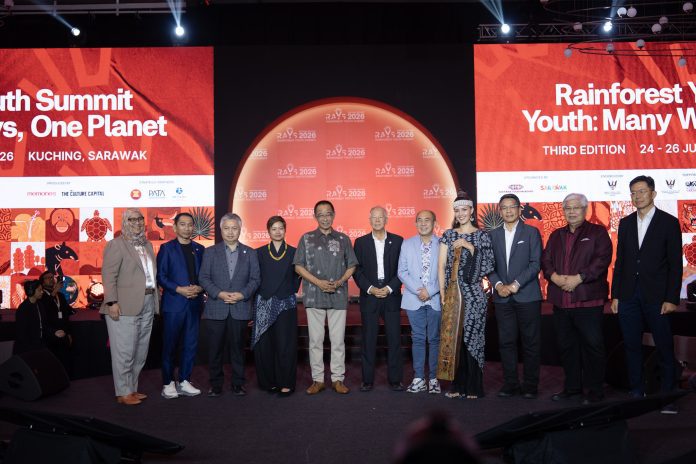
KUCHING, 26 June 2026: The third edition of the Rainforest Youth Summit (RAYS) 2026 officially opened on Wednesday in Kuching, bringing together youth leaders, advocates, researchers, students, emerging policymakers and sustainability practitioners from across ASEAN and beyond for three days of dialogue.
Held from 24 to 26 June 2026 under the theme “Youth: Many Ways, One Planet,” RAYS 2026 reinforces Sarawak’s growing role as a regional platform for youth leadership, sustainability dialogue, environmental stewardship and responsible tourism.
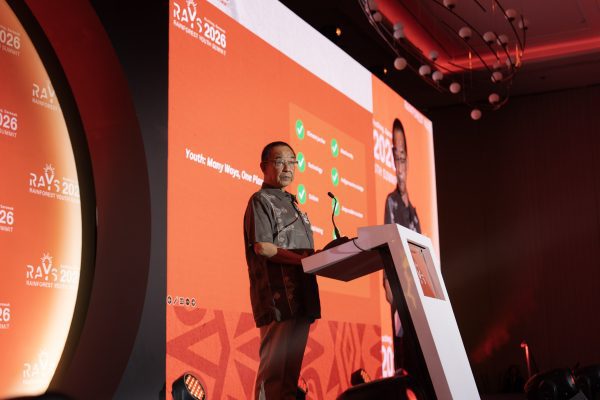
YB Dato Sri Haji Abdul Karim Rahman Hamzah, Minister of Tourism, Creative Industry and Performing Arts Sarawak, and Minister of Youth, Sports and Entrepreneur Development Sarawak, delivers his officiating remarks during the opening ceremony of the Rainforest Youth Summit (RAYS) 2026 at Voco Hotel Kuching, Sarawak.
This year’s participation reflects a strong diversity of youth voices from across all 11 ASEAN countries and the wider international community, including new representation from Timor-Leste, alongside delegates from varied disciplines, communities and lived experiences.
The summit builds on the success of its previous editions, which collectively convened youth participants from 37 countries, engaged over 80 organisations and brought together diverse voices across disciplines and regions. In its third edition, RAYS continues to evolve beyond dialogue by strengthening youth participation in climate governance, applied learning and long-term sustainability action.
The opening ceremony was officiated by YB Dato Sri Haji Abdul Karim Rahman Hamzah, Minister of Tourism, Creative Industry and Performing Arts Sarawak and Minister of Youth, Sports and Entrepreneur Development Sarawak.
In his officiating remarks, he said: “The future cannot be built for youth without youth. RAYS 2026 is a meeting point between youth leadership, environmental stewardship, indigenous knowledge, science, creativity, policy, culture and community, a platform for young people to move from concern to contribution.”
Organised by the Sarawak Tourism Board, RAYS 2026 is designed as a platform for youth, Indigenous leaders, scientists, and changemakers to exchange knowledge and co-create solutions.
Throughout the three-day programme, delegates will participate in keynote dialogues, plenary sessions, workshops, youth-led discussions, cultural exchanges, networking sessions and curated experiences aimed at translating ideas into practical action.
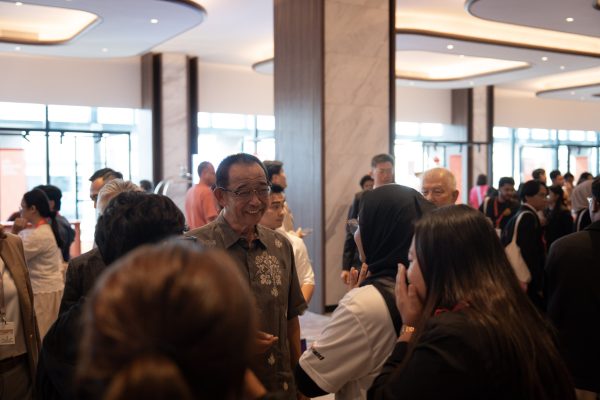
YB Dato Sri Haji Abdul Karim Rahman Hamzah, Minister of Tourism, Creative Industry and Performing Arts Sarawak, engages warmly with local and international youth delegates at the Rainforest Youth Summit (RAYS) 2026 in Kuching, Sarawak.
“RAYS 2026 is more than a three-day summit. It is a pathway for learning, leadership and action, where young people are not only here to receive knowledge, but to bring knowledge, build relationships and carry their commitments forward,” said Dr Sharzede Datu Haji Salleh Askor, Chief Executive Officer of Sarawak Tourism Board.
A key highlight of this year’s summit is the Planet Futures Forum, a collaborative climate simulation that enables youth to step into the realities of how climate decisions are shaped. Through scenario-based negotiation, systems thinking, and collective decision-making, participants will explore the trade-offs, constraints, and shared responsibilities involved in real-world climate governance.
The forum is designed to build youth capacity in design thinking, negotiation and collective decision-making, while contributing towards the development of the RAYS Youth Declaration.
The summit will also produce the inaugural RAYS Youth Declaration, capturing the aspirations, commitments and recommendations of young people towards a more sustainable future. The declaration will serve as a reference point for continued youth engagement, reflecting the summit’s commitment to ensuring youth voices are heard beyond the three-day programme.
RAYS 2026 also marks the launch of the RAYS Fellowship Programme, a 12-month leadership journey for selected young leaders focused on collective climate governance and applied action.
Rooted in the principle of “Many Ways, One Planet,” the fellowship will support fellows in practising shared leadership, engaging with Indigenous and local knowledge-holders, contributing to governance proposals, and translating summit dialogue into action through guided monthly learning, applied governance work and collaborative cohort engagement.
Together, the Planet Futures Forum, RAYS Youth Declaration and RAYS Fellowship Programme demonstrate the long-term direction of RAYS as a platform that extends beyond a one-off summit.
They reflect Sarawak’s commitment to nurturing a generation of youth leaders equipped to collaborate across borders, cultures and disciplines while shaping practical solutions for climate resilience, biodiversity protection and sustainable development.
As part of the programme, RAYS delegates will participate in selected cultural and experiential activities linked to Sarawak’s broader cultural and sustainability ecosystem, including curated experiences that showcase the connections among rainforest, community, and culture.
Delegates will also attend the opening day of the Rainforest World Music Festival 2026, highlighting the intersection of culture, community and conservation.
Funded and organised by the State Government of Sarawak and Sarawak Tourism Board, RAYS 2026 is endorsed by the Ministry of Tourism, Creative Industry and Performing Arts, Sarawak, and supported by the Ministry of Youth, Sports and Entrepreneur Development, Sarawak, together with strategic partners ASEAN, Pacific Asia Travel Association (PATA), and UN Tourism.
BANGKOK, 26 June 2026: Asian Trails’ key leaders gathered for the annual Board of Directors meeting in Bangkok from 18 to 19 June 2026.
The event brought together the company’s senior leadership team, led by Chairman Luzi Matzig and CEO Laurent Kuenzle, along with managing directors of all business units and key decision-makers in technology, e-commerce, sourcing, marketing and sustainability.
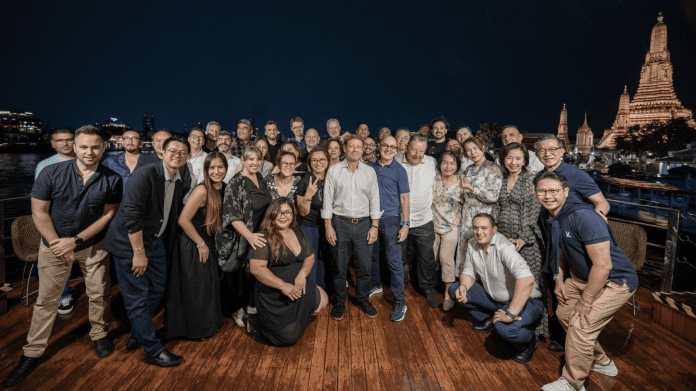
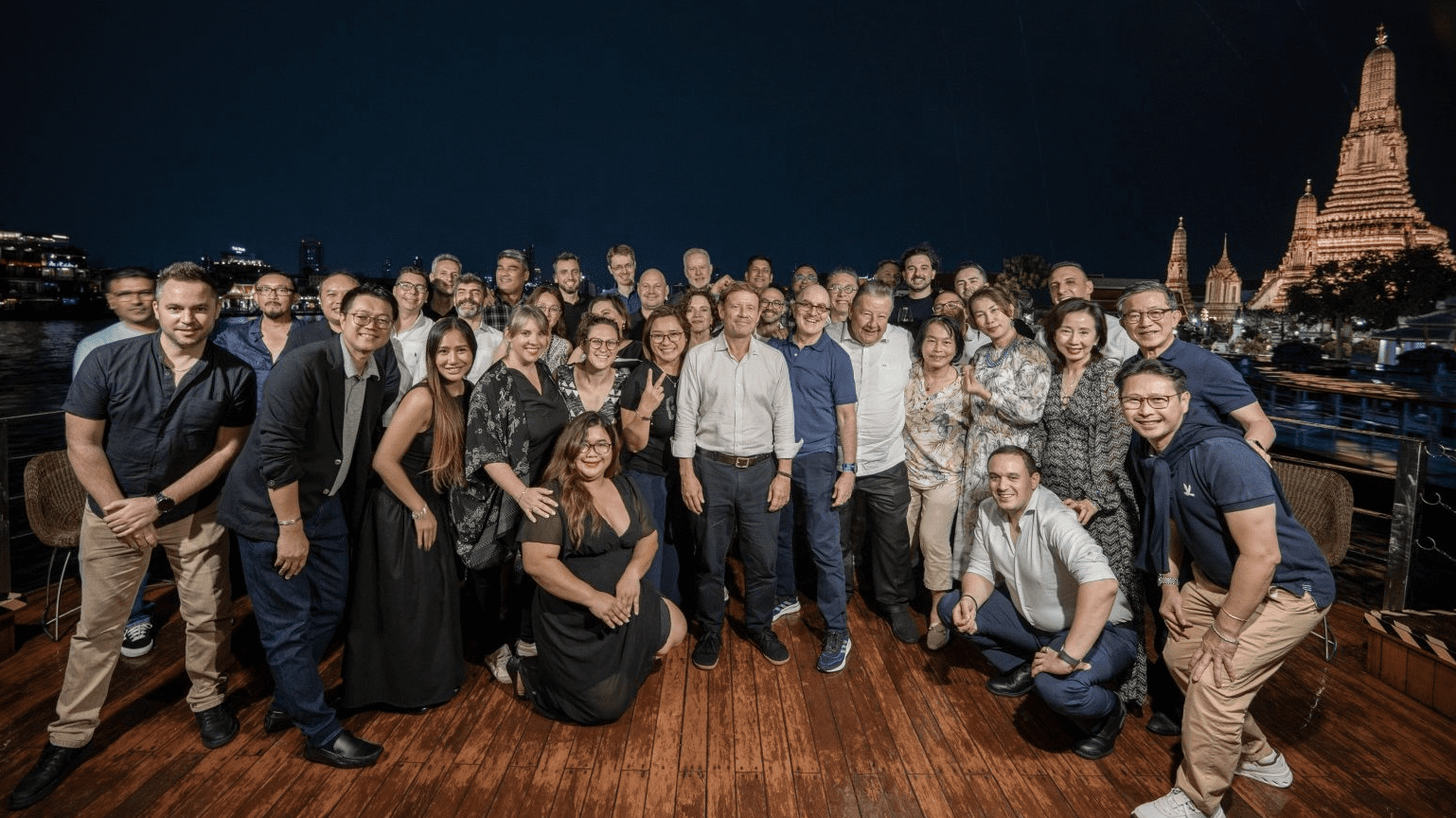
Photo credit: Asian Trails. Plotting new trails at the annual board meeting.
Over two days of strategic discussions, held at dusitD2 Samyan, Bangkok, the leadership team reviewed business performance, explored new opportunities and aligned on the company’s direction for the year ahead, with a focus on sustainable growth, innovation and stronger regional integration.
The event concluded with a memorable evening, as members of Asian Trails’ Bangkok team gathered for a reception at Anantara Riverside Bangkok Resort, followed by a sumptuous dinner cruise along the Chao Phraya River with Loy Pela Voyages.