


BANGKOK, 9 April 2026: China is a tourism dynamo. Its true power lies in the billions of journeys made within its own borders. To understand China’s dominance, it helps to compare it directly with other major tourism markets. The gap is not marginal. It is structural.

China is the world’s largest tourism market. Not marginally bigger. Not competitively ahead. Overwhelmingly dominant.
Every year, it generates around 6 billion domestic trips, a level of movement no other country has ever come close to achieving.
To put that into perspective:
• Around three times the size of the United States (2.4 billion)
• Roughly 15 times larger than France
• Close to 20 times larger than Spain
This is not growth. This is on a completely different scale.
What China has built is not simply a tourism sector. It is a vast, continuous system of movement, driven internally and operating at a magnitude that redefines global benchmarks.
Global tourism snapshot
China leads overwhelmingly in total movement. The US leads in revenue. Europe leads on inbound tourism density.
But no country combines population, frequency and scale the way China does.
A market powered from within
Unlike most major destinations, China is not dependent on international arrivals to sustain its tourism economy.
Its strength lies in its domestic engine:
• A population of over 1.4 billion
• A rapidly expanding middle class
• High-speed rail networks connecting cities across vast distances
• Digital ecosystems that make travel planning, booking and payment seamless
From weekend urban breaks to long-distance heritage journeys, Chinese travellers travel frequently and in large numbers.
This creates a tourism system that is self-sustaining, resilient and far less exposed to global shocks than markets reliant on inbound flows.
Infrastructure at scale
China’s infrastructure is a defining competitive advantage.
The country’s high-speed rail network, the largest in the world, connects major cities and regional centres with speed and efficiency. Airports continue to expand, while domestic aviation remains highly active.
Layered onto this is a fully integrated digital ecosystem, where mobile payments, super apps and real-time booking platforms have removed friction from the travel experience.
The result is simple. Travel within China is easy, fast, and accessible, which drives frequency.
Inbound tourism, rising but not defining
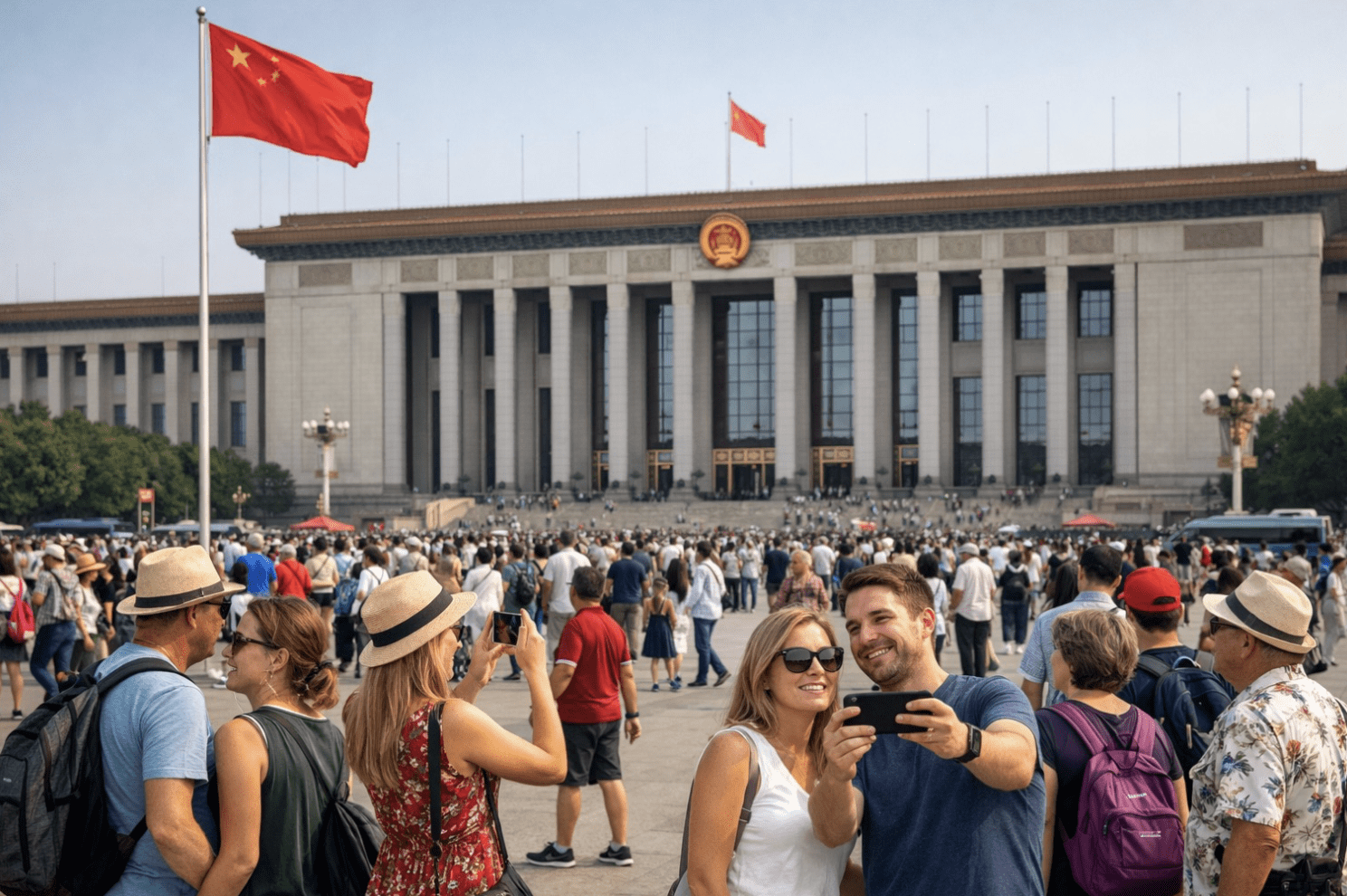
International arrivals to China are recovering, but they remain a secondary component of the overall tourism picture.
Even as global visitors return to landmarks such as the Great Wall and the Forbidden City, inbound tourism accounts for only a small proportion of total travel activity.
This is the defining difference. While most countries compete aggressively for international visitors, China’s tourism strength is fundamentally internal. China may be the world’s largest tourism market by total movement, but it is not yet the leading destination for international visitors. Official figures show around 130 to 150 million inbound trips annually, although a large share comes from Hong Kong, Macau and Taiwan.
Strip those out, and China receives roughly 80 million foreign visitors a year, still behind Europe’s top destinations such as France and Spain. Long-haul arrivals from Western markets remain far smaller, typically around 25 to 30 million, highlighting the gap China must close to become a truly global inbound powerhouse. Inbound growth matters, but it does not define the market.
Economic power, measured in trillions
Tourism in China is not just about volume. It is about economic impact.
Domestic travel spending alone contributes approximately 1.4 trillion dollars annually, supporting:
• Airlines and high-speed rail operators
• Hotels and resorts across all segments
• Food and beverage, retail and entertainment
• Cultural attractions and regional economies
By comparison, the US generates higher overall tourism revenue, but through a different model that combines domestic strength with strong inbound spending. China’s model is unique. It is built on internal demand.
Global comparison: The gap is structural
Other leading tourism markets rely far more heavily on inbound travel.
France and Spain depend on international arrivals for economic impact.
Thailand balances inbound tourism with a solid domestic base.
The US benefits from both strong domestic travel and high-value international visitors.
China stands apart. Its tourism system is not driven by external demand. Its own population powers it. This makes its dominance structural rather than cyclical.
Behavioural shift and travel patterns
Chinese travellers are evolving. There is a growing preference for experiential travel, cultural immersion and shorter, more frequent trips. Secondary cities and regional destinations are seeing increased demand as travellers seek new experiences beyond traditional hotspots.
At the same time, value, convenience and accessibility remain critical drivers. This behavioural shift further reinforces domestic travel.
What happens next
China’s tourism leadership is secure, but the next phase of growth will be shaped by direction rather than volume.
Rising fuel costs, economic uncertainty and shifting consumer priorities are expected to reinforce domestic travel patterns.
Short-haul and regional travel will continue to dominate, supported by infrastructure and convenience.
International travel will recover steadily, but the gap between domestic and inbound tourism will remain significant.
China will continue to generate billions of trips internally, while gradually rebuilding its position in global inbound tourism.
The bottom line
China is already the world’s No 1 tourism giant. Not because it attracts the most international visitors. But because it moves more people, more often, than any country in history.
Measured in billions, not millions, China has redefined the scale of travel.
It is not simply leading the global tourism industry – it is operating at a level no other market can match.

About the Author
Andrew J Wood is a Bangkok-based media executive, travel writer and former hotel executive specialising in Asian tourism. A resident of Thailand since 1991, he brings over four decades of international hospitality experience, including senior roles with leading hotel groups such as Shangri-La Hotels and Resorts, Minor Hotels and the Royal Cliff Hotels Group.
A former Director of Skål International, he also served as President of Skål Asia and National President of Skål Thailand, and twice as President of Skål International Bangkok. He writes widely on tourism and aviation trends across Asia.