


SINGAPORE, 2 July 2026: The International Air Transport Association (IATA) released data this week showing that global passenger demand, measured in revenue passenger kilometres (RPK), declined 2.2% in May 2026 compared with May 2025, mainly due to the war in the Middle East.
However, when data for the Middle East was excluded, global demand grew by 0.7%.
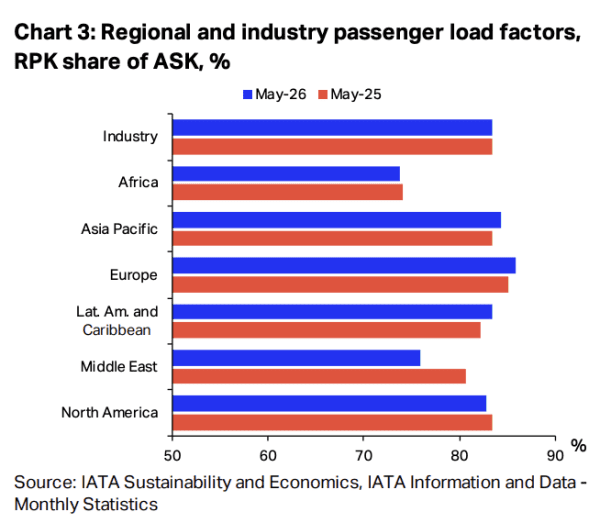
Total capacity, measured in available seat kilometres (ASK), decreased 2.3% year-on-year. The load factor was 83.5% (+0.1 ppt compared to May 2025), a record high for May.
International demand fell 1.6% compared to May 2025. Excluding the Middle East, demand grew by 3.1%. Capacity was down 2.4% year-on-year, and the load factor was 83.7% (+0.7 ppt compared to May 2025).
Domestic demand contracted 3.1% compared to May 2025. Capacity decreased 2.1% year-on-year. The load factor was 83.0% (-0.8 ppt compared to May 2025).
“Air passenger demand was down 2.2% year-on-year in May on the impact of the war in the Middle East. The decline was centred on carriers in the Middle East with a 28.4% year-on-year fall. That’s a significant improvement on the 46.6% decline recorded for April, a sign of the region’s resilience. Notably, we also saw year-on-year declines in demand in both North America and Asia, largely driven by domestic market conditions in the US and China.
“Overall, May demand still appeared to be largely resilient in the face of high fuel prices and airfares. While the recent sharp drop in oil prices is an encouraging development, the challenges created by the war will likely persist for some time. Oil supply through the Strait of Hormuz remains uncertain, and it is likely to take time before the benefit of lower oil prices is reflected in ‘normalised’ jet fuel pricing. In the meantime, airlines that are operating on a 2% margin will have little choice but to continue testing demand resilience with higher fares that attempt to cover elevated fuel costs,” said IATA’s Director General Willie Walsh.
Regional Breakdown – International Passenger Markets
International RPK fell 1.6%, with capacity falling 2.4%. The pace of decline slowed compared to April, and many regions hit record load factors in May, with only the Middle East posting a load factor decline.
Asia-Pacific airlines achieved a 1.3% year-on-year increase in demand. Capacity decreased 1.1% year-on-year, and the load factor was 85.3% (+2.0 ppt compared to May 2025). In Vietnam, tighter limits on jet fuel imports led to significant capacity cuts on short-haul routes, resulting in a decline in intra-Asia international traffic during the month.
European carriers saw a 3.8% year-on-year increase in demand. Capacity increased 2.3% year-on-year, and the load factor was 85.4% (+1.2 ppt compared to May 2025). Of note is the 15% increase in direct traffic to Asia, reflecting a continued shift to direct services between the two regions.
North American carriers increased demand by 1% year-on-year. Capacity increased 0.6% year-on-year, and the load factor was 84.0% (+0.4 ppt compared to May 2025).
Middle Eastern carriers saw a 28.8% year-on-year decrease in demand. Capacity fell 24.3% year-on-year, and the load factor was 76.1% (-4.8 ppt compared to May 2025). The impacts of the Iran war continue to cause a highly negative year-on-year traffic comparison, but month-to-month, the impact is lessening, and the rate of decline was almost half that of April.
Latin American airlines achieved a 10.5% year-on-year increase in demand. Capacity climbed 9.0% year-on-year. The load factor was 85.0% (+1.2% ppt compared to May 2025).
African airlines saw an 8.9% year-on-year increase in demand. Capacity was up 8.3% year-on-year. The load factor was 73.4% (+0.4 ppt compared to May 2025).
(Source: IATA)