SINGAPORE, 24 June 2024: Power Knot Ocean, a market leader for on-site organic waste management solutions in the marine environment, announced this week the successful deployment of 26 of its machines aboard Princess Cruises’ newest luxury cruise ship, the Star Princess.
The integration of Power Knot’s LFC biodigesters and WEP effluent pumps on board the Star Princess marks a significant stride toward sustainable waste management practices within the cruise industry.
Star Princess is one of the largest cruise ships in the Princess Cruises fleet. As the second Sphere-class vessel, the ship weighs 177,882 gross tons, accommodates up to 4,300 guests, and is powered by liquefied natural gas (LNG).
Power Knot Ocean ensured products were commissioned well before the ship’s debut in late 2025, ensuring that sustainable food waste management was operational from her very first voyage. She serves destinations ranging from the Caribbean to Alaska.
The LFC biodigester is a food waste biodigester that uses natural aerobic digestion to break it down into water, reducing the need for traditional disposal methods and substantially lowering both cost and environmental impact. The biodigester units are strategically placed in key areas of the ship, such as galleys and garbage rooms, where food waste is processed or handled, to improve operations.
With nine different sizes available, accommodating the digestion of 10 kg (22 lb) to 6,000 kg (13,200 lb) of food waste per day, the LFC biodigester provides a versatile and effective approach to waste reduction.
“We are proud to have worked with Princess Cruises to bring sustainable food waste management to Star Princess from da” one,” said Power Knot President Iain Milnes. “Having our LFC biodigesters installed and operational before the ship’s maiden voyage reflects the level of planning and commitment that teams brought to this project. With 26 units aboard one of the world’s most advanced cruise ships, we are demonstrating that responsible waste management and world-class hospitality go hand-in-hand.”
About Power Knot Ocean Power Knot Ocean provides safe and cost-effective solutions for managers of cruise ships, cargo ships, and yachts worldwide seeking to reduce their carbon footprint and comply with DOJ and MARPOL regulations.
SINGAPORE, 24 June 2026: New data from Amadeus Travel Intelligence reveals that international air travel to Vietnam rose by 11.1% in March 2026 compared with March 2025.
A closer look at the figures shows the growth is more sustained than the headline number implies, as emerging source markets account for a larger share of the travel.
South Korean travel to Vietnam fell by 4.6% this March. Despite this decline, South Korea remains Vietnam’s largest source market, accounting for 31.5% of all arrivals.
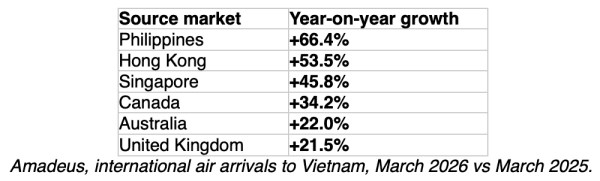
Some markets stood out due to sharp increases in 2026 compared with last year. Regional travel is surging, with the Philippines, Hong Kong and Singapore all posting some of the steepest growth. At the same time, long-haul demand is strengthening, with Canada, Australia and the UK each up by more than a fifth from last year.
Europe also illustrates how varied the picture has become. While the UK grew 21.5%, France softened over the same period, a reminder that demand is shifting market by market rather than moving in a single direction across a region.
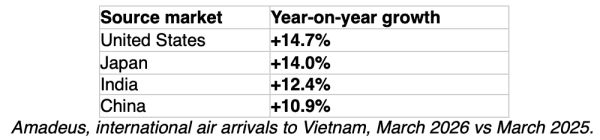
Established markets continue to climb
Several of Vietnam’s largest established source markets grew broadly in line with, or just ahead of, the overall market, indicating that diversification is building on a stable base of demand.
Amadeus Vice President, Hospitality, APAC, Paul Wilson adds: “Vietnam is one of the key travel destinations globally, and it has been for some time. Even the most established destinations are subject to changing demand patterns, and our data reveals subtle yet highly influential shifts in where travellers are coming from.
“A more diversified set of source markets, such as what we are seeing with Vietnam, makes destinations more resilient to unexpected drops in any one country. For hoteliers and destinations, the ability to see these nuanced traveller patterns drives demand and helps understand what travellers are visiting. A broader and more varied traveller base also calls for more nuanced, market-specific campaigns, offers and products to appeal to each audience.”
BANGKOK, 24 June 2026: Demand for luxury hotels in the Asia Pacific (APAC) has grown dramatically, with investors increasingly viewing the asset class as both resilient and enduringly appealing to travellers regionally and globally.
According to JLL, the volume of luxury hotel transactions in the Asia-Pacific region rose significantly by 77% between 2017 and 2025, reaching approximately USD2.1 billion in 2025. Significantly, 2025 volumes represent one of the highest annual investment deployments into luxury hotels since pre-COVID times, where transactions reached over USD2.4 billion in 2019.
Photo credit: JLL.
Whilst luxury hotel transactions accounted for almost 20% of all APAC hotel deals in 2025, more than double the 8% share recorded in 2017 and surpassing even the 16% achieved during the pre-pandemic high, Thailand’s investment landscape remains supply-constrained, as a significant number of properties are tightly held by long-term owners, limiting transaction activity. Since 2017, luxury hotels have accounted for 19.2% of the country’s total hotel sales volume. In contrast, the segment represented just 7.9% of all transactions despite robust investor demand. Notable luxury transactions that year included a shareholder buyout of a hotel in central Bangkok and the sale of a 51% equity stake in the InterContinental Bangkok.
“The luxury hotel segment in Asia Pacific is experiencing a defining moment measured by both its remarkable resilience throughout the pandemic cycle and beyond, and increasingly via a convergence of wealth accumulation and evolving consumer. As a result, we’re seeing sustained appetite from an increasingly diverse investor base, including private wealth and cross-border capital, all seeking exposure to assets that combine prestige, capital preservation, and long-term growth fundamentals,” says JLL Hotels & Hospitality Group Executive Vice President Investment Sales Asia Pacific, Pimpanga Yomchinda.
A fundamental shift is underway in how luxury hotels capture market share. While these properties have always commanded premium rates, the occupancy gap between luxury and mainstream hotels is now narrowing, signalling that luxury hotels are year-round performers with strong, sustainable demand.
This performance evolution is attracting both capital and development activity. In the Asia Pacific, the supply of luxury hotels has grown at a steady 4% annually over the past decade, maintaining approximately 8% of the total market, with moderate growth expected through 2030. Thai luxury properties have demonstrated sustained organic ADR growth while maintaining resilient occupancy levels. Since 2019, ADR in luxury and ultra-luxury segments in Bangkok, Phuket and Samui has recorded double-digit growth. This disciplined expansion has avoided the oversupply challenges that historically affected parts of the hospitality sector, resulting in favourable supply-demand dynamics for investors.
A key driver of this momentum is the rapid evolution of luxury hospitality offerings. Global and regional operators are launching differentiated concepts to capture specific guest preferences, from wellness-focused retreats to culturally immersive experiences. The nature of incoming supply reflects a broader shift in consumer preferences. Traditional five-star hotels are increasingly complemented by “lifestyle luxury” concepts that combine high-end accommodation with curated social, wellness, and cultural experiences. This trend is further reinforced by the rise of integrated mixed-use developments such as One Bangkok, Dusit Central Park, Narai Group’s Hatai project, in which hospitality components are integrated with retail, office, and/or residential offerings, positioning hotels as part of a broader experiential ecosystem.
Thailand’s luxury hotel market continued its expansion with the arrival of new brands such as Aman Nai Lert, Andaz One Bangkok, and Ritz-Carlton One Bangkok. The period also saw the significant relaunch of the celebrated homegrown Dusit Thani Hotel and the opening of Six Senses Bangkok and The Langham – Custom House Bangkok. With this influx of lifestyle-focused supply, ADR ceilings have risen in the ultra-luxury segment, reaching rates approaching THB15,000, up from approximately THB10,000 pre-COVID-19.
“The luxury hospitality landscape has fundamentally evolved. We’re seeing properties adapt to changing guest preferences while maintaining the premium positioning that makes them attractive investment assets,” says JLL Hotels & Hospitality Group Head of Hotels Advisory, Thailand, Chanavudh Vanachaivong.
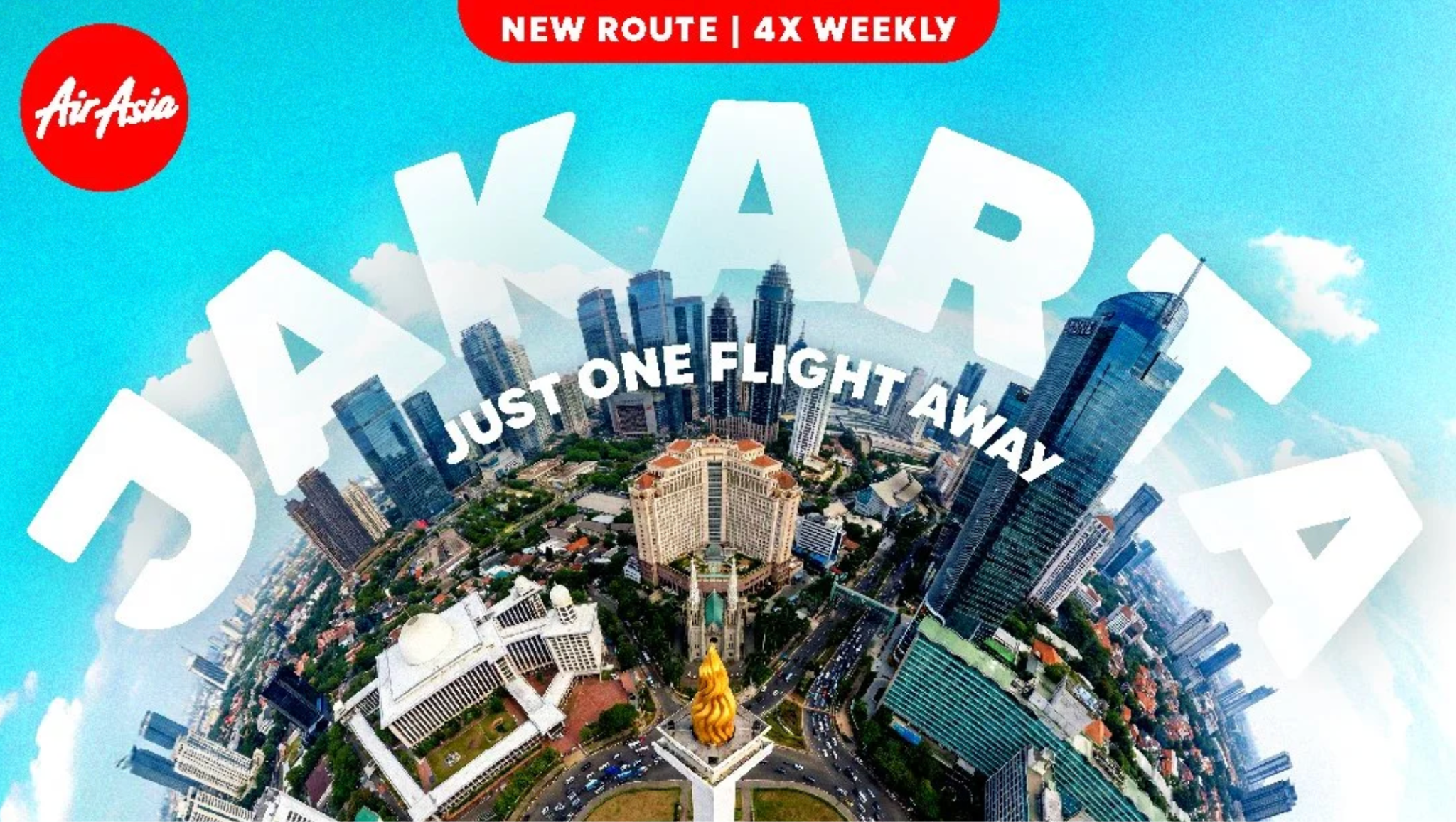
KOTA BHARU, 24 June 2026: Tourism Malaysia, in collaboration with AirAsia, Tourism Kelantan, the State Government of Kelantan, and Malaysia Airports Holdings Berhad (MAHB), welcomed the inaugural direct flight connecting Jakarta, Indonesia (CGK) and Kota Bharu, Kelantan (KBR) on 16 June.
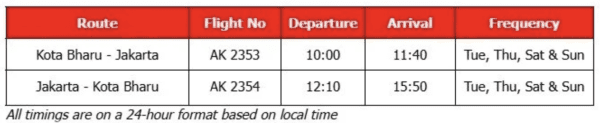
Marking a significant milestone in enhancing regional connectivity and supporting the Visit Malaysia 2026 (VM2026) campaign, the inaugural AirAsia service, flight AK2354, arrived at Sultan Ismail Petra Airport (KBR), Kota Bharu, at 1550 using an Airbus A320 aircraft with a capacity of 180 seats. Four weekly flights depart Kota Bharu on Tuesday, Thursday, Saturday, and Sunday.
Photo credit: AirAsia.
Sultan Ismail Petra Airport (KBR) is a mid-sized airport in Kota Bharu, on the east coast of Malaysia, serving eight destinations, including two international destinations: Singapore and Jakarta, Indonesia.
The new route provides direct accessibility between Indonesia and Malaysia’s East Coast, while opening new opportunities for tourism, trade and economic cooperation.
The inaugural flight carried 117 passengers, representing a load factor of approximately 63% on the 180-seat aircraft, with a passenger mix comprising predominantly Indonesian and Singaporean visitors, as well as returning Malaysian travellers.
Kelantan Tourism Director, Encik Azwan bin Ab Rahman, commented: “Through this direct flight, tourists from Jakarta can not only enjoy the various unique tourism products Kelantan has to offer—such as Pasar Siti Khadijah, Masjid Kampung Laut, Kampung Kraftangan, and Stong Geopark—but Kota Bharu also has the potential to become a strategic gateway or transit hub to other famous tourism destinations in the region.
“Kelantan’s geographical proximity to the border makes it an easy gateway for travellers to continue their journey to major cities in southern Thailand, such as Hat Yai, Narathiwat, and Pattani. At the same time, tourists can use Kelantan as a transit point to popular East Coast islands like Pulau Perhentian, Pulau Redang, and Pulau Kapas, which are major attractions for international tourists.”
AirAsia Malaysia General Manager Dato Captain Fareh Mazputra said: “As the leading ASEAN airline, AirAsia remains committed to connecting underserved destinations with key regional hubs, creating more opportunities for tourism, trade and economic growth. We look forward to welcoming more visitors to Kelantan and contributing to the state’s development through increased connectivity and visitor arrivals.”
Malaysia Airports Managing Director Dato Mohd Izani Ghani noted: “The launch of the direct Jakarta-Kota Bharu service demonstrates how strategic airport infrastructure investment can create new opportunities for connectivity and growth. Following the completion of the terminal expansion at Sultan Ismail Petra Airport to accommodate 4 million passengers per annum, up from 1.5 million previously, KBR is now better positioned to support international services and future traffic growth.”
Indonesia remains one of Malaysia’s key source markets, underpinned by strong air connectivity between the two countries. As of April 2026, Malaysia and Indonesia are connected by 634 weekly flights, offering more than 114,806 seats per week and facilitating greater travel flows between both destinations.
The introduction of this direct service is expected to strengthen tourism flows between Indonesia and Malaysia further while supporting cultural exchange, business travel, and the growing medical tourism segment. The route also enhances connectivity to Kelantan, which serves as a key gateway to Malaysia’s East Coast and a strategic transit point for travellers from Southern Thailand through major border crossings such as Rantau Panjang and Pengkalan Kubor.
Flight Schedule between Kota Bharu (KBR) and Jakarta (CGK):
BANGKOK, 23 June 2026, Myanmar-Tourism is often measured in numbers: Visitor arrivals, hotel occupancy, length of stay and tourism receipts. Yet throughout the Mekong Tourism Forum 2026, held in Yangon, Myanmar, under the theme “Tourism for People, Travel with Purpose”, a different conversation emerged.
Women’s entrepreneurship and workforce development accessibility, living culture, and community stewardship on the MTF agenda.
What if tourism success were measured not only by how many people visit a destination, but by how it improves lives, strengthens communities, protects culture, and creates opportunities for future generations?
Those questions sat at the heart of two of the forum’s most engaging discussions: “People at the Centre of Tourism” and “Living Culture & Creative Expression.”
While the sessions explored different themes, together they painted a compelling picture of what tourism’s future could look like across the Greater Mekong Subregion.
One focused on people.
The other focused on culture.
Both arrived at the same conclusion. Tourism works best when communities remain at its heart.
Tourism begins with people
Moderated by Graham Harper, Director of Clickable Impact, the “People at the Centre of Tourism” panel brought together leaders working on the front lines of entrepreneurship, workforce development, accessibility, and community empowerment.
What made the discussion particularly compelling was that the panellists were not speaking from theory. They were speaking from experience.
As CEO and Founder of Women Transforming Myanmar, Thiri Aung works with a network of more than 5,000 women entrepreneurs across Myanmar.
Through mentoring, leadership development, networking, and business support, the organisation helps women build sustainable enterprises and stronger communities.
Drawing from that experience, Thiri argued that inclusion must extend beyond participation. Women need access to markets, finance, skills, and professional networks. They need a voice in decision-making. And they need opportunities to lead.
“Invest in women, when women thrive, communities thrive,” she said.
The conversation then turned to tourism’s next generation. Representing the Association of Southeast Asian Social Enterprises for Training in Hospitality & Catering (ASSET-H&C), Ha Phan spoke about the importance of creating career pathways for young people from disadvantaged backgrounds.
Operating through a network of vocational training centres and social enterprises across Southeast Asia, ASSET-H&C helps learners develop professional hospitality skills alongside communication, English language proficiency, digital literacy, leadership capabilities, mentoring, and career guidance.
For Ha, workforce development is about far more than filling vacancies.
“I often say that a job placement is an outcome, but a career pathway is an impact.”
Her remarks challenged delegates to think beyond employment statistics and focus instead on long-term human development.
“The future of sustainable tourism depends not only on where people travel, but on how we invest in the people who welcome them.”
The discussion then shifted toward inclusion.
In Kampot, Cambodia, Epic Arts has become internationally recognised for demonstrating how disability inclusion can be woven into everyday life through tourism, hospitality, arts, and community development.
Leading that work is Sokny Onn. As CEO of Epic Arts and a member of Yale University’s Accessibility Advisory Committee, Sokny challenged delegates to rethink how accessibility is discussed within tourism.
“Disability inclusion is a right, not a favour. It is not charity. People with disabilities are equal citizens, customers, workers, artists, entrepreneurs, and leaders.”
Through initiatives such as Epic Arts Café, Epic Creations, and Epic Arts Dance, people with disabilities are not treated as beneficiaries. They are professionals, artists, creators, and leaders.
For Sokny, people-centred tourism should create more than jobs. It should create dignity.
“Inclusive tourism is not only about making places accessible for people with disabilities to visit. It is also about creating pathways for them to work, create, lead, and be recognised as equal contributors to culture, community, society, and the economy.”
Her closing observation left a lasting impression.
“When people with disabilities lead, tourism becomes more than an industry. It becomes a platform for dignity, equality, and change.”
The final perspective came from Koko Tang, Founder of Colorful Earth and Head of Global Impact Measurement at the World Sustainable Hospitality Alliance.
Working at the intersection of biodiversity conservation, local livelihoods, and tourism development, Koko challenged delegates to consider a simple but powerful question: Who gets a voice?
Drawing on her experience in Yunnan and biodiversity-based tourism initiatives, she argued that conservation and community empowerment should never be treated as separate goals. Culture, biodiversity, local livelihoods, and tourism are deeply interconnected.
She also encouraged destinations to rethink how success is measured.
“If we say tourism puts people at the centre, we need to measure not only who benefits economically, but also who has a voice, whether that voice is representative, and whether it actually influences decisions.”
For Koko, tourism should do more than market destinations.
“Tourism should not only promote places; it should help steward them as living landscapes.”
Taken together, the panel offered a powerful reminder that people-centred tourism requires more than good intentions. It requires opportunity, inclusion, leadership, participation, and long-term investment in communities.
Living culture belongs to people
If the first discussion explored who benefits from tourism, the second asked a different question: What are we trying to protect?
The author of this report, Dr Scott Smith of Assumption University, moderated the “Living Culture & Creative Expression” panel, which brought together speakers working in heritage conservation, community tourism, cultural preservation, and sustainable development.
The discussion featured Ohnmar Myo of SEAMEO SPAFA, Maulita Sari Hani of Planeterra, Thuy An Phan of Thai Hai Village in Vietnam, and Zhu Jinsheng (“Jason”) of Guilin Tourism University.
Together, they explored how tourism can support living culture rather than display it.
“Culture is not something we place behind glass,” said Dr Scott Smith. “It is something people live, share, protect, adapt, and carry forward. Tourism has a responsibility to support that process, not interrupt it.”
Ohnmar Myo emphasised that heritage is not confined to museums, monuments, or historic sites. It lives in communities. It survives through traditions, stories, skills, beliefs, and the people who pass them from one generation to the next.
Her contribution reminded delegates that cultural preservation depends not only on protecting physical assets but also on supporting the communities that keep traditions alive.
Maulita Sari Hani brought the perspective of Planeterra, a global organisation that supports community tourism enterprises worldwide.
Drawing from her experience working with local communities, she highlighted how tourism can create long-term social, environmental, and economic benefits when communities remain active participants rather than passive beneficiaries.
Her message reinforced a recurring theme throughout the forum: successful tourism development happens with communities, not to them.
Perhaps the most heartfelt contribution came from Thuy An Phan of Thai Hai Village, recognised by UN Tourism as one of the world’s Best Tourism Villages.
Representing a community often described as a “Village of Love,” Thuy An spoke about the values that have shaped Thai Hai’s success.
Rather than focusing solely on tourism products or visitor experiences, she emphasised relationships: among people, with culture, and with nature.
“With love, we can do anything. Love creates our village. Love for nature can create meaningful tourism.”
The simplicity of her message resonated deeply. In a tourism industry often focused on growth, her remarks served as a reminder that care, connection, and community remain powerful foundations for sustainable development.
The discussion concluded with insights from Zhu Jinsheng (“Jason”) of Guilin Tourism University.
Drawing on his academic and professional experience, Jason emphasised the importance of ensuring that tourism remains rooted in local identity and community participation.
While destinations may evolve and visitor expectations may change, successful tourism must continue to respect the people, traditions, and cultural values that make places unique.
A shared vision for tourism’s future
Although the two discussions explored different themes, they shared a common thread.
The first focused on opportunity.
The second focused on identity.
One asked how tourism can benefit people.
The other asked how tourism can help preserve what communities value most.
Together, they offered a broader definition of tourism success.
Success is not measured only by arrivals and revenue. It is measured through opportunity, inclusion, dignity, stewardship, culture, and community voice.
An interesting observation emerged during the discussions. Seven of the eight featured panellists across both sessions were women. This was not a planned theme. Rather, it reflected the many women leading important work in entrepreneurship, accessibility, workforce development, cultural preservation, community tourism, and destination stewardship throughout the region.
As delegates departed Yangon, they carried with them more than notes and business cards.
They left with examples of people-centred tourism already taking shape across the Mekong region: women entrepreneurs building stronger communities, young people creating new futures, people with disabilities leading change, communities preserving culture through tourism, and destinations balancing conservation and development.
Different stories.
Different places.
One shared vision.
Tourism succeeds not simply when more people visit, but when more people have the opportunity to shape, benefit from, and take pride in its future.
SINGAPORE, 23 June 2026: Chameleon Strategies and CrescentRating, both UN Tourism Affiliate Members, launched the Asia Pacific Outbound Traveler Handbook 2026, a market-by-market intelligence resource covering 26 Asian outbound source markets.
The report was unveiled at the Halal In Travel Global Summit in Singapore, and a condensed version of the handbook is available for free download at AsiaTravelTrends.com. In contrast, the full, comprehensive version is available at 66% discount for a limited time, along with individual market reports.
The publication is written for destination marketers, national tourism organisations, airlines, tour operators, and travel trade professionals who need practical, source-specific intelligence on how Asian consumer travel behaviour is changing and what that change means for their planning decisions.
The launch comes at a moment of significant pressure on Asian outbound travel. Airspace disruptions across the Middle East in 2025 and early 2026 strained routing on corridors that carry some of the largest volumes of outbound Asian passenger traffic.
Against that backdrop, the report’s 26 market chapters are designed to give practitioners the specific, source-market-level understanding they need to plan with greater precision, not just track aggregate trends.
“Tourism posted a post-pandemic record in 2025. In the same season, the corridors, costs, and politics that produced that record were being rewritten underneath it, said Chameleon Strategies CEO and Co-Editor, Asia Pacific Outbound Traveler Report 2026, Dr Jens Thraenhart.
“I call the space between those two realities the Next Tourism Order. In that world, generic aspirational travel fills hotels in good years. Passion-tourism fills them in on the difficult ones. The question destinations should be asking is not how many travellers are coming, but what they are genuinely coming for. The Asia Pacific Outbound Traveler Handbook 2026 is the demand-side guide to that question, written for the destination leaders, who understand that the operators who get this right now will be the ones still standing when conditions shift.”
The report covers 26 source markets: Saudi Arabia, Hong Kong, Malaysia, Singapore, Vietnam, Thailand, the Philippines, India, Pakistan, Bangladesh, Kazakhstan, Uzbekistan, Azerbaijan, Turkey, Oman, Qatar, Kuwait, Australia, New Zealand, Japan, South Korea, Indonesia, UAE, and Taiwan. Each chapter is structured around a single core argument about what a given market is actually doing and why destinations consistently misread it.
The Saudi Arabia chapter, written by Dr Thraenhart and drawing on his experience in the Kingdom and his recent time as an advisor at the Saudi Tourism Authority, makes the case that Saudi outbound represents one of the most consistently underestimated high-yield opportunities in global tourism. Saudi travellers stay an average of 19 nights internationally and have shifted decisively from goods-led to experience-led travel over the past five years. The same motivational shift observed in Chinese outbound travel a decade ago is now building in the Gulf.
The shared values, faith-based needs, and core behaviours of Muslim travellers form an incredibly powerful, unifying bond across borders. This collective identity is the absolute foundation of Muslim-friendly travel. However, we must remember that these travellers are not a monolith. While united by deep universal values, a Muslim traveller from Indonesia still possesses distinct cultural nuances compared to those of a traveller from Saudi Arabia or Kazakhstan. To succeed, destinations must treat these shared Muslim values as their non-negotiable bedrock, while layering source-market-specific execution on top. The Asia Pacific Outbound Traveler Handbook 2026 bridges this gap,” explained CrescentRating CEO and Co-Editor, Asia Pacific Outbound Traveler Report 2026, Fazal Bahardeen.
The Asia Pacific Outbound Traveller Report 2026 is an initiative by PATA and the UN Tourism Affiliate Members, Chameleon Strategies and CrescentRating. Free registration at AsiaTravelTrends.com enables digital downloads of the handbooks and specific source-market reports.
KUALA LUMPUR, 23 June 2026: The Malaysian Association of Tour and Travel Agents (MATTA) announces the return of its MATTA Muslim Friendly Travel Fair (MFTF), taking place on 4 and 5 July 2026 at the World Trade Centre, Kuala Lumpur (WTC KL).
The Muslim-friendly tourism segment continues to grow as a significant driver of worldwide demand. It is shaped by consumers seeking safer and more reliable travel experiences.
Taking over the Muslim-Friendly sector, the association aims to drive growth in this niche segment by enabling members to promote their products and offerings focused on destinations that cater to Islamic principles, ensuring easy access to halal food, prayer facilities, and modesty.
This year, MATTA elevates the second edition by featuring 123 exhibitors from 57 participating organisations, occupying a vast 2,700 sqm area, taking the MFTF to the next level.
MFTF 2026 Deputy Organising Chairman Dr Fazil Khan noted that while demand for Muslim-friendly travel products continues to rise in both inbound and outbound markets, inconsistencies in verification processes and operational standards remain a primary concern for the industry.
“Without consistent benchmarks, consumers are left to navigate a wide range of offerings, some of which may fall short of expected standards. This creates uncertainty for loyal customers and uneven conditions for legitimate operators who comply with regulations and invest in proper service delivery. Building trust in the Muslim-friendly segment, or in tourism generally, ultimately comes down to regulation, education, and industry responsibility. We have established a strong platform that helps consumers understand the value of choosing licensed and verified operators, while raising its standards collectively,” he said.
The MFTF complements this by promoting greater alignment within the industry as a whole. It also reinforces Malaysia’s position as a recognised leader in Muslim-friendly tourism development, while highlighting the need for continuous improvement to meet evolving global expectations.
Nevertheless, Muslim Friendly isn’t just a halal way of travel; it is a modest lifestyle that people of all ages, races, and religions can enjoy.
MATTA acknowledges the support of its sponsors and partners:
Islamic Tourism Centre as Strategic Partner
Macao Tourism Government Office (MGTO) as a Sponsor
RHB Bank Berhad as the Exclusive Platinum Sponsor
MFTF is open to the public from 1000 to 2100 on Saturday and Sunday, 4 and 5 July 2026.
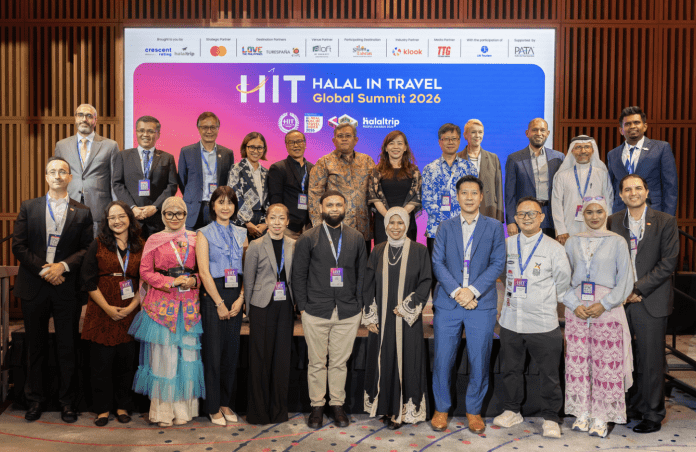
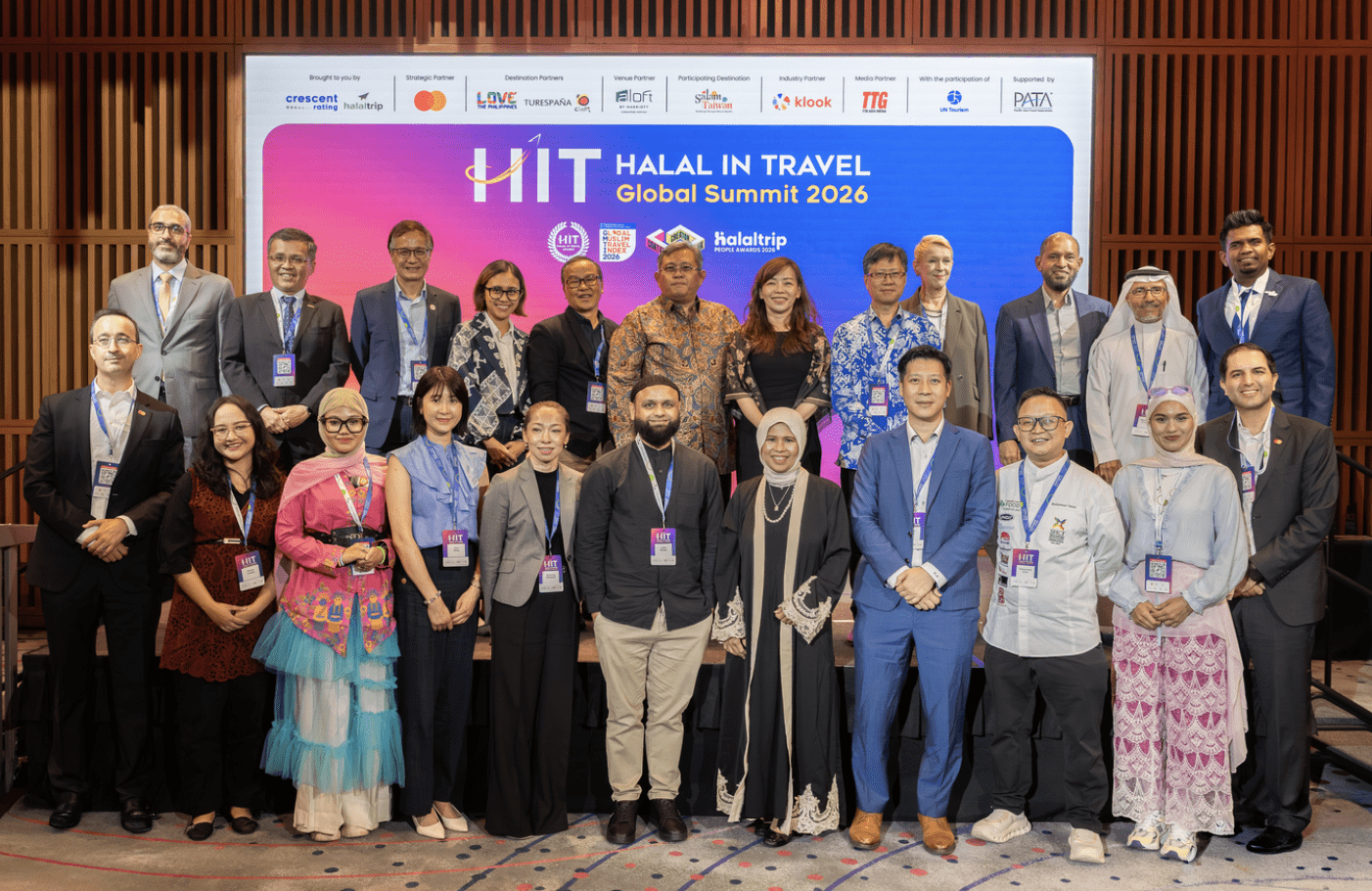
SINGAPORE, 23 June 2026: The 6th edition of the Halal In Travel Global Summit (HITGS) concluded on 18 June at Aloft Singapore Novena, with sessions spanning research, digital transformation, destination policy, and the presentation of awards.
Photo credit: Halal In Travel Global Summit 2026.
Halal In Travel (HIT) Awards 2026
The HIT Awards 2026 recognised the destinations, brands, and individuals who are raising the bar for Muslim-friendly travel. Winners span four categories:
Mastercard-CrescentRating GMTI Awards
Top Muslim-friendly Destination of the Year: Malaysia — once again the world’s highest-ranked Muslim-friendly destination, its lead built on a mature halal ecosystem, extensive certified accommodation, and deeply embedded Islamic heritage that few destinations can match.
Muslim-friendly Destination of the Year (2nd place): Indonesia, Türkiye, and Saudi Arabia — three destinations occupying joint second place, each representing a distinct model of Muslim-friendly excellence: Indonesia’s breadth and cultural depth, Türkiye’s heritage-meets-modernity offer, and Saudi Arabia’s unparalleled spiritual significance alongside a rapidly evolving modern tourism infrastructure.
Top Muslim-friendly Destination of the Year (non-OIC) Singapore
The benchmark non-OIC destination, combining rigorous halal certification under MUIS, dense prayer facility coverage, and a multicultural environment that makes Muslim visitors feel genuinely at home.
Accessible Muslim-friendly Destination of the Year
Joint winners — Singapore, Hong Kong, and Malaysia — recognised across both OIC and non-OIC categories. Hong Kong and Singapore each scored 84 and tied at #1 non-OIC for accessible travel; Malaysia topped the OIC ranking with a score of 83. All three destinations demonstrate that accessible Muslim-friendly travel depends on systematic infrastructure decisions — digital wayfinding, transit-integrated prayer spaces, and visible halal signage — not just an absence of obstacles.
Muslim Women-friendly Destination of the Year
Joint winners — Singapore and Malaysia — the first time this category has been recognised in the HIT Awards, reflecting the GMTI 2026’s dedicated focus on Muslim women as a distinct travel segment. Singapore led the non-OIC category with a score of 82; Malaysia led the OIC category with a score of 84. The award signals an industry shift: destinations are beginning to design for Muslim women as a primary audience rather than an afterthought.
Muslim-friendly Destination of the Year (non-OIC) 2nd place
Hong Kong — a destination in genuine transformation, with close to 220 halal-certified establishments and a coordinated push across attractions, hotels, and transport to meet the expectations of Muslim visitors.
Muslim-friendly Destination of the Year (non-OIC) 3rd place
Taiwan — steadily building its Muslim-friendly profile through expanded halal dining, accessible prayer facilities, and a hospitality culture known for exceptional warmth.
Most Promising Muslim-friendly Region (OIC)
Jawa Barat, Indonesia — the top-ranked province in the Indonesia Muslim Travel Index 2025, driven by its government’s commitment to halal tourism policy and anchored by the rich Sundanese cultural heritage that defines the region.
Most Promising Muslim-friendly Region (non-OIC)
Mindanao, Philippines — a region with deep Islamic roots, dramatic natural landscapes, and a growing determination to translate its cultural identity into a compelling, structured offer for Muslim travellers.
Emerging Muslim-friendly Destination (non-OIC)
Germany — home to one of Europe’s largest Muslim communities and now making tangible strides in halal infrastructure — is included, signalling that European destinations are beginning to take the Muslim travel market seriously.
SINGAPORE, 23 June 2026: Marriott International has appointed Sander Looijen as its new Market Vice President for Vietnam, effective 22 June.
Photo credit: Marriott. Sander Looijen, Market Vice President for Vietnam.
He will oversee the company’s hotel operations and rapid expansion in this key Asian market. A hospitality expert with 25 years of experience. He will oversee a growing portfolio of 32 hotels & resorts across Vietnam.
Across Asia-Pacific, he has led four hotel projects as a general manager and served a spell as area director of operations for South Korea.
Most recently, he was Marriott’s Area General Manager for Bali, overseeing a portfolio of 22 hotels and resorts in this popular Indonesian island and leading the opening of eight new properties.
Now, as Market Vice President for Vietnam, he will oversee a portfolio of 32 hotels and resorts across the country, comprising 9,900 keys and spanning 11 brands. With more than 50 new projects in the pipeline, Vietnam is one of Marriott’s fastest-growing markets worldwide. Looijen will be based at Marriott International’s Vietnam office in Ho Chi Minh City.
NEW DELHI, 23 June 2026: Air India and Booking.com announced a strategic partnership on Monday to deliver a more seamless and rewarding travel booking experience.
Customers can now access a vast array of global accommodations via a dedicated co-branded platform on the Air India website and mobile app, powered by Booking.com, along with exclusive benefits and loyalty rewards for Maharaja Club members.
Photo credit: Air India.
The co-branded platform offers Air India customers access to Booking.com’s global inventory of over 31 million reported listings in 45 languages, including 8.6 million listings in homes, villas and other unique places to stay, backed by its 24/7 customer support.
Air India’s Maharaja Club members can earn five Maharaja Points for every INR 100 spent on stays booked through the dedicated platform. These points can be redeemed for award flights and cabin upgrades. Customers will also benefit from exclusive discounts of up to 15% on participating properties for a limited period, from 22 June to 21 July 2026.
“Our partnership with Booking.com is another step in our efforts to build a comprehensive travel ecosystem for our customers. By combining Air India’s growing global network with Booking.com’s vast portfolio, we are offering our guests greater convenience, choice and added value across journeys,” said Air India Divisional Vice President & Head of Revenue Management, Abhijit Menon.
Booking.com Managing Director and Vice President, Asia Pacific, Laura Houldsworth added: “As travellers increasingly seek integrated, digital-first travel experiences, we are excited to partner with Air India. This collaboration reflects our Connected Trip vision of making travel planning simpler and more seamless. By combining our diverse global accommodation inventory with Air India’s growing international network, we are helping to make it easier for travellers to book their flights and stay in one place. This partnership also reinforces our commitment to India, delivering greater value, rewarding loyalty and creating a more seamless, end-to-end travel experience.”
Industry data indicate that travellers increasingly prefer to plan multiple parts of their journey through a single platform. Research shows that leisure travellers opt for bundled travel offerings that combine flights, accommodation, and other services. The partnership reflects Air India’s and Booking.com’s continued focus on supporting this shift towards more seamless, end-to-end travel planning by offering integrated accommodation options.