


BANGKOK, 20 March 2026: The global power shifts do not remain confined to geopolitics. They travel quickly, and often invisibly, through economic systems.
For Asia, and particularly for Thailand, the consequences of the Gulf War are immediate. The most direct transmission channel is energy.
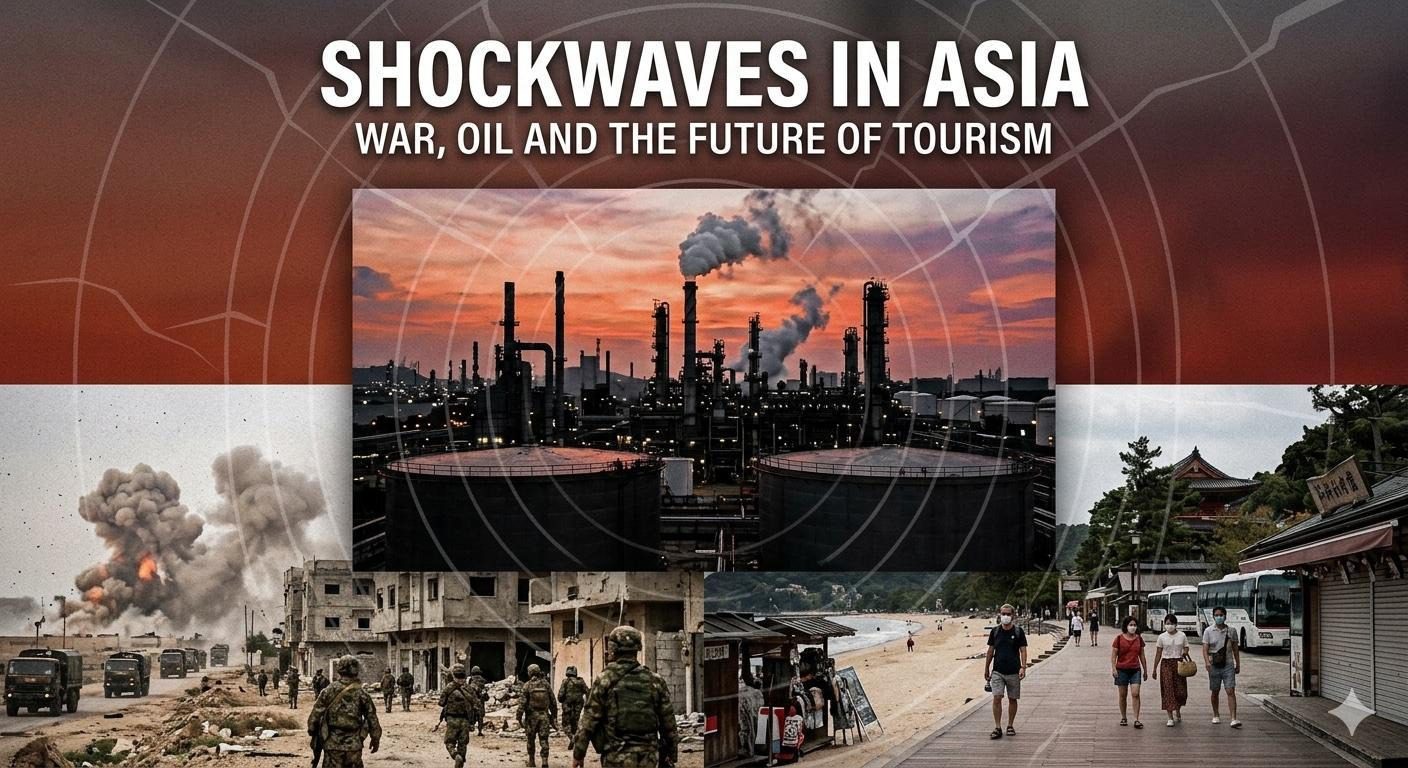
Any sustained disruption in Middle Eastern supply routes pushes oil prices higher. This feeds directly into aviation fuel costs, which in turn drives airfares upward. The result is predictable. Long-haul travel demand weakens, particularly from Europe, where consumers are already sensitive to economic uncertainty.
For Thailand, where tourism remains a central pillar of the economy, this creates a series of cascading risks.
The first is long-haul softness. European travellers may delay decisions, shorten stays, or opt for closer destinations. Even marginal declines in arrivals can have a disproportionate impact on high-value segments.
The second is airline behaviour. Carriers respond quickly to rising costs and operational risk. Routes may be adjusted, frequencies reduced, and fares increased. Airspace constraints linked to Middle Eastern instability can further complicate scheduling, adding time and cost to long-haul journeys.
The third is psychological. War involving major powers alters traveller sentiment. Even when destinations such as Thailand remain entirely safe, perception often overrides reality. The result is hesitation.
For Thailand, the danger is not the war itself but the hesitation it creates in travellers’ minds. Yet the outlook is not uniformly negative.
Asia’s intra-regional travel market provides a buffer. Demand from China, India, and ASEAN is structurally stronger and less exposed to disruption in the Middle East. Short-haul travel can partially offset long-haul weakness, particularly if supported by targeted government stimulus and competitive pricing.
Thailand also benefits from a diversified base of source markets and a deeply embedded reputation for hospitality and value. These strengths have historically enabled rapid recovery following external shocks, from financial crises to pandemics.
However, timing is critical. The longer uncertainty persists, the more likely temporary softness becomes structural weakness.
Airlines, tour operators and hoteliers will need to remain agile. Pricing strategies, market diversification and regional focus will be key to maintaining momentum.
At a broader level, this moment highlights a deeper truth. Global conflicts no longer remain contained within their regions. Their effects ripple outward through energy markets, transport systems and consumer behaviour, reaching destinations thousands of miles away.
For Asia’s tourism economies, resilience will depend not only on demand but on adaptability. Because in this new global environment, stability is no longer guaranteed. It must be managed.
And for Thailand, success will depend on how quickly it can respond, reassure and reposition itself in a world where uncertainty has become the norm.
About the author
Andrew J Wood is a Bangkok-based travel writer and former hotel executive specialising in Asian tourism.