


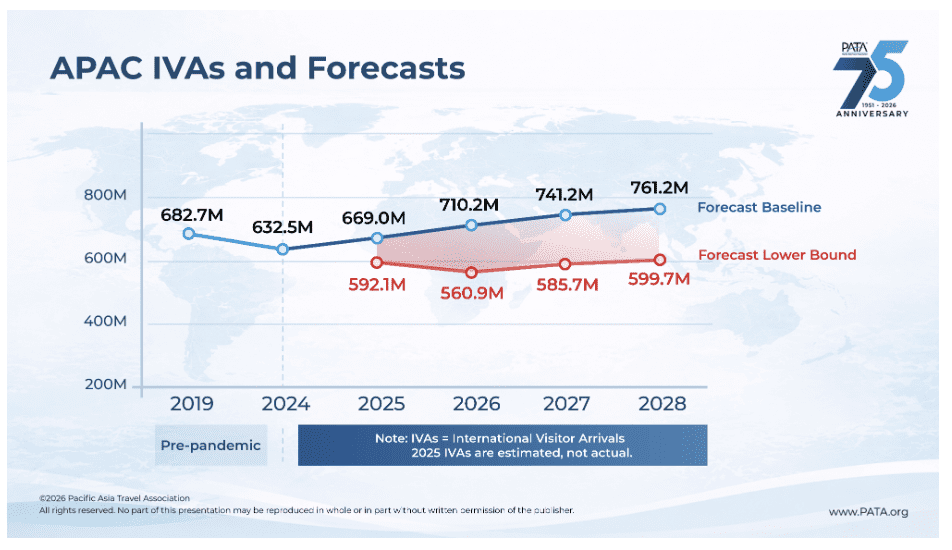
BANGKOK, 2 April 2026: The Pacific Asia Travel Association has released its PATA Asia Pacific Visitor Forecasts 2026-2028, which shows that inbound arrivals to the Asia Pacific region are projected to exceed pre-pandemic levels from 2026 onward, with the baseline reaching 761.2 million by 2028.
However, in light of the evolving geopolitical crisis and hostilities in the Middle East, the outlook also considers a lower-bound scenario in which international visitor arrivals could reach 599.7 million by 2028, representing approximately an 88% recovery from 2019 levels.
“International tourism is entering a more complex phase where growth continues, but under increasing pressure,” said PATA CEO Noor Ahmad Hamid. “At PATA, we recognise both sides of the equation — the positive momentum driven by strong regional demand, and the downside risks arising from geopolitical tensions, economic volatility, and climate-related disruptions.
“In this environment, growth is no longer linear or guaranteed. Destinations and organisations must be prepared for multiple scenarios, able to adapt quickly, recalibrate strategies, and respond with agility. Decision-making must be grounded in real-time data and a clear understanding of risk.
“Ultimately, resilience and preparedness will define how well the industry navigates this next phase of uncertainty.”
The report was developed in partnership with the Hospitality and Tourism Research Centre at SHTM PolyU, with additional contributions from PATA destination members and regional data partners. It offers inbound visitor forecasts for 39 Asia-Pacific destinations, providing a detailed analysis that reflects the diversity of recovery and potential growth across regions and sub-regions.
Drawing on current data and scenario-based modelling, the study outlines a period of structurally constrained and uneven growth shaped by geopolitical uncertainty, climate-related disruptions, evolving aviation and visa policies, and rapid digital and AI-driven transformation across the tourism economy.
In addition to the regional outlook, individual destination reports have also been published for all 39 covered destinations, each providing detailed market-specific projections and localised analysis.
Highlights from the report
Ongoing geopolitical tensions and conflicts continue to pose downside risks to travel demand and cross-border mobility.
Destinations are encouraged to diversify source markets and strengthen public–private collaboration to build greater resilience.
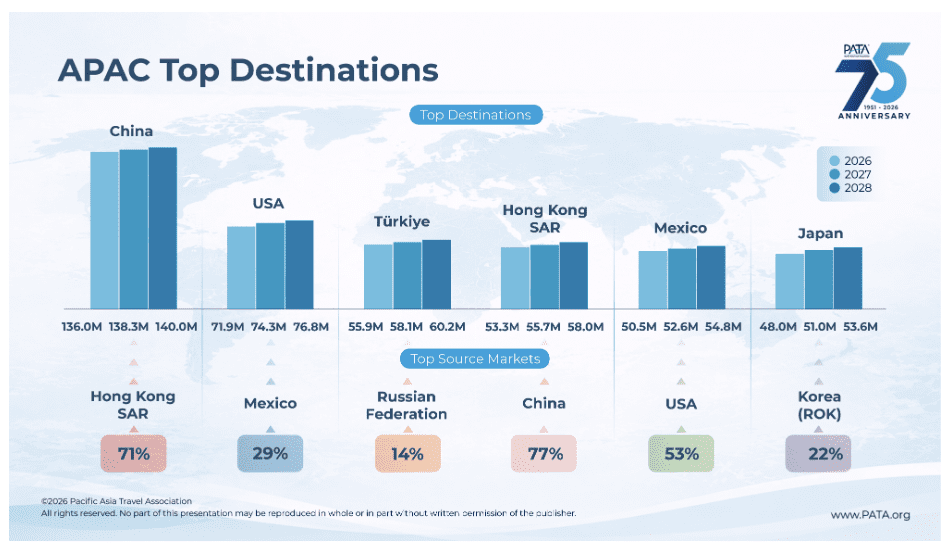
China, the United States, and Türkiye are projected to remain the top three destinations through 2028.
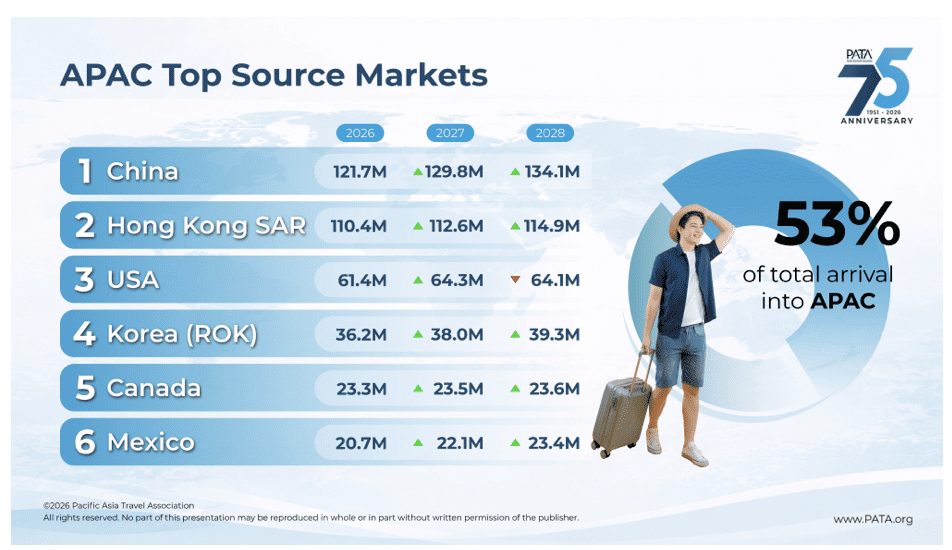
China, Hong Kong SAR, the United States, and Korea (ROK) continue to rank among the region’s leading source markets, despite ongoing air capacity and cost pressures.
Japan and Hong Kong SAR show notable improvement in destination rankings in the post-pandemic period.
Mongolia, Japan, Chile, the Maldives, and Sri Lanka are leading recovery performance, each exceeding 150% of their 2019 levels.
By 2028, 27 of the 39 destinations covered in the forecast are expected to surpass their pre-pandemic arrival volumes.
The PATA Asia Pacific Visitor Forecasts 2026–2028 is now available. Based on the level of membership, access may be granted either directly through the PATA Info Hub or via the PATA Publications using a discount code.
To request the code or to confirm membership-level access, contact the PATA Membership Team at [email protected].
Additionally, detailed data and projections related to the lower bound forecast are available upon request for eligible members. Members in this group may contact the PATA Project Management Department at [email protected] for more information and to request access.
Non-members can purchase the reports at PATA Publications by visiting the following link: www.pata.org/research-q1v63g6n2dw/p/asia-pacific-visitor-forecasts-2026-2028
The full recording can be accessed via the following link: www.pata.org/calendar/asia-pacific-tourism-outlook-20262028-growth-under-global-uncertainty
For further information, visit www.PATA.org.
(Source: PATA)