

SURAT THANI, Thailand, 26 October 2026: There are places where the landscape provides a backdrop to the journey, and there are places where the landscape is the journey. Khao Sok belongs firmly in the latter category.
From the moment we entered this extraordinary corner of Surat Thani, the great limestone mountains seemed to be everywhere. They rose beyond the road, appeared unexpectedly through breaks in the forest and towered above the river. Even from our accommodation, they formed a dramatic natural skyline.
This was not the Thailand of beaches, shopping malls and rooftop bars. This was an older land of a green and wonderfully untamed Thailand.
Our base was Lost Horizon Resort, surrounded by rainforest and those extraordinary limestone formations that dominate this part of southern Thailand. The resort was a comfortable retreat, but it never felt disconnected from the landscape we had come to experience.
A landscape written in limestone
You can’t experience Khao Sok without looking up. Great grey-white karst limestone pinnacles rise abruptly from an almost impenetrable sea of green. The limestone here was formed hundreds of millions of years ago, when this part of the world lay beneath an ancient sea. Over immense periods of time, geological movement, tropical rainfall, and flowing water sculpted the cliffs, caves, and dramatic karst formations that define the landscape today.
Standing beneath them, however, the numbers become almost irrelevant. What matters is their sheer presence.
From the river, they seem immense. From Lost Horizon, they feel almost theatrical, great limestone walls rising above the forest. As the light changes through the day, so do the mountains: sometimes cloaked in early-morning mist or sharply defined against a blue sky, and sometimes softened by cloud and tropical humidity.
In Khao Sok, you don’t simply visit the landscape. You live beneath it.
Into the green
Our journey through the forest was one of those occasions when slowing down became part of the experience. The road narrowed, and the vegetation seemed to close around us. Sunlight filtered through the canopy, illuminating palms, bamboo and tropical trees in constantly changing shades of green. Then came one of those unscripted encounters that no carefully arranged excursion can reproduce.
A macaque wandered casually across the road in front of us, seemingly far less interested in us than we were in him. Colour appeared everywhere once we began looking for it. Brilliant red hibiscus stood out against the forest, while exotic heliconias emerged from the undergrowth like splashes of tropical paint.
Khao Sok rewards those prepared to slow down and look.
Taking to the water
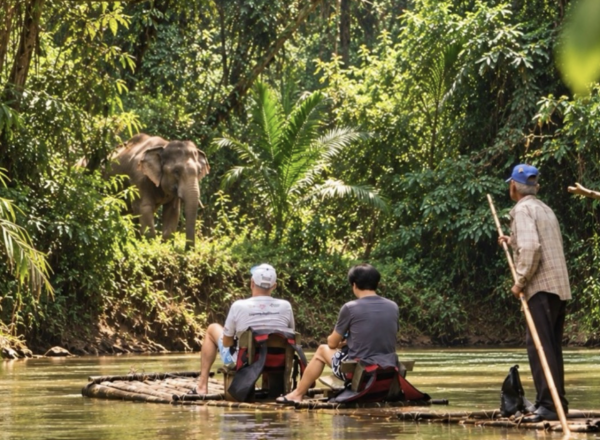
The perspective changed completely when we reached the river. From a simple bamboo raft, Khao Sok suddenly seemed even larger. The water gently carried us through dense vegetation beneath soaring limestone mountains, with the forest pressing towards the river’s edge. There is something wonderfully calming about surrendering to the river’s gentle pace as we drifted along this meandering highway through the forest. Time seemed to slow with us. It was one of those rare moments when you stop thinking about where you are going and enjoy being exactly where you are.
And then came the moment I will probably remember longest: A wild elephant appeared beside the river. We watched from the water as she moved through the vegetation along the riverbank. There was no performance and no carefully constructed wildlife encounter. We were simply fortunate enough to see this magnificent animal roaming in her natural surroundings. For a few moments there was little conversation. None was necessary. Khao Sok provided its own theatre.
Elsewhere we swam and floated in the jungle surrounded by forest and limestone. No artificial entertainment was needed. The landscape provided it.
Tourism with a local purpose
Experiences such as these also remind us that responsible tourism is about people as well as places. Our local guides knew the river and forest intimately. Around Khao Sok, tourism employs guides, drivers, restaurant and resort staff, farmers, and many others whose livelihoods are directly or indirectly connected to visitors.
At Our Jungle Camp — which shares its roots and philosophy with Lost Horizon Resort — gardens, vegetable beds, and nursery plots offered another glimpse of a tourism model closely connected to its surroundings.
Founded by Richard “Dick” Sandler, Lost Horizon is part of a story that also embraces Our Jungle House and Our Jungle Camp. All three share a philosophy of connecting visitors responsibly with Khao Sok’s extraordinary landscape and its communities, combining conservation and sustainability with local employment and meaningful tourism experiences.
It is a symbiotic relationship. Tourism supports the local community, while the community has every reason to protect the environment that brings visitors here. In Khao Sok, you can see that relationship at work.
A name that brought back memories
The name Lost Horizon also held a wonderfully personal connection for me. James Hilton’s celebrated 1933 novel Lost Horizon introduced the world to the fictional paradise of Shangri-La, a secluded sanctuary hidden among magnificent mountains.
I stayed at my first hotel in Thailand, Shangri-La Bangkok, in 1991, where copies of the novel sat in guest rooms. More than three decades later, staying at Lost Horizon beneath Khao Sok’s magnificent mountains brought back very happy memories.
A comfortable retreat
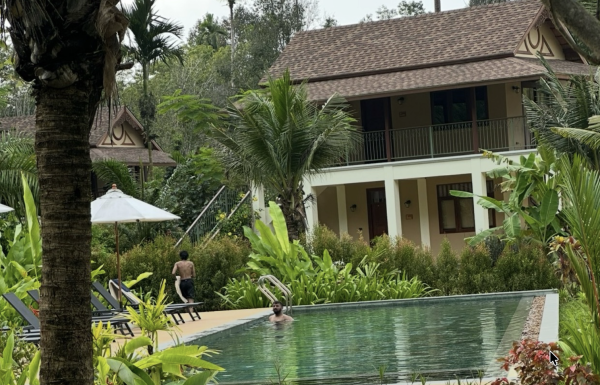
After days dominated by jungle, river, and rock, returning to Lost Horizon felt like a welcome contrast. Our room was spacious and comfortable, with warm timber furnishings and views towards the surrounding greenery. Thoughtful details made it welcoming, while the architecture and landscaping let nature, not the buildings, command attention. That was perhaps the property’s greatest luxury. The mountains remained outside. The forest remained close.
And Khao Sok never felt shut away behind a hotel door.
Back at our jungle camp
After a day exploring, returning to Our Jungle Camp brought us to another side of the Khao Sok experience. The property feels connected to its surroundings rather than separated from them. Tropical vegetation dominates, traditional-style accommodation sits among the greenery, and gardens and cultivated areas provide a softer transition between resort and forest. After days dominated by jungle, river, and rock, returning to comfortable accommodation felt like a welcome contrast.
Our room was spacious and pleasantly traditional, with warm timber furniture, twin beds and a balcony opening directly towards the surrounding greenery and stream.
The bathroom combined contemporary fittings with traditional decorative touches, including a particularly handsome patterned basin, while the large rain shower was especially welcome after a humid day exploring.
Small details mattered too. Tea, coffee, snacks and a proper coffee machine made the room feel welcoming rather than austere.
The public areas continued the property’s character with rattan furniture, timber, patterned floor tiles, and artwork recalling an earlier era of tropical travel.
It had a gentle nostalgia, a suggestion of the days when travelling somewhere remote really did mean leaving much of the outside world behind.
More than a national park
What struck me most about Khao Sok was the variety contained within a relatively short journey. We encountered wildlife, brilliant tropical flowers, forest, caves, rivers and some of the most dramatic limestone scenery in southern Thailand.
Yet Khao Sok does not need to shout. No manufactured attraction could improve the view from a bamboo raft. No giant screen could compete with wild elephants moving beside a river. No architect could design a more impressive backdrop than mountains formed over hundreds of millions of years.
As travellers increasingly seek nature, authenticity, and meaningful experiences, places like Khao Sok represent an enormously important part of Thailand’s tourism future. The challenge is to protect them while ensuring that the communities living alongside them share meaningfully in tourism’s benefits.
Khao Sok is not simply somewhere to photograph. It is somewhere to listen, observe and occasionally do very little at all.
About the author
Andrew J Wood is a British-born travel writer, tourism commentator and former hotelier based in Thailand since 1991. A graduate of Napier University, Edinburgh, he has more than four decades of hospitality and tourism experience in Asia and Europe. A long-standing member of Skål International since 1992, Andrew has held senior leadership positions in Thailand and across Asia. He is also an elected Director of the South African-Thai Chamber of Commerce (SATCC), responsible for tourism, and remains actively involved with Thailand’s tourism and hospitality community. The views expressed are personal.