

PHUKET, Thailand, 11 November 2026: Phuket is experiencing an extraordinary wave of tourism, hospitality and property investment, reinforcing its position as one of Asia’s leading luxury destinations.
This is excellent news for Phuket and Thailand.
New hotels, branded residences, wellness centres, and mixed-use developments are attracting international capital, creating jobs, and generating opportunities for construction companies, local suppliers, restaurants, retailers, and transport operators. The benefits extend into healthcare, education, professional services and the wider economy.
According to C9 Hotelworks, Phuket has 30 hotel projects comprising 5,517 rooms in its development pipeline, with approximately 85% internationally branded.
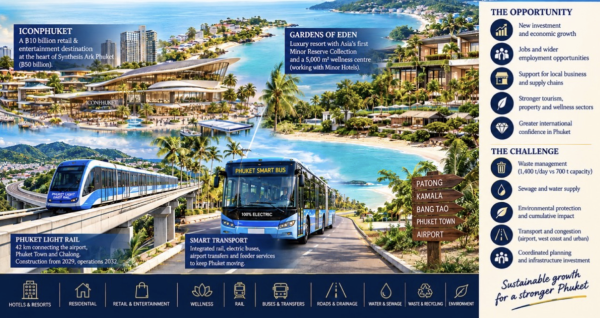
Major investments include the proposed Bt 50 billion Synthesis Ark Phuket, incorporating the Bt 10 billion ICONPHUKET retail and entertainment destination.
At Bang Tao, Gardens of Eden, working with Minor Hotels, is developing a world-class integrated luxury destination featuring Asia’s first Minor Reserve Collection resort and a planned 5,000-square-metre wellness centre.
These projects demonstrate confidence in Phuket’s future and deserve encouragement.
But with investment comes responsibility.
Development Must Benefit Everyone
Phuket’s transformation affects investors, residents, employees and millions of visitors.
Every new hotel, residence and commercial complex increases demand for roads, transport, electricity, water, rubbish collection, sewage treatment and public services.
Development planning must incorporate these requirements from the outset, not leave them for communities and authorities to resolve later.
Phuket’s 700-Tonne Rubbish Shortfall
Phuket generates a staggering 1,400 tonnes of rubbish daily, while existing facilities can process only 700 tonnes, leaving a daily shortfall of 700 tonnes.
A second incinerator expected in 2027 should add approximately 500 tonnes of daily capacity. Even then, Phuket would face a further 200-tonne daily shortfall, assuming waste volumes remain unchanged.
With thousands of additional hotel rooms and residences planned, that assumption may prove optimistic.
Effective collection, waste separation, recycling, food-waste management and sufficient long-term treatment capacity are essential.
This is not simply a municipal inconvenience. It directly affects Phuket’s environment, economy and reputation as a premium destination.
Clean Water Demand And Environmental Protection
Every additional hotel room, residence, restaurant, and swimming pool increases demand for clean water and generates wastewater that requires treatment.
Phuket already experiences seasonal water pressures, while heavy rainfall creates drainage and flooding challenges.
Poorly managed sewage threatens beaches, marine ecosystems and public health, potentially damaging the natural attractions that underpin the island’s tourism economy.
New developments should demonstrate adequate water supply, wastewater treatment, drainage and environmental safeguards before opening. Developers should contribute fairly where additional infrastructure is required.

How to preserve Phuket’s natural beauty
Thailand already requires Environmental Impact Assessments (EIAs) for certain developments, including hotels with 80 rooms or more, or at least 4,000 square metres of usable space.
But do existing assessments adequately consider the combined impact of multiple developments?
Individual projects may meet environmental requirements, while dozens of developments collectively overwhelm roads, water supplies, sewage systems, and waste facilities.
Phuket should consider stronger cumulative environmental assessments, independent infrastructure-capacity studies and effective monitoring after construction.
Environmental responsibility must continue long after planning permission is granted.
Transport: Phuket cannot wait another decade
Traffic congestion between Phuket International Airport and major resort areas increasingly affects residents, employees and visitors.
The proposed 42-kilometre light rail system, linking the airport with Chalong through Phuket Town, has been discussed for years.
The latest Mass Rapid Transit Authority timetable anticipates construction beginning in September 2029, with operations targeted for December 2032.
That remains six years away, assuming the timetable is achieved.
The railway would be welcome but would not directly serve important west-coast destinations including Patong, Kamala and Bang Tao.
Phuket needs an integrated network combining rail, electric buses, airport transfers, feeder services and improved roads.
Efficient transport is essential for tourism, local employment, business productivity and quality of life.
Who is managing Phuket’s future?
Phuket’s Provincial Administration, the Provincial Administrative Organisation (PAO), municipalities, and national agencies share responsibility for infrastructure. Strong coordination is therefore essential.
Phuket needs a comprehensive island-wide infrastructure development and management plan, covering transport, water, sewage, rubbish, environmental protection and future land use.
It should include realistic population and visitor forecasts, funding responsibilities, delivery schedules and measurable performance standards.
Major private developments should contribute fairly towards the public infrastructure needed to support them.
Clear provincial leadership, transparency and accountability are essential.
Protecting Phuket’s success
Phuket has an extraordinary opportunity to strengthen its position as one of Asia’s leading luxury and wellness destinations.
The scale of investment promises prosperity, employment and long-term economic growth. But successful destinations must manage growth as carefully as they attract it.
Experience has taught me that even the finest hotel cannot compensate for congested roads, unreliable public services, polluted beaches or environmental deterioration.
Investors, residents and visitors share the same interest: a Phuket that remains attractive, efficient, environmentally responsible and economically successful.
Phuket’s luxury boom is good news. The challenge is ensuring infrastructure, environmental safeguards and responsible management grow alongside it.
The island’s next great investment should not simply be another luxury development. It should be the infrastructure that makes all those developments sustainable.
About the author
Andrew J Wood is a British-born travel writer and former hotelier who has lived in Thailand since 1991. A graduate of Napier University, Edinburgh, he has more than four decades of international hospitality and tourism experience. He chairs the JFCCT Tourism Committee, serves as a SATCC board member, and has held senior leadership roles with Skål International in Thailand and Asia.