


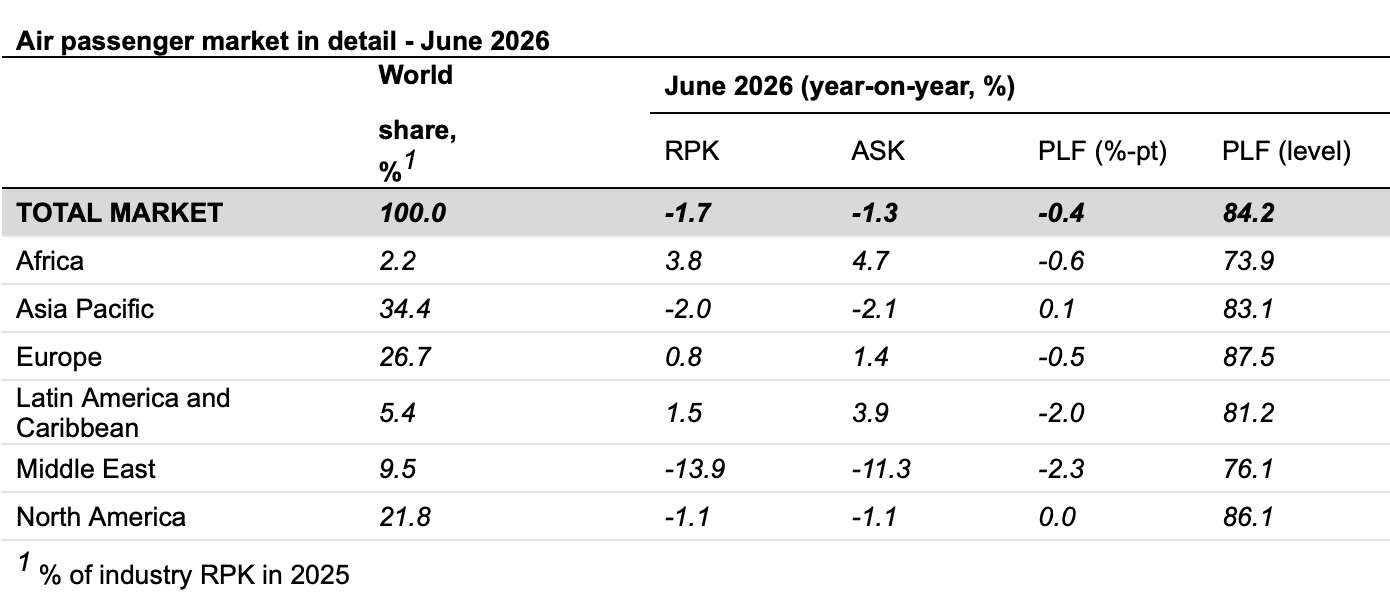
SINGAPORE, 3 August 2026: The International Air Transport Association (IATA) released data for June 2026 indicating that total global passenger demand, measured in revenue passenger kilometres (RPK), declined by 1.7% compared to June 2025.
Total capacity, measured in available seat kilometres (ASK), decreased 1.3% year-on-year. The load factor was 84.2% (-0.4 ppt compared to June 2025).
International demand fell 0.9% compared to June 2025. Excluding the Middle East, demand grew by 1.1%. Capacity was down 0.6% year-on-year, and the load factor was 84.2% (-0.2 ppt compared to June 2025).
“Global demand for air travel was down 1.7% in June compared to 2025. This is largely due to domestic market declines in China, the US and Japan, and weak but improving international demand for Middle East carriers. While performance in the Middle East improved, renewed tensions will not help the region’s recovery, and the knock-on impact of rising fuel prices will continue to burden travellers with higher airfares.
People continue to travel, which is an important contributor to global economic growth. There is no doubt, however, that stabilising the situation in the Middle East and normalising oil supplies would improve prospects for airlines, economies and societies the world over,” said IATA’s Director General Willie Walsh.
Regional Breakdown — International Passenger Markets
International RPK fell 0.9%, with capacity falling 0.6%. Excluding the Middle East, international traffic was up 1.1%.
Asia-Pacific airlines achieved a 0.4% year-on-year increase in demand. Capacity decreased 1.1% year-on-year, and the load factor was 84.0% (+1.3 ppt compared to June 2025). Slower growth was a result of some carriers cutting back on short-haul routes due to higher fuel prices (capacity on international routes within Asia was down 4.8%).
European carriers saw a 1.5% year-on-year increase in demand. Capacity increased 2.0% year-on-year, and the load factor was 87.1% (-0.5 ppt compared to June 2025). Growth on the Europe-Asia corridor was 11.0%, the fastest growth among all major international route corridors.
North American carriers saw a 1.0% year-on-year decrease in demand. Capacity decreased 0.7% year-on-year, and the load factor was 86.9% (-0.3 ppt compared to June 2025).
Middle Eastern carriers saw a 14% year-on-year decrease in demand. Capacity fell 11% year-on-year, and the load factor was 76.3% (-2.6 ppt compared to June 2025). The impacts of the Iran war continue to cause a highly negative year-on-year traffic comparison, but the rate of decline halved month-to-month since April. This reflects both the gradual normalisation of airline operations across the region and the lower comparison base, as traffic in June 2025 was impacted by the military strikes that month.
Latin American airlines achieved a 3.5% year-on-year increase in demand. Capacity climbed 6.3% year-on-year. The load factor was 81.6% (-2.2 ppt compared to June 2025).
African airlines saw a 6.7% year-on-year increase in demand. Capacity was up 7.0% year-on-year. The load factor was 74.2% (-0.3 ppt compared to June 2025).
For more information, check out IATA’s
Air Passenger Market Analysis – Traffic Contraction Eased Slightly in June.
(Source: IATA)