


GENEVA, Switzerland, 28 September 2026: Travel and tourism conditions have strengthened across most of the world, a new World Economic Forum report finds, but destinations face the headwinds of geopolitical and climate disruptions, workforce shortages and mounting pressure on infrastructure and communities.
Developed in collaboration with Zurich Insurance Group, the 10th edition of the Travel & Tourism Development Index (TTDI) 2026, launched 25 September at Beyond Tourism Day, finds that 101 of 110 ranked economies improved their scores between 2024 and 2026, with the average rising 2.1% — the fastest pace since 2019.

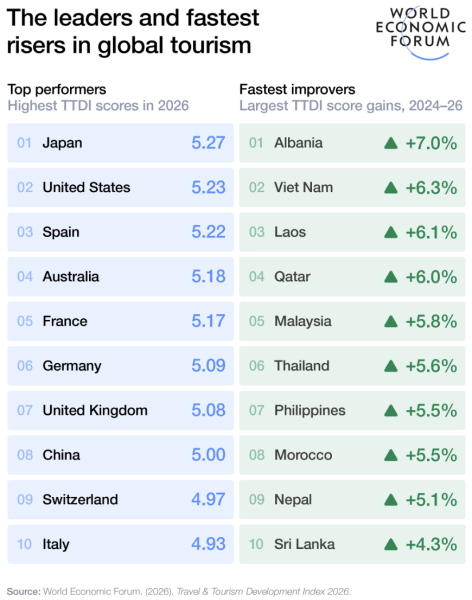
Increased cultural resources, tourism infrastructure and services, and air connectivity and business travel drove gains. Japan leads the Index, followed by the US, Spain, Australia and France.
“The latest Travel & Tourism Development Index shows that the enabling conditions for travel and tourism are at their strongest since the pandemic, with 92% of economies improving since 2024,” said World Economic Forum Head of Experience Economy and Cities Ramya Krishnaswamy. “The next chapter is not simply about attracting more visitors, but it is going to be about creating greater value by investing in people, infrastructure and stronger public-private collaboration so tourism delivers lasting benefits for communities, businesses and destinations.”
The Index also shows that tourism is facing growing challenges. Between 2024 and 2026, travel became less affordable in three out of four economies, while tourism investment failed to keep pace with rising demand and labour shortages threatened further growth. Benefits for local communities also weakened during this period, highlighting that more visitors do not automatically translate into better livelihoods or higher quality jobs, particularly in destinations where tourism is highly seasonal.
Despite these pressures, emerging tourism economies are gaining ground. Since 2019, the largest emerging economies have improved their TTDI scores more than twice as fast as the Top 20, with Asia-Pacific economies accounting for seven of the 10 fastest-improving performers. Albania recorded the largest overall gain between 2024 and 2026.
“Tourism is a major part of the global economy, and the TTDI makes clear that resilience is what keeps that value intact when conditions change,” said Zurich Insurance Group CEO Global Businesses and Operations Cara Morton. “That kind of resilience requires businesses and governments to take responsibility together.”
Beyond Tourism Day: bringing the ecosystem together
The Index will be launched at the World Economic Forum’s inaugural Beyond Tourism Day in Geneva, convening senior leaders from business, government and civil society under the theme “Resilient Growth. Renewed Impact”. Discussions will focus on strengthening competitiveness and resilience through workforce readiness, technology and innovation, investment and scalable solutions.
Beyond Tourism Day took place two days before World Tourism Day, on 27 September, providing a platform to carry the conversation from Geneva to a broader global discussion on how travel and tourism can strengthen economic resilience, create quality jobs and opportunities, and deliver greater value to communities and destinations.
About the TTDI
Drawing on nearly two decades of WEF benchmarking, the Travel & Tourism Development Index 2026 measures the factors and policies that enable sustainable and resilient travel and tourism development. It does not measure tourism performance directly – such as arrivals, spending, or revenue – but the underlying conditions that enable destinations to attract, support and sustain tourism in ways that benefit economies and societies. The 2026 edition covers 110 economies and is organised around 17 pillars and 102 indicators. Zurich Insurance Group produced it in collaboration with the Beyond Tourism Insights Council.
Read the full report and learn about the initiative.
(Source: World Economic Forum)