


BANGKOK, 17 August 2026: Asia Aviation Public Company Limited, the parent company of Thai AirAsia, has released its financial and operational performance for the second quarter of 2026 (“2Q26”).
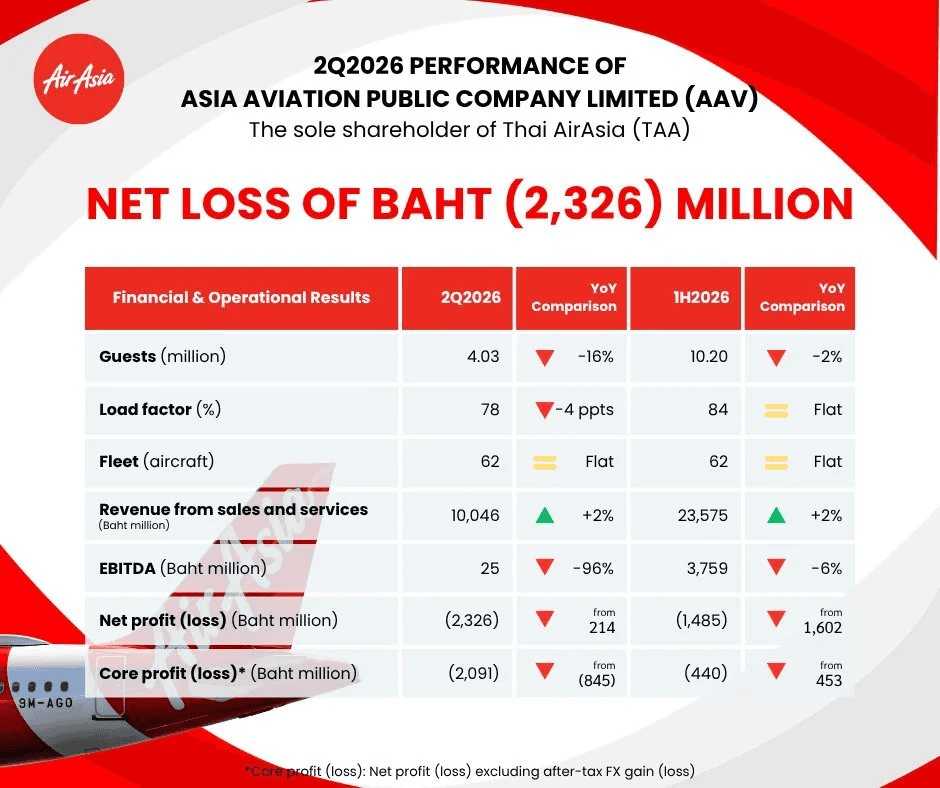
An unprecedented 124% jump in jet fuel prices to USD183 per barrel pushed total fuel expenses up 43% YoY to THB5 billion. Even under this heavy cost pressure environment, TAA achieved an Earnings Before Interest, Taxes, Depreciation, and Amortisation (EBITDA) breakeven of THB25 million.
Net loss was THB2,326 million, including a foreign exchange loss of THB293 million. Core operating loss for the quarter was THB2,091 million. Overall, 1H2026 core loss was THB440 million.
Despite elevated global fuel price spikes and the regional low-travel season, the airline acted quickly to protect margins by cutting excess capacity and raising ticket yields.
Revenue from sales and services rose 2% year-on-year to THB10,046 million while ticket revenue grew 6% YoY to THB8,575 million. TAA intentionally trimmed seat capacity by 13% YoY to 5.14 million seats, focusing on core markets. Average fares surged 27% YoY, covering half of the fuel price inflation while keeping guest traffic steady at 4.03 million passengers.
On cost control, TAA reinforced AirAsia’s low-cost DNA by delivering an absolute reduction in non-fuel operating expenses. Selling and administrative expenses reduced by 17% YoY and staff costs reduced by 12% YoY. While ex-fuel absolute costs fell 8% YoY through cost discipline, cost per unit excluding fuel (“CASK ex-fuel”) rose 13% YoY to THB1.43.
Operational performance improved sharply with On-Time Performance (OTP) rebounding to 88%. TAA also retained its position as Thailand’s top domestic airline with a leading 37% market share and an 80% domestic load factor. To secure liquidity, TAA successfully raised THB 3,815 million through a new debenture issuance in June 2026, keeping its net interest-bearing debt-to-equity ratio low at 1.1x.
AAV and Thai AirAsia Chief Executive Officer Phairat Pornpathananangoon said: “We made a decisive move in 2Q26 to prioritise yield quality and liquidity during a global fuel crisis. By focusing on profitable routes, we proved the power of our brand and pricing leadership, holding an 80% domestic load factor even as average fares increased.
“Looking ahead to 2H2026, TAA is set to rebound as fuel prices stabilise from their peak levels. The airline will keep tight capacity control through Q3 before ramping up operating fleet deployment to 52 aircraft in Q4 to capture peak year-end holiday demand. TAA will reopen suspended international routes while strengthening flight frequencies across its Bangkok Don Mueang and Suvarnabhumi hubs. The airline will also tap into upcoming government tourism schemes and major international events to boost passenger traffic. Fuel risk remains managed with 13% of 3Q26 fuel needs locked in at USD 89 per barrel. TAA expects to return to profitability as peak travel season returns in the last quarter of the year.”
(Source: Thai AirAsia)