

BANGKOK, 2 September 2026: As Vietnam surges ahead, Thailand has an opportunity to turn competition into collaboration and take the lead in creating a new generation of multi-country ASEAN holidays
For decades, Thailand has been one of Southeast Asia’s great tourism success stories. Bangkok, Phuket, Pattaya, Chiang Mai and our wonderful islands are recognised around the world.

But Vietnam is gaining ground fast, and Thailand would be wise to pay close attention.
In 2025, Vietnam welcomed a record 21.2 million international visitors, more than 20 per cent above the previous year. Thailand received approximately 33 million, down 7.2%.
It is tempting to portray this simply as Vietnam rising while Thailand declines.
I think that misses a much bigger opportunity.
Vietnam isn’t replacing Thailand. Increasingly, it is learning how to share Thailand’s tourists.
Russia provides a fascinating example. Russian travellers have enjoyed a long love affair with Thailand, particularly Phuket and Pattaya. Thailand welcomed almost 1.9 million Russians in 2025.
But Russians are now also falling in love with Vietnam.
Vietnam received almost 690,000 Russian visitors in 2025, nearly three times the previous year’s total. Nha Trang and Phu Quoc are increasingly competing for travellers who might once have automatically chosen Phuket, Pattaya or Samui.
Should Thailand see this simply as a threat?
In my view, no.
Perhaps it is time to revisit one of ASEAN tourism’s oldest ambitions: getting its member countries to work together more effectively as one great regional destination.
Historically, that has often been easier to discuss than to deliver, but today’s traveller is changing. Better air connectivity, competitive fares and easier entry arrangements make two- and three-country holidays increasingly practical.
Thailand, with its extraordinary tourism infrastructure and Bangkok’s position as one of Asia’s great aviation gateways, is ideally placed to take the lead.
Imagine selling not simply Thailand, but Thailand plus Vietnam. Bangkok, Chiang Mai and Hanoi. Bangkok, Phuket and Phu Quoc. Or Thailand, Vietnam and Cambodia combined into one memorable Asian journey.
Instead of worrying about losing four nights of a 14-night holiday to Vietnam, we should ask whether working together could persuade that visitor to spend 18 or 21 nights in Southeast Asia.
This is not an entirely new idea. Specialist travel agents and DMCs have been offering multi-country ASEAN itineraries for as long as I can remember, certainly since I arrived in Thailand in 1991, and they have regularly featured around major regional gatherings such as the ASEAN Tourism Forum (ATF).
What feels different today is the scale of the opportunity. Perhaps now is the time to supercharge the concept, with stronger regional leadership and a clearer framework for cooperation. Thailand, with its tourism experience, connectivity and established position as a regional gateway, is ideally placed to take the lead.
The goal should be simple: make it easier and more attractive for visitors to combine two or three ASEAN countries in one holiday, while ensuring Thailand remains at the heart of that journey.
That, to me, is where the real opportunity lies.
Experience has taught me that destinations can never afford to take their visitors for granted. Vietnam is improving quickly, with excellent food, culture, beaches, resorts and tremendous value.
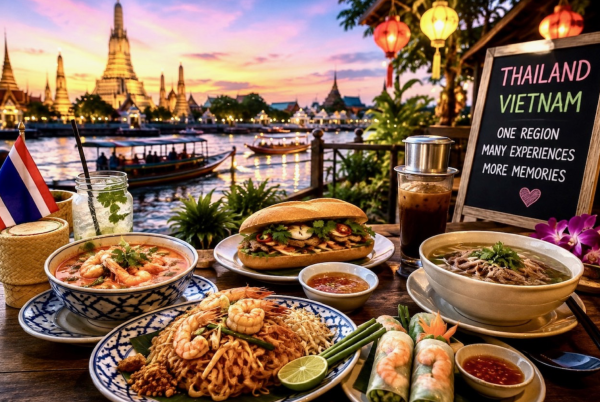
Under ASEAN, connected through food, people and culture.
Thailand still possesses formidable advantages: mature infrastructure, superb hotels, outstanding hospitality, food, wellness, shopping and an enviable position at the heart of the region.
So why not use them?
Thailand should take the initiative and help turn ASEAN’s long-standing ambition of greater tourism cooperation into something travellers can actually buy.
The question need not be: Thailand or Vietnam?
Increasingly, it could be: Thailand and Vietnam. Perhaps Laos too.
That is not surrendering tourists to our neighbours. It is giving them another reason to come to Southeast Asia, stay longer and, importantly, keep Thailand at the centre of their journey.

About the author
Andrew J Wood is a British-born travel writer and former hotelier who has lived in Thailand since 1991. A graduate of Napier University, Edinburgh, he has spent more than four decades in international hospitality and tourism.
A long-standing member of Skål International, Andrew is a former Director of Skål International and Past President of Skål International Asia, Thailand and Bangkok. He currently serves as Vice President of Skål International Bangkok. He writes extensively about travel, tourism, hospitality and developments shaping the industry across Thailand, ASEAN and the Asia-Pacific region.