


PHUKET, 9 September 2026: Phuket’s hotel industry has put sustainability firmly centre stage today as more than 1,000 delegates gather at Angsana Laguna Phuket for PHIST 2026, one of Southeast Asia’s leading hotel sustainability events.
Now in its ninth year, Phuket Hotels for Islands Sustaining Tourism, or PHIST, is calling for a “Whole Village” approach to sustainability, arguing that environmental responsibility must become a fundamental requirement for Thailand’s long-term tourism competitiveness, not simply a collection of corporate pledges.
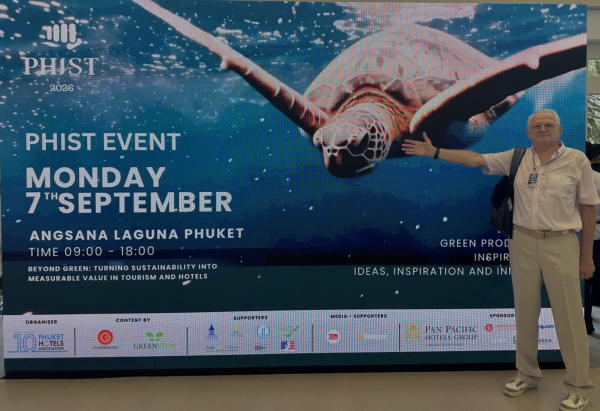
Organised by the Phuket Hotels Association, PHIST 2026 brings together hotel owners, operators, developers, architects, suppliers, government representatives, environmental organisations and tourism leaders.
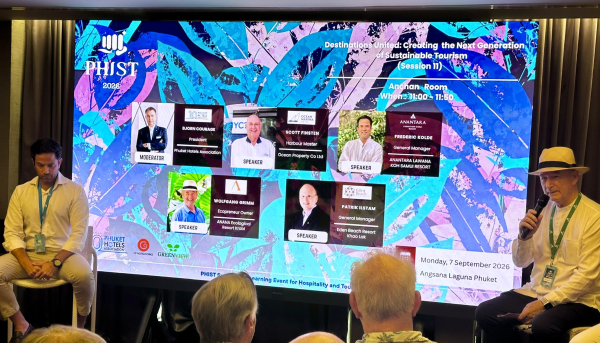
This year’s programme features 93 speakers across 26 panel sessions, workshops and masterclasses, together with 43 exhibitors and 13 non-profit organisations.
Among the speakers are KP Ho, Founder and Executive Chairman of Banyan Group, Dr Pinsak Suraswadi, Director-General of Thailand’s Department of Marine and Coastal Resources, and Phil Smith, General Manager of Parkroyal Collection Marina Bay, Singapore.
Phuket provides an increasingly important test case for sustainable tourism. The island continues to experience rapid hotel and property development alongside infrastructure pressures, traffic congestion, water and waste challenges and continued expansion at the luxury end of the hospitality market.
The industry’s challenge is therefore changing.
The question is no longer whether hotels have sustainability policies. Most now do. The more difficult question is what those policies are actually achieving and how results are being measured.
Increasingly, attention is shifting toward operational key performance indicators, including energy consumption per occupied room, water usage, food waste, single-use plastics, local purchasing, staff accommodation, transport emissions, and coastal protection.
This moves the sustainability conversation beyond awards, pledges and good intentions towards measurable performance and accountability.

PHIST’s organisers believe collaboration is essential. Sustainability cannot be delivered by hotels acting independently when many of the pressures affecting destinations, from waste management and infrastructure to coastal protection and transport, extend far beyond individual properties.
The “Whole Village” approach therefore calls for hotels, government, communities, suppliers, developers and environmental organisations to work collectively rather than in isolation.
For Phuket, the stakes are particularly high. Tourism underpins the island’s economy, but continued growth also puts increasing pressure on the environment and quality of life that make the destination attractive.
PHIST has developed significantly since its launch nine years ago. What began primarily as an annual industry gathering is evolving into a year-round platform designed to encourage collaboration, share practical solutions and turn sustainability commitments into measurable action.
The message from PHIST 2026 is increasingly clear: sustainability is no longer simply about protecting the environment. It is about protecting the long-term competitiveness of Thailand’s tourism industry itself.
About the author
Andrew J Wood is a British-born travel writer and former hotelier who has lived in Thailand since 1991. A graduate of Napier University, Edinburgh, he has more than four decades of experience in international hospitality and tourism. A long-standing member of Skål International, he is a former Director and Past President of Skål International Asia, Thailand and Bangkok. Currently, he serves as Vice President of Skål International Bangkok. He writes regularly on travel, tourism, hospitality and Asia-Pacific industry developments.



Excellent article covering all the contemporary needs, with an emphasis on the essence of sustainability. How to hold various stakeholders accountable is indeed another key approach, especially when it comes to measurable results. It’s also great to see that Phuket, particularly the Phuket Hotel Association, is taking a leading role in this. Bravo!