


KUALA LUMPUR, 3 September 2026: Preliminary July 2026 traffic figures released today by the Association of Asia Pacific Airlines (AAPA) showed further moderation in international passenger markets. Higher air fares continued to weigh on demand among price-sensitive leisure travellers.
Regional travel was also affected by further rationalisation of network operations in the industry, in response to persistently elevated jet fuel prices and airspace restrictions associated with the Middle East conflict.
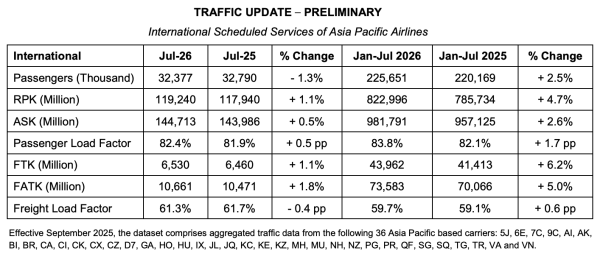
Against this backdrop, Asia Pacific airlines recorded a 1.3% decline in international passengers carried to a combined total of 32.4 million in July. Demand, as measured in revenue passenger kilometres, remained firm, increasing by 1.1% year-on-year, buoyed by encouraging growth on longer-haul routes. Available seat capacity edged 0.5% higher, resulting in a 0.5 percentage point increase in the average international passenger load factor to 82.4%.
Air cargo markets posted another month of growth, albeit at a more moderate pace, as strong demand for technology products was partly offset by softer demand for consumer goods. International air cargo demand, as measured in freight tonne kilometres (FTK), grew by 1.1% year-on-year, while offered freight capacity expanded by 1.8%. Consequently, the average international freight load factor declined by 0.4 percentage points to 61.3% for the month.
Commenting on the results, AAPA Director General, Wong Hong, said: “Asian airlines carried a combined 225.7 million international passengers in the first seven months of the year, 2.5% more than in the corresponding period last year. Longer-haul markets in particular saw encouraging growth, supporting the overall increase in passenger demand.
“At the same time, July saw jet fuel prices averaging USD143 per barrel, a 52% jump compared with the same month last year, driven by the conflict in the Middle East. Consequently, higher air fares weighed on demand, particularly on shorter-haul routes, with the impact more pronounced in the price-sensitive leisure sector.”
Wong Hong added: “The cargo business segment continued to benefit from growth in export activity from major regional manufacturing hubs. Overall, international air cargo demand rose by a robust 6.2% year-on-year during the first seven months of the year, although the pace of growth has become more moderate in recent months.”
Looking ahead, he said: “Underlying demand conditions remain supportive, underpinned by continued growth in regional economies, though momentum has moderated. Persistently high fuel prices, together with the weakening of several Asian currencies against the US dollar, continue to add to airline cost pressures, while rising inflation also weighs on demand. Against this backdrop, carriers continue to align capacity with demand, while retaining the flexibility to respond to changing market conditions.”
(Source: AAPA)